
Aluminum Extrusion Market Trends: Lightweight Materials Demand, EV Adoption & Forecast to 2034
Growing investments in green buildings, lightweight automotive structures, and recyclable materials are strengthening long-term demand for aluminum extrusion products worldwide.

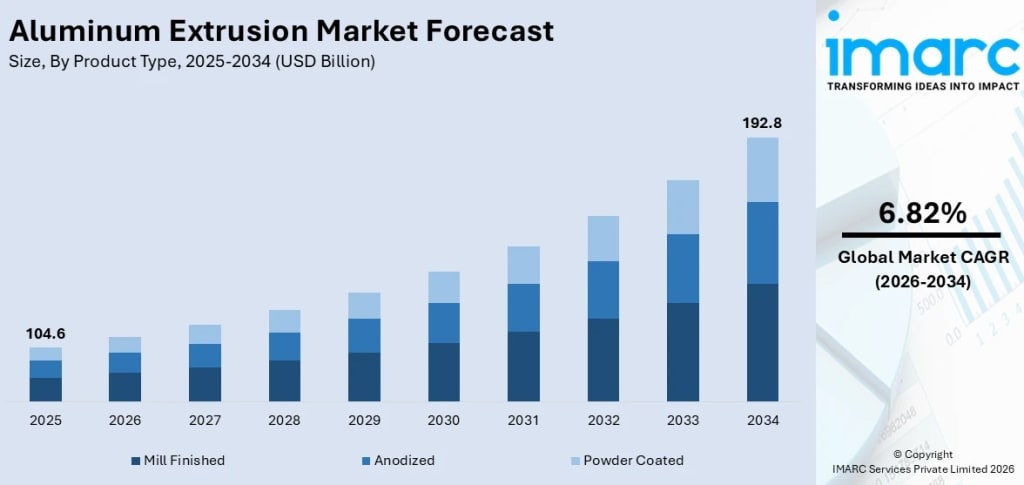
The global aluminium extrusion market is on a strong growth trajectory, powered by surging demand across the automotive, construction, and aerospace sectors. According to IMARC Group's latest research, the global aluminium extrusion market size was valued at USD 104.6 Billion in 2025. Looking forward, IMARC Group estimates the market to reach USD 192.8 Billion by 2034, exhibiting a CAGR of 6.82% during 2026-2034. Asia-Pacific currently dominates the market, holding a significant market share of over 74.0% in 2025.
Aluminium extrusion — the process of shaping aluminium alloy by forcing it through a die — has become a cornerstone of modern manufacturing. Its unique combination of light weight, corrosion resistance, and design flexibility makes it indispensable in everything from skyscraper curtain walls to EV battery enclosures. With global urbanization accelerating and sustainability goals tightening, industries are leaning harder on aluminium as a material that checks all the boxes.
Get a Sample Report for Actionable Market Insights
Aluminum Extrusion Market Growth Drivers
Rising Demand from the Automotive and EV Sector
The automotive industry's push toward fuel efficiency and zero-emission vehicles is one of the biggest tailwinds for aluminium extrusion. Automakers are replacing heavier steel components with extruded aluminium profiles to shed vehicle weight and extend battery range. According to the IEA, global EV sales hit approximately 17 million units in 2024, accounting for more than one in five cars sold worldwide. Battery enclosures, structural frames, crash management systems, and heat exchangers all rely on precision aluminium extrusions — and that demand is only growing as EV production scales up globally.
Rapid Urbanization and Infrastructure Expansion
Cities are expanding at an unprecedented pace — as of 2024, 57.5% of the global population lives in urban areas, and that share keeps rising. This fuels massive construction activity, from residential towers and commercial complexes to public transit systems and airports. Aluminum extrusion is deeply embedded in this building boom, used in window frames, curtain walls, door systems, staircases, and structural components. The global buildings construction market reached USD 6.8 Trillion in 2024, and every percentage point of growth translates directly into higher aluminium extrusion consumption.
Government Initiatives Supporting Lightweight and Sustainable Materials
Regulators in the US, EU, and Asia have introduced a raft of policies incentivizing energy-efficient construction and low-emission transportation — and aluminium benefits directly from both. LEED certification credits recyclable materials like aluminium, pushing construction firms to specify it over alternatives. In the US, the Infrastructure Investment and Jobs Act has channeled billions into transport infrastructure, driving demand for aluminium in bridges, rail systems, and transit vehicles. Recyclability is a key selling point: aluminium can be recycled repeatedly without losing its properties, making it a natural fit for circular economy mandates.
Aluminum Extrusion Market Trends
Industry 4.0 and Smart Manufacturing Integration
Modern extrusion plants are rapidly adopting Industry 4.0 tools — real-time process monitoring, predictive maintenance algorithms, and AI-driven quality control. These technologies have cut scrap rates, improved dimensional accuracy, and enabled producers to run more complex profiles at scale. The global smart manufacturing market reached USD 358.3 Billion in 2024, and aluminium extrusion is an active participant in that shift. For buyers, this means tighter tolerances, faster lead times, and more consistent product quality — all of which open new application windows in aerospace, electronics, and precision engineering.
Sustainability and Circular Economy Practices
Sustainability isn't just a buzzword in this sector — it's reshaping procurement decisions and investment priorities. Aluminum is already one of the most recycled industrial metals, with recycled (secondary) aluminium requiring roughly 95% less energy to produce than primary metal. Major producers like Hydro, Novelis, and Constellium have made public commitments to increase recycled content in their extrusion billets. Customers in the automotive and construction sectors are increasingly specifying low-carbon or recycled-content aluminium to meet their own ESG targets, pushing producers to differentiate on sustainability credentials as much as on price or lead time.
Premiumization and High-Performance Alloy Development
Beyond standard 6000-series profiles, there is growing demand for high-strength 7000-series alloys in aerospace, defense, and performance automotive applications. Advances in alloy design and heat treatment are yielding extrusions with improved fatigue life, thermal conductivity, and machinability. Meanwhile, surface finishing innovations — from anodizing to powder coating — are allowing architects and industrial designers to specify aluminium in applications where aesthetics matter as much as structural performance. Mill finished extrusions still dominate with a 57.6% share in 2025, but value-added finished products are gaining ground as design standards rise.
Aluminum Extrusion Market Segmentation Highlights
IMARC Group's analysis segments the global aluminium extrusion market across three primary dimensions:
By Product Type: Mill Finished, Anodized, Powder Coated — Mill Finished leads with 57.6% market share in 2025, prized for its versatility and cost efficiency.
By Alloy Type: Series 1000, 2000, 3000, 5000, 6000, 7000 — The 6000-series (aluminium-magnesium-silicon) dominates commercial applications due to its excellent extrudability and post-extrusion strength.
By End-Use Industry: Construction and Infrastructure, Automotive and Transportation, Electrical and Electronics, Consumer Goods and Industrial Machinery, and Others.
By Region: Asia-Pacific leads with 74.0%+ market share; North America is an active growth market driven by reshoring trends and EV infrastructure build-out.
Recent News and Developments in the Aluminum Extrusion Market
August 2025: Novelis announced a major capacity expansion at its Nachterstedt, Germany facility, adding 100,000 tonnes of annual recycled aluminium capacity to serve growing European automotive demand, particularly for EV structural components.
September 2025: Hydro launched its REDUXA 4.0 low-carbon aluminium product line for the extrusion market, offering verified carbon footprints below 4.0 kg CO₂ per kg of aluminium — targeting construction and automotive customers with stringent sustainability requirements.
October 2025: US-based Kaiser Aluminum broke ground on a new extrusion facility in the American Southeast, backed in part by domestic manufacturing incentive programs, with production capacity targeted at aerospace and defense profiles.
Note: If you require specific details, data, or insights that are not currently included in the scope of this report, we are happy to accommodate your request. As part of our customization service, we will gather and provide the additional information you need, tailored to your specific requirements. Please let us know your exact needs, and we will ensure the report is updated accordingly to meet your expectations.
About IMARC Group
IMARC Group is a global management consulting firm that helps the world's most ambitious companies solve their most complex challenges. With a team of researchers, analysts, and consultants, IMARC provides market intelligence and strategic advisory services across industries including food and beverages, technology, energy, healthcare, and materials. For more information, visit www.imarcgroup.com.
About the Creator
Rahul Pal
Market research professional with expertise in analyzing trends, consumer behavior, and market dynamics. Skilled in delivering actionable insights to support strategic decision-making and drive business growth across diverse industries.
The Future of Productivity Is Voice
Introduction The future of Productivity is rapidly shifting toward voice. In 2026, advanced AI technology allows Virtual Assistants to do more than follow commands — they understand context, anticipate needs, and help you manage your day effortlessly. Speaking to your assistant is faster, more natural, and often more efficient than typing or clicking.
By MUHAMMAD SHAFIE7 days ago in 01
The Rise of AI Presentation Tools: Transforming the Way We Create Slides
Artificial intelligence is quietly reshaping how we work, learn, and communicate. One area where this shift is especially noticeable is presentation design. Creating slides used to mean hours of formatting, arranging content, and adjusting visuals. Today, AI-powered tools are simplifying that process, helping users turn ideas into polished presentations in a fraction of the time.
By charliesamuel4 days ago in 01
The BAFTA Awards
By now, in a stunning departure from recent years, most of the world is aware of what happened at the BAFTA film awards. Social Media Headlines will tell you the bare bones: that John Davidson, a Tourette's Syndrome advocate, shouted a racial slur at two Actors of Colour, Michael B Jordan and Delroy Lindo.
By Natasja Rose5 days ago in Psyche




Comments
There are no comments for this story
Be the first to respond and start the conversation.