
Stars or Sand: Which Is More Numerous in the Universe?
A fascinating exploration of whether the cosmos holds more stars than the grains of sand covering Earth’s beaches.

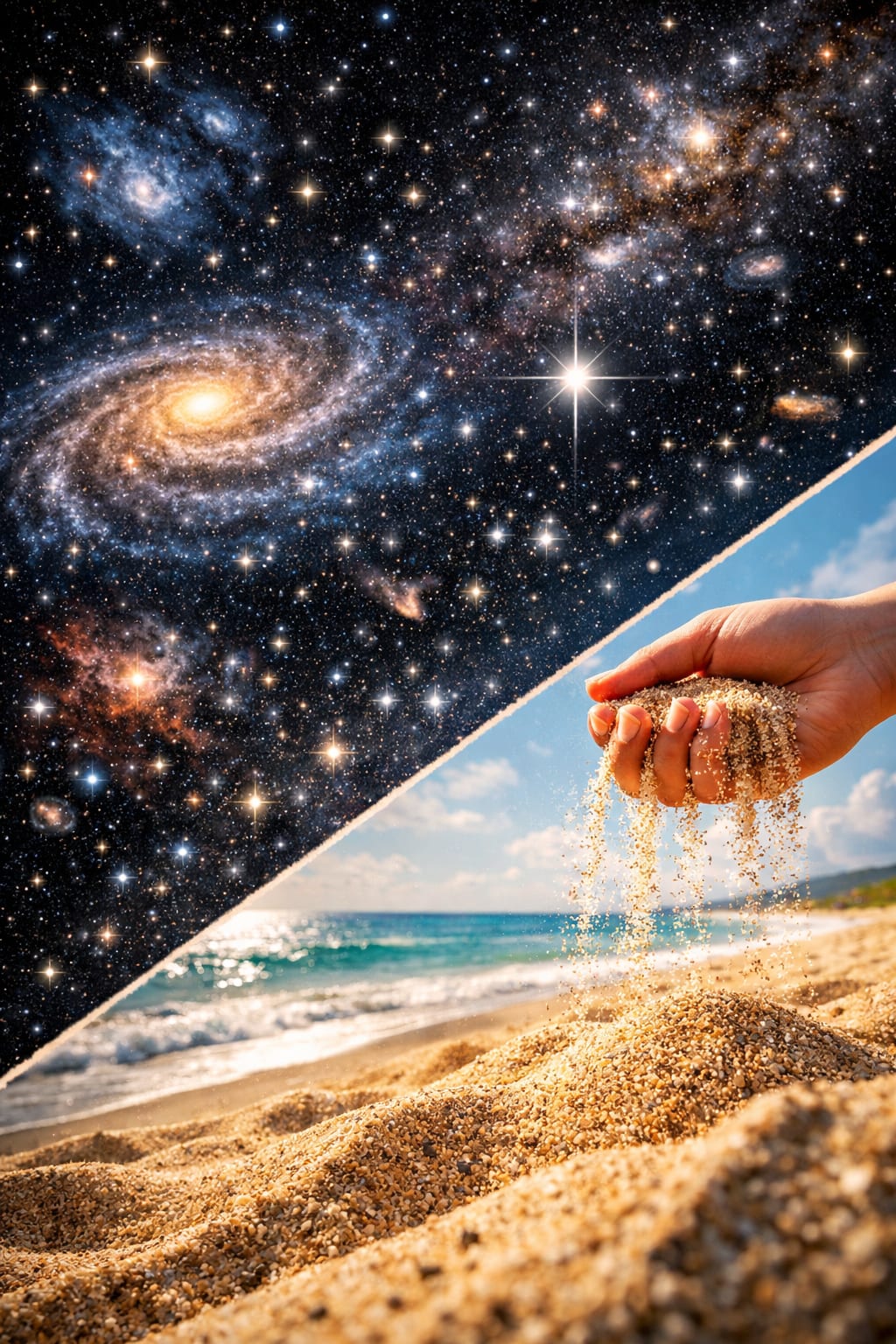
For centuries, humans have looked up at the night sky and wondered about the vastness of the universe. On a clear night, thousands of stars appear scattered across the sky like tiny shining dots. At the same time, anyone who has walked along a beach has seen what seems like an endless number of grains of sand. This raises a fascinating question: Are there more stars in the universe, or more grains of sand on Earth’s beaches?
At first glance, the number of grains of sand might seem greater. Beaches stretch across continents, deserts cover enormous areas, and sand appears almost limitless when you hold it in your hand. However, when scientists actually attempt to estimate these numbers, the results reveal something astonishing about the scale of the universe.
To understand the comparison, we first need to estimate the number of grains of sand on Earth. Researchers have tried to calculate this by measuring the average size of a grain of sand and estimating how much sand exists along the world’s beaches and deserts. While the number varies depending on the assumptions used, scientists often estimate that Earth contains around 7.5 quintillion grains of sand. Written out, that number is:
7,500,000,000,000,000,000 grains of sand
This number is almost impossible to imagine. If you tried counting one grain every second, it would take hundreds of billions of years to reach this total. Yet, despite this enormous figure, it may still be smaller than the number of stars in the universe.
Astronomers estimate the number of stars by observing galaxies. Our home galaxy, the Milky Way, contains somewhere between 100 billion and 400 billion stars. Using powerful telescopes, scientists have also discovered that the universe contains an incredible number of galaxies. Early estimates suggested around 100 billion galaxies, but more recent research indicates that there may be two trillion galaxies in the observable universe.
If each galaxy contains billions or even hundreds of billions of stars, the total number of stars becomes mind-boggling. When astronomers multiply these estimates together, they arrive at a number around one septillion stars in the observable universe. In numbers, that looks like this:
1,000,000,000,000,000,000,000,000 stars
This means there could be far more stars in the universe than grains of sand on all the beaches of Earth.
However, this comparison is not as simple as it seems. Both numbers are estimates rather than exact counts. Scientists cannot count every grain of sand on Earth, and they certainly cannot count every star in the universe. Instead, they rely on sampling, observation, and mathematical models.
For example, telescopes such as the Hubble Space Telescope have allowed astronomers to look deep into space and observe distant galaxies. By studying a tiny patch of sky and counting how many galaxies appear within it, scientists can estimate how many galaxies exist across the entire observable universe. Similarly, geologists estimate the number of grains of sand by calculating the volume of sandy areas and dividing it by the average size of a grain.
Another important point is that the universe is far larger than the observable universe. The observable universe refers only to the region of space whose light has had enough time to reach us since the beginning of the cosmos about 13.8 billion years ago. Beyond this boundary, there may be vastly more galaxies and stars that we simply cannot see yet. If those regions were included, the number of stars could be unimaginably greater.
This comparison between stars and sand also helps us understand just how vast the universe truly is. Humans often think of Earth as enormous, yet when compared with the cosmic scale, our planet is incredibly small. Every beach, desert, and sand dune on Earth combined still cannot match the immense number of stars scattered throughout the universe.
The idea has also inspired poets, philosophers, and scientists alike. The image of countless stars shining in the night sky mirrors the countless grains of sand beneath our feet. Both remind us of nature’s incredible complexity and scale.
In the end, while exact numbers remain uncertain, scientific estimates strongly suggest that the universe contains far more stars than there are grains of sand on Earth’s beaches. The next time you stand on a shoreline and feel sand slipping through your fingers, remember that somewhere in the vast universe, even more stars are shining silently in the darkness.
This simple comparison reveals one profound truth: the universe is far larger and more mysterious than our minds can easily comprehend.
About the Creator
Irshad Abbasi
Ali ibn Abi Talib (RA) said 📚
“Knowledge is better than wealth, because knowledge protects you, while you have to protect wealth.
Keep reading
More stories from Irshad Abbasi and writers in Beat and other communities.
Frank Caprio: The Compassionate Judge Loved Across the World
In a world where courtrooms are often associated with strict rules and harsh judgments, one judge stood out for his compassion and humanity. **Frank Caprio**, a municipal judge from Providence, Rhode Island, became widely known around the globe for the kindness he showed to people appearing in his courtroom. Often called “the world’s kindest judge,” Caprio’s unique style of justice made him a beloved figure not only in the United States but also in countries thousands of miles away — including Pakistan.
By Irshad Abbasi a day ago in Beat
Review of 'Man on the Run'
My wife and I saw Man on the Run, a nearly 2-hour documentary on Amazon Prime, about Wings, Paul McCartney's group that flew around the world from shortly after The Beatles broke up in early 1970 to shortly after John Lennon was murdered at the end of 1980, making a Beatles reunion forever impossible.
By Paul Levinson6 days ago in Beat
50 CENT FIRES BACK 50 Cent Shuts Down T.I.’s Son King Harris After He Posted Alleged Paperwork: "I Ain't Never Told On No N**ga In My Life!"
50 cent claims he’s never snitched on anyone. What a pity. Snitching is part of the ecosystem that sustains society. Those nosy old women, Karens some of them, hold this world together like glue. Those boys on the playground who play tattletale ensure that order is kept. The responsible young men who see a four-year-old gunned down in the street and know who the killer(s) is should be lauded and applauded.
By Skyler Saunders5 days ago in Beat




Comments
There are no comments for this story
Be the first to respond and start the conversation.