
The Storytellers of Kurdistan’s Capital
Voices of Pain and Memory That Transcend Language

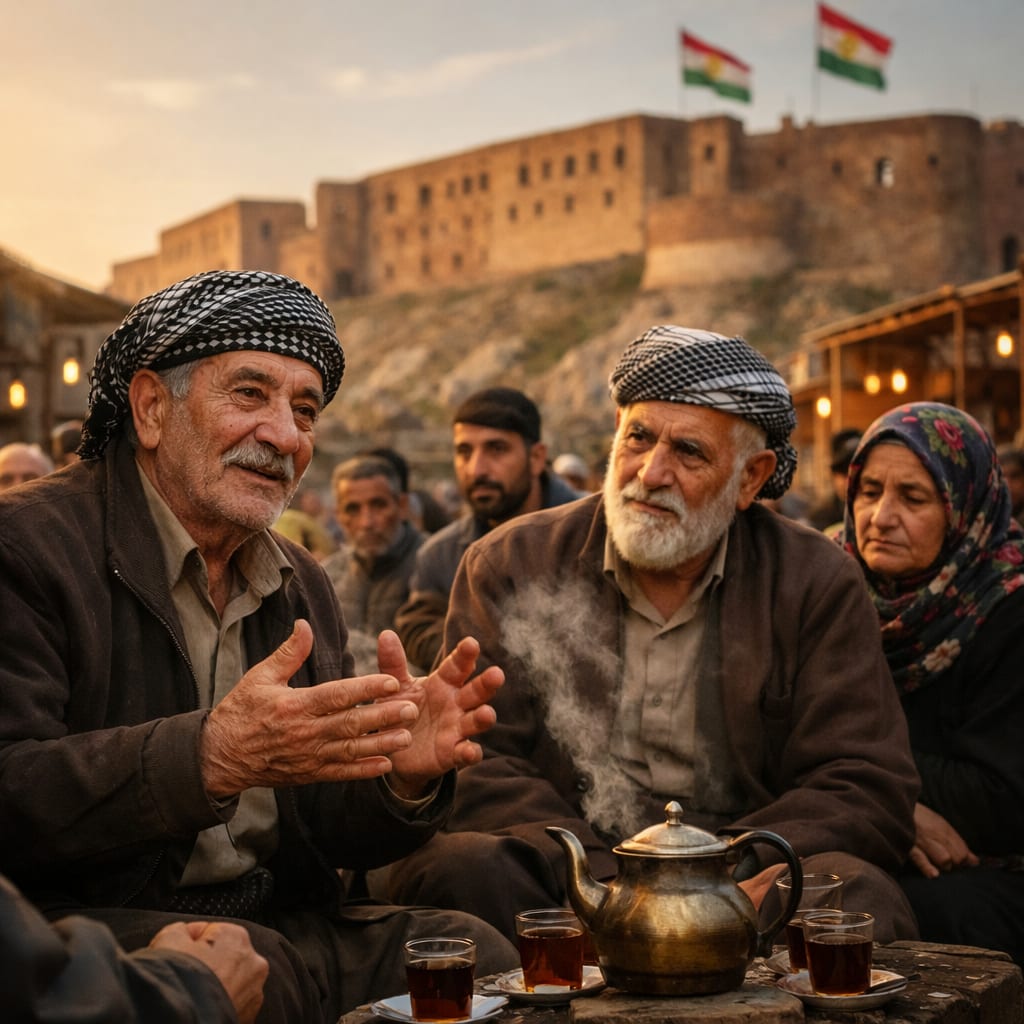
Kurdistan’s capital, Erbil, is a city of contradictions. Its streets, ancient yet bustling with modern life, carry stories older than the stones of the Citadel itself. Among its residents are a unique group of people: the storytellers, those who have witnessed upheaval, survival, and the relentless flow of history, and yet continue to speak in voices that resonate far beyond words.
The storytellers of Erbil are not just narrators of tales; they are the keepers of collective memory. They convey the struggles of displacement, the heartbreak of loss, and the joy of fleeting moments, all within the intimate framework of oral tradition. What makes their craft extraordinary is that it transcends the limitations of language. One does not always need to understand Kurdish to feel the weight of their stories—the cadence, the pauses, and the rhythm of their speech communicate the rawness of human experience.
Historically, the Kurdish people have endured centuries of political marginalization, conflict, and forced migrations. Each storyteller carries fragments of these experiences, weaving them into narratives that are deeply personal yet profoundly universal. In Erbil, this oral heritage finds its home in tea houses, bustling marketplaces, and quiet corners of the Citadel, where elders recount tales to eager listeners, young and old alike. These stories serve as a bridge between generations, ensuring that the wisdom, resilience, and culture of the Kurdish people are preserved.
A particularly striking feature of these storytellers is their emotional transparency. They do not merely recount events—they embody them. The pain of exile, the sorrow of lost loved ones, or the elation of community celebrations is communicated through voice, gesture, and expression, creating a visceral connection with the audience. For many visitors and locals alike, this emotional resonance is the first encounter with the Kurdish experience in its most authentic form. It is a reminder that the human heart can speak without the need for translation.
In recent decades, Erbil has undergone rapid transformation. The city’s skyline is punctuated with modern high-rises, shopping malls, and luxury hotels. While development brings economic opportunity, it also poses challenges for the preservation of intangible cultural heritage. Storytelling, once a ubiquitous daily practice, risks being relegated to ceremonial or tourist-centered performances. Yet, amidst this transformation, the storytellers remain vigilant. Many adapt their narratives to contemporary realities, incorporating modern events, politics, and social change, while retaining the essence of their heritage.
Women, too, play a critical role in this tradition, although their voices have historically been less visible. Female storytellers in Erbil are gradually emerging as prominent custodians of memory, offering perspectives that are both deeply personal and socially critical. Through their stories, they address issues of gender, family, and societal norms, highlighting the intersection of tradition and modernity in Kurdish life.
The significance of storytelling in Erbil goes beyond mere entertainment. It is a political act, a declaration of existence in a world that has often sought to erase Kurdish voices. Each story is a testament to survival, resistance, and identity. By preserving these narratives, the storytellers reinforce a sense of belonging and continuity, reminding both locals and outsiders that the Kurdish experience is not ephemeral—it is enduring and vibrant.
As one walks through the winding alleys of the Citadel or sits in a neighborhood café, listening to a tale unfold, it becomes clear that the storytellers’ power lies not just in what they say but in how they make listeners feel. They transform personal histories into shared human experiences, proving that some truths do not require translation, only attention and empathy.
In a city at the crossroads of history and modernity, the storytellers of Erbil remain essential witnesses. Their voices, imbued with pain, hope, and resilience, ensure that the spirit of Kurdistan is never forgotten. And in every word, pause, and sigh, one understands that some stories are so profound, they speak directly to the heart—beyond the need for language.
About the Creator
Irshad Abbasi
Ali ibn Abi Talib (RA) said 📚
“Knowledge is better than wealth, because knowledge protects you, while you have to protect wealth.
Keep reading
More stories from Irshad Abbasi and writers in Beat and other communities.
The Unsinkable Ambition: China’s Massive Undertaking to Recreate the Titanic
The story of the RMS Titanic has fascinated the world for over a century. From the tragic night in April 1912 to James Cameron’s cinematic masterpiece, the "Ship of Dreams" remains a global symbol of both human ingenuity and sobering hubris. Now, in a landlocked county in southwest China, that legend is being physically rebuilt. The Unsinkable Titanic, a full-scale, 1:1 replica, is currently under construction in Daying County, Sichuan Province, marking one of the most ambitious—and controversial—tourism projects in modern history.
By Irshad Abbasi 10 days ago in Beat
The First Rainbow Baby
Pitter-patter, pitter-patter. The rain fell in rhythmic splatters, slowly slowing, but still constant. Mira rolled onto her side pulling the blanket tight against her ears, but still she could hear chitter-chatter and scurrying feet of the creatures that refused to sleep in the lower decks.
By A. J. Schoenfeld3 days ago in Fiction




Comments
There are no comments for this story
Be the first to respond and start the conversation.