
Empires of Writing: Civilisation as Scripted Infrastructure
Book Review

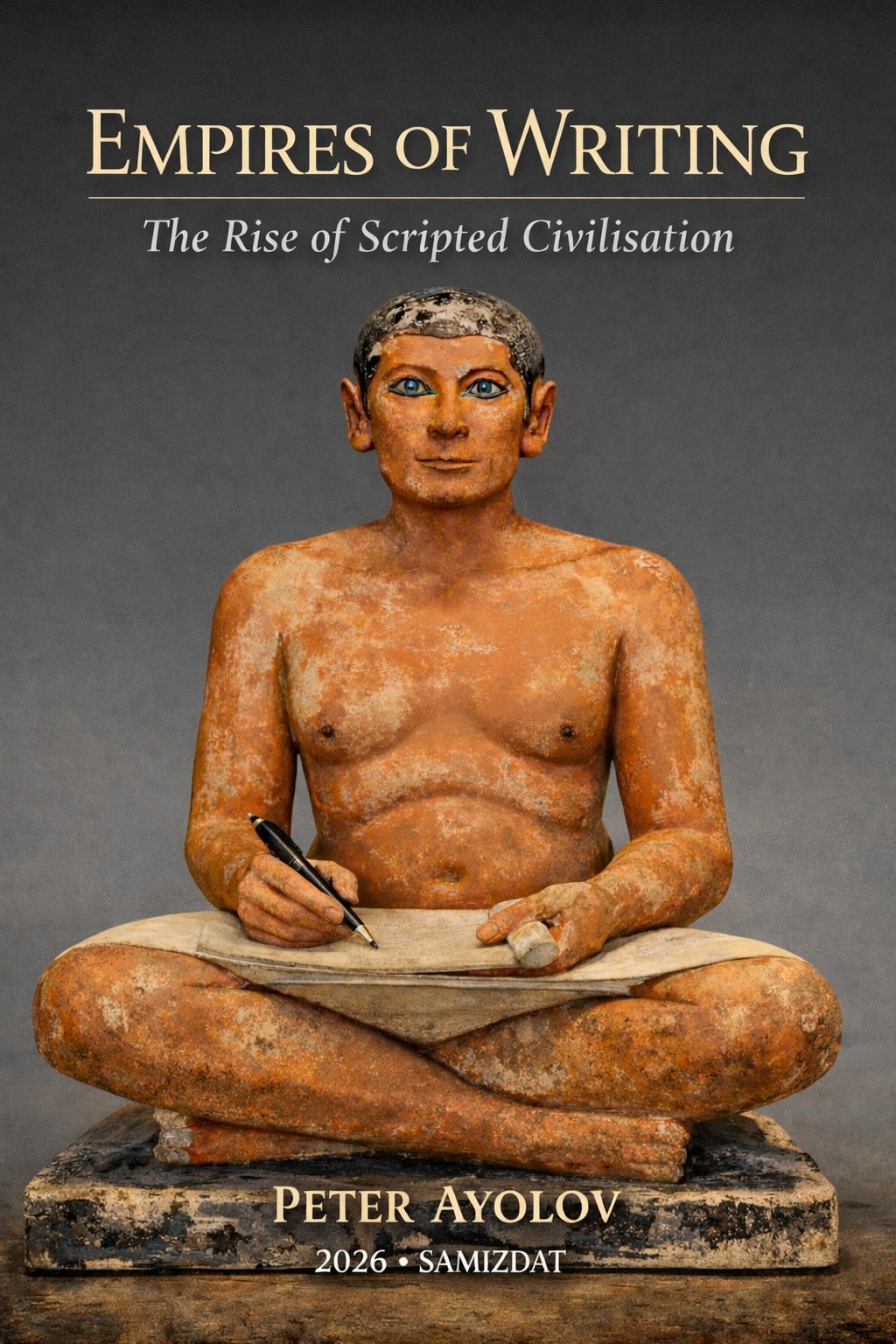
Empires of Writing: Civilisation as Scripted Infrastructure
"Civilisation depends less on stories than on ledgers.
Empire begins when memory leaves the body.
The map is the Empire."
– Sacra Littera Alpha
There are books about writing, and there are books written within writing. Empires of Writing: The Rise of Scripted Civilisation belongs to the second category. It does not treat literacy as a skill, nor writing as a neutral tool of cultural transmission. Instead, it advances a sustained and ambitious thesis: writing is a civilisational infrastructure. It is not an ornament of culture but the architecture of power. Empire does not merely conquer; it records. It does not only rule; it archives. And in doing so, it reshapes the very structure of human consciousness.
The book opens with a deceptively simple distinction: in oral cultures, words are events; in literate cultures, words become objects. This shift from sound to inscription, from time to space, forms the conceptual engine of the entire work. Sound vanishes as it occurs. It exists only while disappearing. Writing arrests this vanishing. It freezes the event of speech into a visible trace. Once words are stabilised, they can be stored, counted, compared, transported, standardised. This transformation from ephemeral utterance to durable mark marks the beginning of what the book calls scripted civilisation.
What distinguishes this work from earlier media theories is its insistence on materiality. Writing is not reduced to semiotics or symbolism. It is clay tablets, reed styluses, parchment rolls, tax ledgers, cadastral maps, bureaucratic files, and eventually digital databases. The book situates writing within the physical infrastructures that sustain power. Archives are architectural spaces. Maps are tools of territorial compression. Ledgers are instruments of economic abstraction. The emperor, the governor, the tax collector, and the scribe are not literary figures; they are operators of a technical system.
One of the book’s strongest contributions is its treatment of scale. Empires expand not only by force but by administration. Administration requires stable records. Stable records require writing. Through inscription, territory becomes legible. Grain becomes quantity. Population becomes census. Law becomes codified. The book’s central claim that “the emperor can read the world on a map” is not rhetorical flourish but structural diagnosis. Once the world is rendered in graphic abstraction, it becomes governable at a distance. The ruler does not need to see the land; he needs to see its representation.
In tracing this development historically, the work moves from early Mesopotamian accounting systems through Roman bureaucratic organisation and into early modern cartography and legal codification. Yet it avoids turning into a conventional narrative history. The emphasis remains philosophical: what changes when speech becomes storage? The answer is not merely institutional but cognitive. Writing provides models for language. It brings words, propositions, and logical relations into consciousness. Grammar, dictionary, and code become possible only when language itself is objectified.
Here the book enters into dialogue with theories of literacy and cognition, but it does so without collapsing into determinism. Writing does not magically create rationality. Rather, it enables new forms of reflection. Once propositions are visible, they can be analysed. Once statements are separated from their speaker, they can be tested. Representation acquires autonomy. This autonomy is the condition for both scientific reasoning and bureaucratic abstraction. The same mechanism that allows logical deduction also allows impersonal governance.
The discussion of reading is particularly striking. The book argues that the history of literacy is not merely the history of writing systems but the history of interpretation. As texts accumulate authority—religious, legal, scientific—communities develop shared hermeneutic frameworks. Textual communities become political communities. The Protestant insistence on literal reading is interpreted not simply as a theological development but as a structural transformation in how texts are treated as binding sources of truth. In parallel, the “Book of Nature” becomes readable according to similar principles. Empirical science emerges within a framework shaped by scriptural interpretation.
What is especially compelling is the analysis of illocutionary force and intentionality. Writing captures what was said but not how it was said. Tone, gesture, and context vanish in transcription. The need to compensate for this absence generates complex interpretive tools: concepts such as assumption, inference, hypothesis, and assertion. These epistemological distinctions, the book argues, emerge historically as responses to the limitations of script. Literacy does not only store meaning; it reorganises the structure of belief.
This leads to one of the work’s most ambitious claims: modern self-consciousness is a by-product of writing. When representations become independent from the world they represent, humans begin to think about thinking. Thought becomes reflexive. Propositions become objects of evaluation. Evidence becomes separable from theory. The literate mind does not merely know; it examines the conditions under which knowledge is justified. The transformation from oral immediacy to written abstraction thus produces the conceptual groundwork of modern epistemology.
The strength of the book lies in its coherence. Its thesis—that writing is infrastructure—remains stable across chapters. The movement from clay tablet to digital database is not presented as a simple linear progress but as a deepening of abstraction. Each technological shift intensifies the same structural principle: externalised memory permits scalable authority. The bureaucrat replaces the warrior as the key figure of empire. Control migrates from battlefield to archive.
At the same time, the book avoids celebratory tones. It does not romanticise literacy. Writing enables administration, but it also enables distance. Decisions made in abstraction can obscure lived consequences. Maps flatten terrain; ledgers reduce people to entries. The transformation of speech into storage makes governance more efficient but also more impersonal. Scripted civilisation risks becoming a civilisation of documents rather than of presence.
Stylistically, the prose is dense, declarative, and philosophically driven. The argument unfolds through layered exposition rather than anecdotal narrative. At times, the conceptual density demands careful reading, but this density is part of the book’s intellectual ambition. It seeks not merely to inform but to reframe how readers understand civilisation itself.
There are moments where repetition reinforces rather than advances the thesis. The concepts of map, ledger, archive, and abstraction recur frequently. Yet this recurrence serves a structural purpose: the argument accumulates through reiteration, mirroring the very accumulation of inscription it describes. If anything, the book might benefit from occasional sharper transitions between historical case and theoretical claim, but the underlying architecture remains solid.
Perhaps the most significant achievement of the work is its integration of material history with philosophy of mind. Rather than treating cognition as an internal psychological process, it situates thought within technological environments. The mind is not isolated from its media. It is shaped by them. Writing does not simply express consciousness; it configures it. This perspective aligns the book with major traditions in media theory while preserving its distinctive emphasis on empire and governance.
In its final movement, the book suggests that modern digital infrastructures represent not a rupture but an intensification of the same logic. Databases are contemporary archives. Algorithms are new bureaucrats. The principle remains unchanged: when memory is externalised and structured, power becomes scalable. The difference lies in speed and volume, not in structural essence. Scripted civilisation has not ended; it has accelerated.
The book ultimately asks readers to reconsider what civilisation means. Instead of defining civilisation by monuments, philosophies, or artistic achievements, it invites us to look at storage systems. Archives, registries, cadastral surveys, legal codices—these are the true skeleton of empire. Without them, power dissipates. With them, it persists beyond the lifespan of rulers.
In doing so, Empires of Writing offers a powerful corrective to romantic notions of cultural development. Civilisation depends less on stories than on ledgers. It depends less on myths of origin than on mechanisms of record. Writing is not secondary to history; it is its condition of possibility.
For scholars of media, history, political theory, or philosophy, the book provides a rigorous and provocative framework. For general readers, it offers a conceptual lens through which to reinterpret familiar historical developments. Its ambition is considerable: to redefine the rise of civilisation through the rise of script. That ambition is largely fulfilled.
In the end, the book leaves a lingering insight: once speech leaves the body and enters the archive, the world itself becomes readable. And once the world becomes readable, it becomes governable. The making of the literate mind is inseparable from the making of empire. Writing does not merely record civilisation. It builds it.
About the Creator
Peter Ayolov
Peter Ayolov’s key contribution to media theory is the development of the "Propaganda 2.0" or the "manufacture of dissent" model, which he details in his 2024 book, The Economic Policy of Online Media: Manufacture of Dissent.
Keep reading
More stories from Peter Ayolov and writers in BookClub and other communities.
Mirror Selves Trilogy: The Architecture of the Formatted Human
Mirror Selves Trilogy: The Architecture of the Formatted Human The Mirror Selves Trilogy—Identity Industrial Complex, Copyrighting the Self, and The Shapes of the Self—offers one of the most systematic contemporary analyses of how identity has migrated from lived interiority to formatted visibility. Across its three volumes, Peter Ayolov develops a coherent theoretical architecture that traces the transformation of the self from a psychological and philosophical category into a political, economic, and technological construct. What begins as an inquiry into representation unfolds into a diagnosis of civilizational change: the shift from narrative selfhood to infrastructural identity, from subjectivity to profile, from history to circulation. At the core of the trilogy stands a simple but destabilizing claim: identity no longer precedes representation. It is formatted by it. The trilogy does not treat this as metaphor. It is not a cultural lament about social media narcissism or a nostalgic defense of authenticity. It is an ontological and political thesis. The human being, once imagined as a bearer of interior depth, now appears as a visible configuration inside systems of recognition. The mirror no longer reflects; it produces.
By Peter Ayolov4 days ago in BookClub
Book Review: Atmosphere by Taylor Jenkins Reid
I flipped the book over in my hands in the centre of the small airport book shop. Although I had heard promising reviews of Atmosphere by Taylor Jenkins Reid, I hesitated. The synopsis didn’t compel me - I wasn’t much of a space girly. In high school it made me cringe when my peers would talk about the stars.
By sleepy drafts27 days ago in BookClub
I Reread Twilight—And Discovered a Lifehack for Confidence, Charm, and Building Magnetic Relationships
When I first read Twilight by Stephenie Meyer, I was captivated by the love story between Bella Swan and Edward Cullen, the tension of the supernatural world, and the emotional intensity that drew me in. At first, it felt like a romantic fantasy full of drama and longing. Revisiting it as an adult, I realized that hidden within the narrative is a lifehack: Twilight offers lessons about confidence, social awareness, and relationship dynamics that can be applied to personal growth, social influence, and building meaningful connections.
By Lukáš Hrdlička4 days ago in BookClub



Comments
There are no comments for this story
Be the first to respond and start the conversation.