
AI, Nuclear Escalation, and Pakistan’s Critical Role
How Artificial Intelligence Is Reshaping Nuclear Risk in South Asia and Beyond

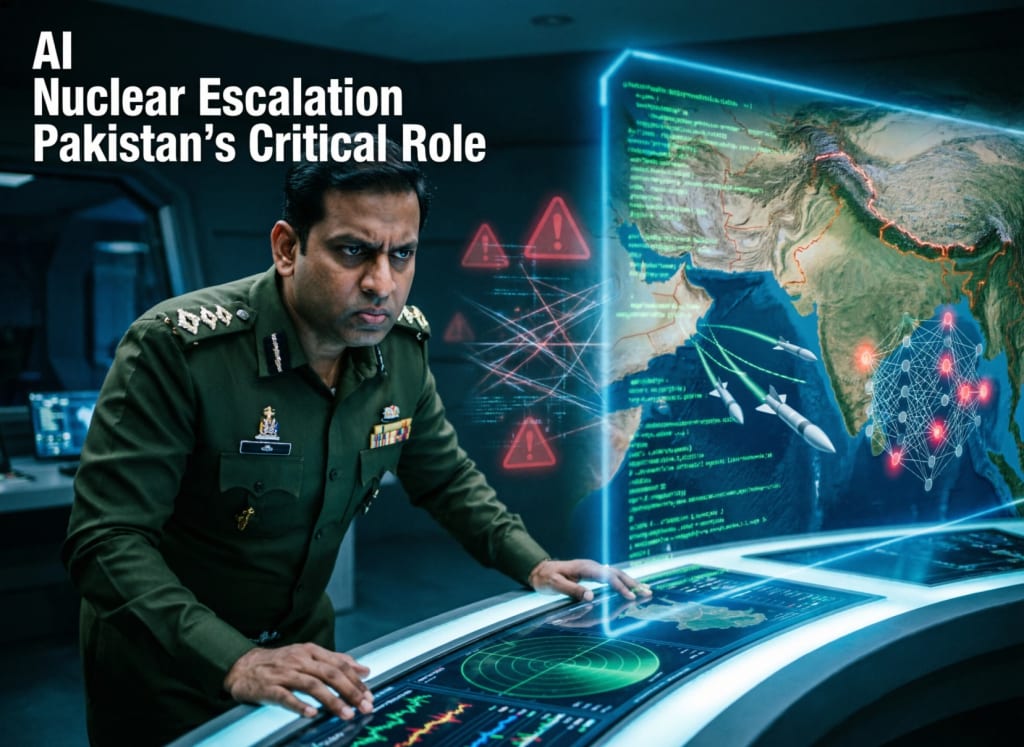
AI, Nuclear Escalation, and Pakistan’s Critical Role
If World War III begins, it is unlikely to start with marching armies or formal declarations. Instead, it may begin silently—inside algorithms, early-warning systems, and automated decision tools powered by artificial intelligence. Nowhere is this risk more serious than in regions where nuclear weapons exist alongside historical rivalries, limited decision time, and high political tension. South Asia, especially Pakistan, sits at the center of this emerging danger.
Artificial intelligence is increasingly used in modern militaries for surveillance, threat detection, cyber defense, missile tracking, and battlefield analysis. These systems promise speed and accuracy, but they also introduce a new and dangerous problem: machines reacting faster than humans can think. In nuclear-armed states, speed can be deadly.
Pakistan is one of the world’s nine nuclear-armed countries. Its nuclear doctrine is built around deterrence—preventing war, not fighting one. However, Pakistan exists in a highly sensitive security environment, shaped largely by its long-standing rivalry with India. Both countries have fought multiple wars, experienced crises, and live under constant military alertness. When AI enters this equation, the margin for error becomes dangerously small.
One of the greatest risks comes from AI-assisted early warning systems. These systems analyze satellite data, radar signals, cyber activity, and troop movements to detect possible attacks. In theory, AI improves accuracy. In reality, AI systems can misinterpret unusual data, be fooled by cyber manipulation, or react incorrectly to incomplete information. A false warning—especially during high tension—could pressure leaders into making rapid nuclear decisions.
Unlike humans, AI does not understand political context, intent, or diplomacy. It sees patterns, not meaning. If an AI system flags an event as a possible nuclear threat, military leaders may have only minutes to respond. In South Asia, where missile flight times are extremely short, decision windows are already compressed. AI could reduce them even further.
Pakistan, like other responsible nuclear states, emphasizes human control over nuclear weapons. However, the global arms race is quietly pushing countries toward automation. Surveillance drones, AI-powered intelligence analysis, and automated defense systems are becoming standard. The danger is not that Pakistan wants AI-controlled nuclear weapons—but that pressure to keep up may slowly increase reliance on automated systems.
Another major concern is cyber warfare. AI-driven cyber tools can target communication networks, military databases, and command systems. If a nuclear command-and-control system is disrupted or spoofed, leaders may fear they are under attack—even if they are not. In such a scenario, escalation could occur based on fear, not fact.
This is not just a Pakistan-India issue. Global powers are also integrating AI into nuclear-related systems. The United States, China, and Russia are all investing heavily in AI-enabled military technologies. Any global crisis involving these powers could spill over into regions like South Asia, pulling Pakistan into broader geopolitical tensions.
Pakistan’s position is especially delicate because it must balance deterrence, regional stability, and international responsibility. Islamabad has consistently stated that its nuclear weapons are for defense only. But deterrence works only if communication remains clear and systems remain stable. AI threatens both if not carefully controlled.
International institutions like the United Nations have warned about autonomous weapons and AI escalation risks. Yet global rules remain weak. There is no binding international treaty that clearly limits AI use in nuclear command systems. This gap increases the chance that technological competition will outpace ethical restraint.
The solution is not to reject AI entirely. AI can improve safety if used carefully—by detecting false alarms, improving transparency, and assisting human decision-makers rather than replacing them. For Pakistan and other nuclear states, the key principle must remain human-in-the-loop control, where no nuclear action is possible without deliberate human authorization.
World War III may not start with hatred or ambition. It could begin with a machine misreading data, a cyberattack creating confusion, or an automated system escalating a crisis faster than diplomacy can respond. Pakistan’s experience, restraint, and strategic caution make it a crucial case study in how nuclear states can resist this dangerous path.
The future of global peace may depend less on how powerful our weapons become—and more on how wisely we limit the machines that help control them.
About the Creator
Wings of Time
I'm Wings of Time—a storyteller from Swat, Pakistan. I write immersive, researched tales of war, aviation, and history that bring the past roaring back to life
Keep reading
More stories from Wings of Time and writers in Chapters and other communities.
Has World War III Started?
Has World War III Started? The question “Has World War III started?” is no longer limited to academic debate or fictional movies. It is now openly discussed in newsrooms, policy circles, and online platforms around the world. While the simple answer remains no, the conditions shaping today’s global environment are deeply alarming. The world is experiencing an unprecedented convergence of regional wars, technological disruption, and power competition that closely resembles the early stages of past global conflicts.
By Wings of Time about 16 hours ago in Chapters
Mojahedin-e Khalq (MEK) Claims 250 Operatives Attacked Iran Supreme Leader’s Residence — Tehran Calls It Fake News
The organization Mojahedin-e Khalq (MEK) has claimed that around “250 of its operatives” carried out an attack in central Tehran targeting the office and residence of Iran’s Supreme Leader, Ayatollah Ali Khamenei. However, Iranian officials and state media have denied that any such incident occurred.
By Real content7 days ago in Chapters




Comments
There are no comments for this story
Be the first to respond and start the conversation.