


I presented him with a list of his harsh remarks, each entry dated and quoted verbatim, hoping that the undeniable record would force him to acknowledge his misconduct. He laughed, a harsh, guttural sound, and replied, “You think you can challenge my authority with petty grievances? I have been teaching for twenty‑three years; you are merely students with no right to question me.” The tension snapped, and the room seemed to close in, as if the very walls were listening, poised to judge, while I felt the crushing weight of his disdain settle upon my shoulders like an oppressive blanket.
In the days that followed, Mr. Hargrove’s retaliation was swift and merciless, a calculated campaign designed to break our spirits. He assigned us extra reading, marked our work with even harsher critiques, and publicly questioned our commitment to the class, asking, “Do you even understand what it means to be a student under my guidance?” The whispers among classmates turned into furtive glances, and I sensed that many were too frightened to align with us, fearing that the teacher’s wrath would spill over onto them as well. Maya’s grades slipped, and I watched her confidence erode like sand under relentless waves. Yet, amidst the growing despair, we clung to the evidence we had gathered, each entry a small beacon of hope that perhaps, somewhere beyond the confines of our classroom, there existed a system capable of hearing our plea for fairness.
Desperate for an ally, I reached out to Mrs. Patel, the school counselor, whose office was a sanctuary of soft lighting and quiet empathy. I recounted the series of humiliations, presenting her with the meticulously compiled dossier, and pleaded, “Please, help us stop this.” She listened intently, her brow furrowing as she read each entry, the weight of the teacher’s words echoing in her solemn gaze. “I will bring this to the attention of the principal,” she promised, “but you must be prepared for the possibility that change may be slow.” Maya and I left her office feeling a fragile optimism rise within us, bolstered by the knowledge that an adult authority might finally intervene, even if the path ahead remained uncertain and fraught with potential repercussions.
Armed with Mrs. Patel’s endorsement, we scheduled a meeting with the principal, Mr. Alvarez, a man known for his measured approach to disciplinary matters. In the sterile conference room, we laid out the chronology of Mr. Hargrove’s behavior, quoting his exact words: “You are worthless,” “Your work is a disgrace,” and “You will never amount to anything.” I spoke with a steady voice, describing the emotional toll the teacher’s conduct had taken on our academic performance and mental health. Maya added, “We are not asking for special treatment; we simply seek an environment where we can learn without fear.” Mr. Alvarez listened without interruption, his expression growing increasingly grave, and finally said, “I assure you, this will be investigated thoroughly. No student should endure such treatment.” The meeting concluded with a promise of a formal inquiry, and for the first time in weeks, we felt the oppressive fog beginning to lift.
The investigation unfolded over several weeks, during which Mr. Hargrove’s façade of authority cracked under the scrutiny of the administration. Several students, emboldened by our courage, stepped forward, each recounting their own encounters with his vitriolic remarks and unjust grading practices. The school board convened, reviewed the compiled evidence, and ultimately concluded that Mr. Hargrove’s conduct violated the district’s policies on student welfare. He was placed on administrative leave pending further action, and a new teacher, Ms. Rivera, was assigned to guide the class through the remainder of the semester. The atmosphere in the classroom transformed from one of dread to cautious optimism, as the lingering shadows of tyranny receded, allowing us to breathe freely once more.
Reflecting now, years later, on that tumultuous chapter of my life, I realize how the ordeal forged an unbreakable bond between Maya and me, and taught us the value of standing up against injustice, even when the odds seemed insurmountable. The serious tone of those days still reverberates in my memory, a reminder that silence can be as damaging as any harsh word. “Never underestimate the power of documented truth,” Maya once told me, a mantra that has guided my own career as an advocate for student rights. I carry forward that lesson, knowing that facing a mean teacher was not merely a battle for grades, but a profound struggle for dignity and the right to be heard, a struggle that continues to shape who I am today.
About the Creator
Forest Green
Hi. I am a writer with some years of experiences, although I am still working out the progress in my work. I make different types of stories that I hope many will enjoy. I also appreciate tips, and would like my stories should be noticed.
Keep reading
More stories from Forest Green and writers in Chapters and other communities.
Inside Rebels
I still remembered the first day Mr. Hargrove entered our sophomore English classroom, his shoulders hunched like a storm cloud ready to unload its fury. I was fifteen, clutching a battered notebook, and my best friend, Maya, sat beside me, her eyes narrowed with an instinctive wariness. The walls, once adorned with vibrant student posters, seemed to shrink under the weight of his scowl, and his voice cut through the chatter like a blade. “This is not a playground; it is a battlefield of ideas,” he announced, his tone dripping with disdain for any hint of youthful enthusiasm. From that moment, the air grew thick with an oppressive expectation that made each breath feel like a silent accusation, and I sensed that Maya and I would soon be forced to navigate a terrain far more treacherous than any literary analysis we were meant to master.
By Forest Greena day ago in Chapters
A Historic Declaration
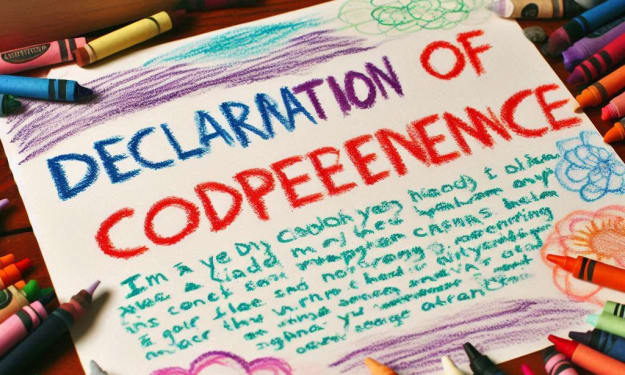
We the People of the Husbands of the United States of America, in Order to form a more perfect Union, and I mean you...with me...establish Justice, insure domestic Tranquility, provide for the common defence, promote the general Welfare, and secure the Blessings of Liberty to ourselves, after Puberty, do ordain and establish this Declaration of Co-Dependence.
By Gerard DiLeo6 days ago in Humans



Comments
There are no comments for this story
Be the first to respond and start the conversation.