
The 2026 Iranian Missile and Its Impact on Gulf Business, Travel, and Daily Life
An in-depth look at the March 2026 Iran-UAE conflict. From airport closures and Fairmont The Palm damage to the shift in Dubai’s business landscape and resident safety,

Alia has been living in the Dubai Hills area with her husband and two daughters for the past eight years.
She never imagined that even a city as safe as Dubai could come under attack. These days, she constantly hears the sound of explosions that make the windows of her home tremble and leave her young daughters frightened.
Alia says, “We have never seen anything like this in our lives. The sound of the explosions is very terrifying.”
She is worried about her daughters and is trying to keep them away from the windows.
For the past two days, most residents of Dubai have been staying indoors. Malls and roads are almost empty, and restaurants are not as crowded as usual.
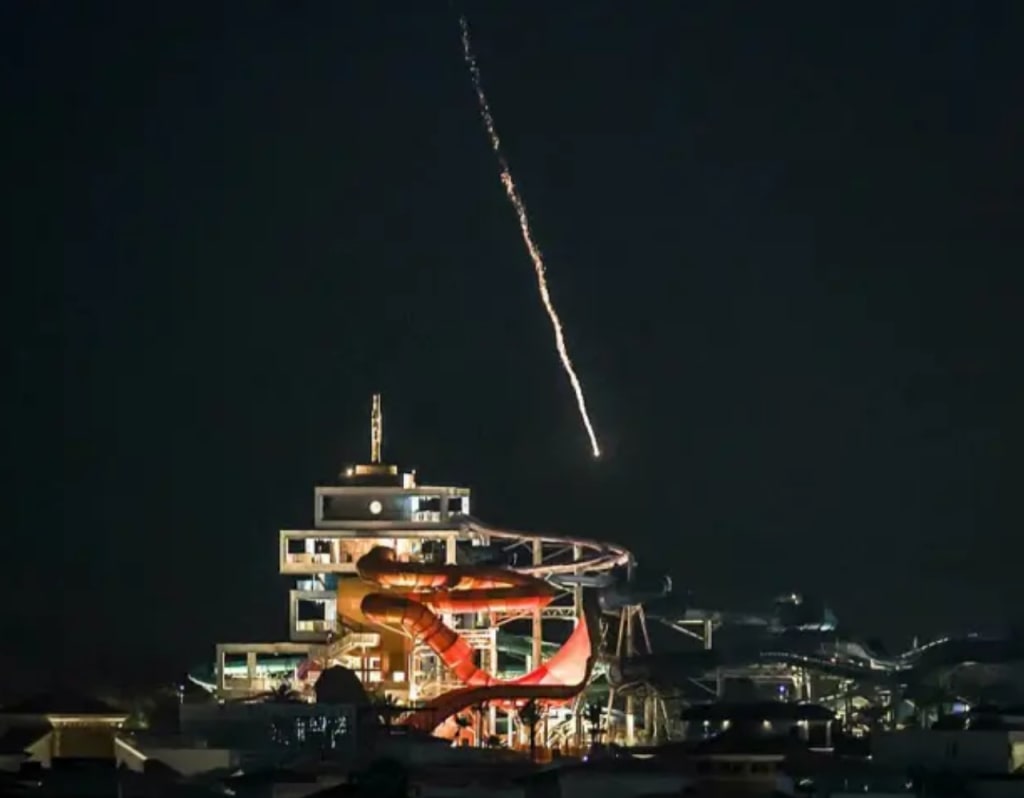
The skies above the city no longer show Dreamliners or Airbuses carrying tourists and cargo in large numbers. Instead, at short intervals, ballistic missiles and drones can be seen, reportedly launched by Iran neighboring the United Arab Emirates across the Gulf toward these states.
The city that residents and tourists once considered the safest in the world is now within range of Iranian missiles and drones. These attacks are being described as a response to strikes carried out by the United States and Israel against Iran.
From the luxury Fairmont The Palm hotel to shopping malls, high-rise apartment blocks, and Dubai Airport the world’s busiest international passenger airport damage has also been reported.
When these cities were built, no one imagined that one day they would face drone and ballistic missile attacks. A friend living in Dubai complained that, unlike Israel, there are no bunkers here where people can take shelter.
And even if you are one of the richest people in the world, you cannot currently leave Dubai, Abu Dhabi, Doha, Bahrain, or Kuwait by flight. For residents and millions of tourists in these Arab countries, life has changed overnight.
Some people, worried, have headed toward Hatta and Fujairah.
According to Alia, some of her friends who lived near military bases or sensitive areas left for Hatta and Fujairah out of concern, many of them Western nationals.
Despite the continuous attacks, Alia says she is satisfied with the government’s response. According to her, the Dubai government is handling the situation effectively and is sending real-time alerts to residents.
She says there is uncertainty, but people around her do not appear panicked. Hotels, restaurants, and malls are open. There are fewer people outside than usual, but overall conditions seem normal.
Alia says most people in Dubai order their supplies online, though supermarkets are also open. Many stores have displayed notices stating that they have stable stock supplies.
She has not stockpiled anything, except ordering slightly more water than usual.
Her daughter’s school has shifted to online learning until Wednesday. One of Alia’s friends, who was traveling from Manchester to Pakistan, had to stop in Dubai due to the deteriorating situation and cannot continue her journey.
However, Alia says the government has provided full assistance to her friend, including an email stating that the government would arrange visas and hotel accommodations, though for now she is staying with Alia.
On March 1, 2026, the UAE Ministry of Defense announced that the country’s air defense system had successfully intercepted Iranian ballistic missiles, cruise missiles, and drone attacks. According to the statement, a total of 541 drones were launched, of which 506 were destroyed and 35 fell within the country.
Similarly, 165 ballistic missiles were detected, of which 152 were intercepted mid-air and 13 fell into the sea. The Ministry of Defense stated that the defense system effectively countered the attacks and ensured the protection of the country’s airspace. However, independent sources have not yet confirmed these claims.
As a result of these attacks, three people have been killed and dozens injured in the UAE so far.
This is not the Dubai we are used to.
Thirty-five-year-old Sathya Jagannathan said that her sister’s family and their pets had to take shelter in their apartment because they lived near Jebel Ali Port, where “a lot of debris was falling.”
Authorities reported on Saturday that a fire broke out in part of the port due to debris from air interceptions. The port is the ninth busiest in the world.
Jagannathan said, “Every few hours we hear explosions. It’s very frightening because this is not the Dubai we are used to.”
Mohammad Nafea has been living in Dubai for nine years. He says the situation is largely normal. Although private businesses and companies were instructed to work from home for two days, all government offices, courts, and immigration offices remain open and functioning.
According to Nafea, although air cargo operations have been halted, there is no shortage of food, and supermarkets are fully stocked. He says that among the Pakistani and Indian nationals he spoke to in Dubai, Doha, Abu Dhabi, Kuwait, and Bahrain, none appeared fearful. They trust their governments and seem satisfied with the arrangements so far.
Nafea shares this confidence. He explains that if debris falls in a particular area, authorities send alerts only to residents of that specific area rather than alarming the entire city, allowing enough time for people to move to safer places.
“I heard the sound of missiles, but I believe we are in Dubai. The government will keep us safe.”
Danish, an Indian national who has been living in Dubai for six months and works in marketing, says he lives in BurJuman in old Dubai, where conditions are relatively normal.
“I heard missiles passing over my rooftop for the first time in my life. It shook me a bit, but I knew we are in Dubai and we will be kept safe,” he says.
He acknowledges the uncertainty but expresses complete confidence in the government and its measures.
The UAE government has decided to cover expenses for all tourists stranded in the country. Reports suggest that some tourists stuck in Dubai and Abu Dhabi are traveling by road to Saudi Arabia to catch flights from there.
One of Nafea’s friends, stranded in Abu Dhabi, was allowed by authorities to leave and has reached Jeddah by road. He reported heavy crowds at the border, mostly Western nationals leaving the UAE and Qatar.
According to Nafea, the Dubai government has decided to cover accommodation costs for all stranded tourists.
A friend who runs an Airbnb in Dubai received an email from the government stating that all vacant hotels and Airbnb properties would provide free accommodation to stranded tourists, with the government covering the costs.
The UAE government has announced that, due to airport closures, it will bear the accommodation costs of stranded tourists and travelers.
In a circular to hotels, Abu Dhabi’s Department of Culture and Tourism requested that guests unable to travel be allowed to extend their stay, with the department covering the additional costs.
My daughter said, ‘Dad, let’s go back to Pakistan.
Unlike Alia and Nafea, another resident, Murtaza, says the roads are completely empty, and malls were deserted over the weekend—contrary to usual scenes.
He says he never imagined a rapidly developing place like Dubai could come under attack, but he praises the government’s handling of the situation and its provision of free hotels and food to stranded tourists.
A Pakistani father living in the Marina area said a loud explosion late at night woke the entire household. “Both my children started crying. My daughter said, ‘Dad, let’s go back to Pakistan.’”
Another woman said she has packed a precautionary bag with passports, some cash, and children’s clothes. “I never thought I would see a day like this in Dubai. We always believed we were far from any danger.
Although most people report no shortages in supermarkets, some say increased buying has occasionally left shelves empty. A Pakistani youth remarked, “Fear makes people do anything.”
At Dubai International Airport, there is also an atmosphere of anxiety.
A family from Lahore, who came for vacation, has been waiting three days for a return flight. Their two young children fall asleep on airport chairs and wake up startled at every announcement.
The father says, “Flights keep getting canceled. The children ask when we will go home. We came here for leisure, but now we just pray to return safely.”
Kuwaiti citizens woke up to countless explosions.
Dr. Ayesha Suleiman, who has lived in Kuwait for 17 years, says her morning began with numerous explosions. In all these years, she has never seen Kuwait under attack like this.
She says earlier attacks targeted U.S. bases, but last night civilian areas were also hit, and she personally heard the explosions.
Kuwait’s Ministry of Defense said that “multiple” U.S. fighter jets had also crashed in Kuwait.
On the first day, some people panicked and attempted to stockpile essentials, but later stores were seen to be adequately supplied.
When asked whether malls and roads are functioning normally, she says sirens are constantly sounding during attacks, including loud ones this morning, yet “our life is almost normal.”
As a doctor, she continues going to the hospital, though schools and educational institutions have been instructed to operate online until further notice.
Shops and malls are open, but the government has advised people not to go out unnecessarily, so fewer people are seen outside.
She had hoped the situation would improve, but now it seems unlikely to settle in a few days.
Flight uncertainty also persists. Her son, a student in Pakistan, was supposed to return after vacation, but now cannot. “We packed his things, but we don’t know when he will be able to come back,” she says.
What is the situation in Bahrain?
Another person currently on a tourist trip in Bahrain says conditions there appear normal.
He mentions that the mosque in front of his house has never been empty. At every prayer time, cars arrive as usual, and the rows fill up just like on normal days.
He believes people have strong confidence in their government and defense system, assuming that if attacks occur, they will target U.S. bases, with only debris falling elsewhere.
He says work-from-home has been implemented and the government has also advised remote work, which may explain why fewer people are outside. There has been no visible panic buying.
Interceptions of missiles are occasionally heard, and when attacks occur, the bridge connecting Manama is temporarily closed.
It is worth noting that Bahrain hosts the headquarters of the U.S. Navy’s Fifth Fleet, whose area of responsibility includes the Gulf, the Red Sea, the Arabian Sea, and parts of the Indian Ocean.
About the Creator
Keep reading
More stories from Real content and writers in Chapters and other communities.
How did Israel kill Iranian Supreme Leader Ayatollah Ali Khamenei?
The attack intended to kill Iran’s Supreme Leader, Ayatollah Ali Khamenei, did not take place in the middle of the night under cover of darkness. Contrary to expectations, it was carried out in broad daylight.
By Real contenta day ago in Chapters




Comments
There are no comments for this story
Be the first to respond and start the conversation.