
The Dead Soul of Ayn Rand (Chapter One)
The Red Powder on the Water (Part 1)


Ivan trudged through the sleet-slicked streets toward Pandit Yad Adnan's bungalow, the cold seeping into his bones like an old accusation. Two weeks before, Job's election had promised a brief lifting of the fog that had settled after Donnie's triumph years earlier--a triumph that had driven Ivan, in a moment of black humor and despair, to mutter prayers to Satan under his breath. The next mornings brought the stench of tar hanging over the neighborhood, and before dawn the sound of many small legs scraping across the floorboards, as though insects were marching in formation toward his bed. He would bolt upright, heart hammering, then run to the bus stop in the gray light, convinced the world had noticed his blasphemy and was closing in.
The relief after Job's win had lasted only weeks. Wrong turns accumulated: the chronic aches in his gut and pelvis that no doctor could name, the endless shifts at Hameln Hospital where faces blurred into indifference, and above all the memory of Varun.
Varun, the East Indian prison guard who had come from a homeland that left long, puckered scars along his arms and back--marks from men who hated what he desired. Ivan had loved him with a quiet, hopeless ferocity, offering himself in dim motel rooms where Varun took what he wanted with mechanical efficiency, never once returning the gaze or the tenderness. Varun used him, discarded him, and Ivan carried the wound silently, never breathing a word of it to the holy men who now promised to scour his soul.
He rang the doorbell. A woman in a sari answered, wordless, and waited while he slipped off his wet shoes. In the living room a Telugu film played--garish colors, lovers twirling in impossible joy--while she placed a glass of water before him. Red powder floated on the surface like blood in milk. Ivan stared at it, then drank from his own bottle instead.
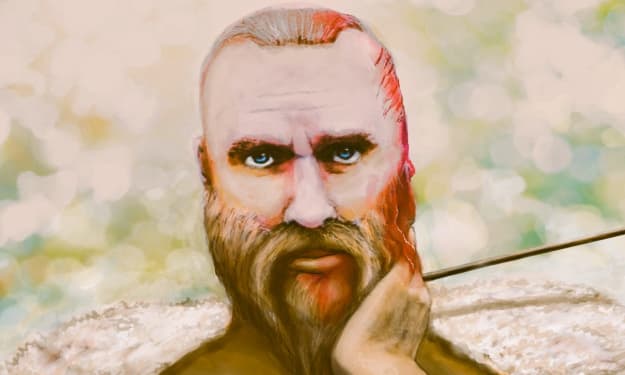
She led him to Adnan's room. The pandit sat serene behind a low table, sketching a chart from an ephemeris, his beard and calm eyes reminding Ivan of Alyosha Karamazov if Alyosha had traded the monastery for a side business in cosmic repairs.
"How are you, brother?"
"Good."
Adnan glanced up. "Get rid of this mask."
Ivan peeled it off, feeling naked.
Seashells clattered across the table like dice in a condemned man's game. "Cradle them, think of your problem, shake, drop." Wind moaned outside, a low continuous note. Adnan studied the fall and then Ivan's hand. "Your native planet--very good. This hand is a very good hand. Any place you go, you can eat--no problem. Education line: very big education. But medium education ruins your life--no success. One woman sends black magic, attacking your stomach inside. Who is this woman?"
"Somebody in my family," Ivan said, thinking of his aunt.
Adnan banged his fist. "True. Remove it, you'll be happy. If not--day by day, bugs sleeping in your bed. Prayers cost one thousand seven hundred ten dollars."
Ivan's throat tightened. "I have eighty in cash--" He sat rigid in the chair, the small room pressing in around him like the walls of a confessional that offered no absolution.
The pandit's voice moved with the calm certainty of a man who had long ago ceased to question the machinery of fate.
"Slowly slowly arrange money. Try E-transfer."
Adnan slid the paper across the table. His finger tapped once, twice, a quiet command. "Put your hand here. Say your name three times, then your mother's."
Ivan obeyed, palm flat against the cheap sheet, murmuring the syllables--his own name, then hers--like a prayer he no longer believed in. The words tasted metallic.
"Write your full name," Adnan continued, "your mommy's name, your date of birth, your mommy's date of birth, your problems. Write me your address and phone number, your signature. Write today's date. Write the money. How much can you pay today?"
Ivan's throat worked. "Five hundred... I've never done e-transfers."
"Slowly, slowly." Adnan began folding the paper, tucking the colorful powder inside with deliberate care, as though sealing a wound rather than a curse. "Did you drink the water?"
"I have my own bottle. I could transfer from Savings into Checking."
"Today, can you try--$1000?"
Ivan stared at the folded packet. His savings account held the last frail threads of security he possessed. "Should I transfer $1600?"
"Okay."
"There has to be a name."
"Yad Adnan."
"I-A-D--"
Adnan lifted his phone, spoke his own name into Google Translate, and tilted the screen so Ivan could see the correct spelling glow in neat letters. A small, absurd courtesy in the midst of cosmic bargaining.
The iPhone rang again. Adnan answered without apology.
"Hello?"
"Hello." A woman's voice, thin and frayed, came through the speaker.
"I can help you."
"I'm calling to remove... Would you be able to do it, or... How much would be the cost?"
"My consultation is forty dollar. I'll remove everything. What problem? Relationship problem?"
"Yeah, 'cause I don't want to keep crying. Let's face it, that's why I want to know the price on the phone..."
"Where are you living?"
"Lambquitok."
"I can help you with everything. When will you come meet me?"
"I need to know your price for the treatment because the consultation is not gonna be changing my life, right?"
"Give me five minutes. Okay? I'm talking to clients."
Adnan ended the call with a gentle press of the thumb, as though closing the lid on someone else's small tragedy. He turned back to Ivan.
"Where do you work?"
"Hameln Hospital."
The pandit nodded once, gravely, as though the name of the place confirmed some hidden diagnosis. He lifted a wand--feathers tied to a thin stick, ridiculous and sacred at once--and passed it slowly over Ivan's head. The motion stirred the air between them. Then the chanting began, rapid, unbroken, a river of sound pouring from his throat:
"Gurur Brahmā Gurur Vishnur Gurur devo Maheshvarah. Guruh sakshat... jai ram... dūram... Kaali... Om devi."
The syllables wrapped around Ivan like smoke. He felt them settle into his clothes, into the creases of his skin, into the hollow place beneath his ribs where hope had once lodged and long since rotted away, but not completely.
Adnan pressed the folded paper into Ivan's hand. It was warm, almost alive.
"Take it to your house. Put it inside any T-shirt, fold it, put in a drawer in your personal room. I'm sending energy."
Ivan closed his fingers around it. The paper crinkled softly, a sound like dry leaves underfoot. He rose, legs unsteady, and walked out past the Telugu film still playing its impossible happiness in the next room, past the untouched glass of spiced* water, past the woman who watched him go without a word.
Outside, the sleet had thickened into something closer to snow. Ivan stood on the step for a long moment, clutching the packet to his chest. Sixteen hundred dollars gone--more than he could afford. He thought of Varun's scarred back and arms, the way they had held him without ever truly holding, and the ache in his stomach and pelvis sharpened, as though the black magic Adnan had named was already tightening its grip.
He started walking. The streetlights flickered above him, weak and yellow, like candles burning in a wind that refused to die. Somewhere far off, a dog barked once, then fell silent. Ivan kept moving, one foot after the other, carrying the folded promise while doing his best to restrain his barely conscious doubts, to suppress his subconscious fear that no energy--divine or otherwise--was coming to save him.
Ivan left, the lightness in his chest almost comical--a man lighter by sixteen hundred dollars and a promise.
*Kumkum / vermilion (sindoor) [a red ritual powder used in blessings and protective rites], or turmeric mixed with lime, or a pinch of ritual pigment used for offerings
About the Creator
ANTICHRIST SUPERSTAR
"A look around us at this moment shows what the regression of bourgeois society into barbarism means. This world war is a regression into barbarism. The triumph of imperialism leads to the annihilation of civilization." (Rosa Luxemburg)
Keep reading
More stories from ANTICHRIST SUPERSTAR and writers in Chapters and other communities.
PYRAMIDS OF PARANOIA (Chapter 2)
He stopped reading, overwhelmed by the grotesque, simplistic hatred being spewed on every page. What was this place? What had he walked into? He glanced up at the other students, their faces emotionless, absorbed in their hateful readings as though they were the gospel truth.
By ANTICHRIST SUPERSTARabout a year ago in Chapters
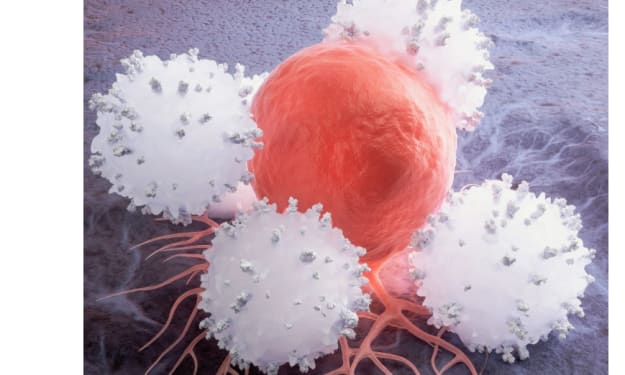
Coffee may eventually turn cancer treatments on and off.
Without thinking twice, the majority of us reach for coffee. Scientists are now transforming that well-known shock into something even more accurate: a switch that can regulate gene editing within living cells.
By Francis Damiabout 21 hours ago in Chapters
Pearl
1980 something. we all hung out at Pearl and you and i were nothing special, or so i thought. i mean we all danced, drenched in our own sweat, our own saline solution of fear, too many beers, shots, laughter, tears, fucks in the bathroom and i don't know when we began to be afraid. do you?
By ROCK aka Andrea Polla (Simmons)5 days ago in Fiction


Comments
There are no comments for this story
Be the first to respond and start the conversation.