
The First Hours of World War III
How Regional Wars, Artificial Intelligence, and Nuclear Powers Could Ignite a Conflict Humanity Cannot Control

The First Hours of World War III
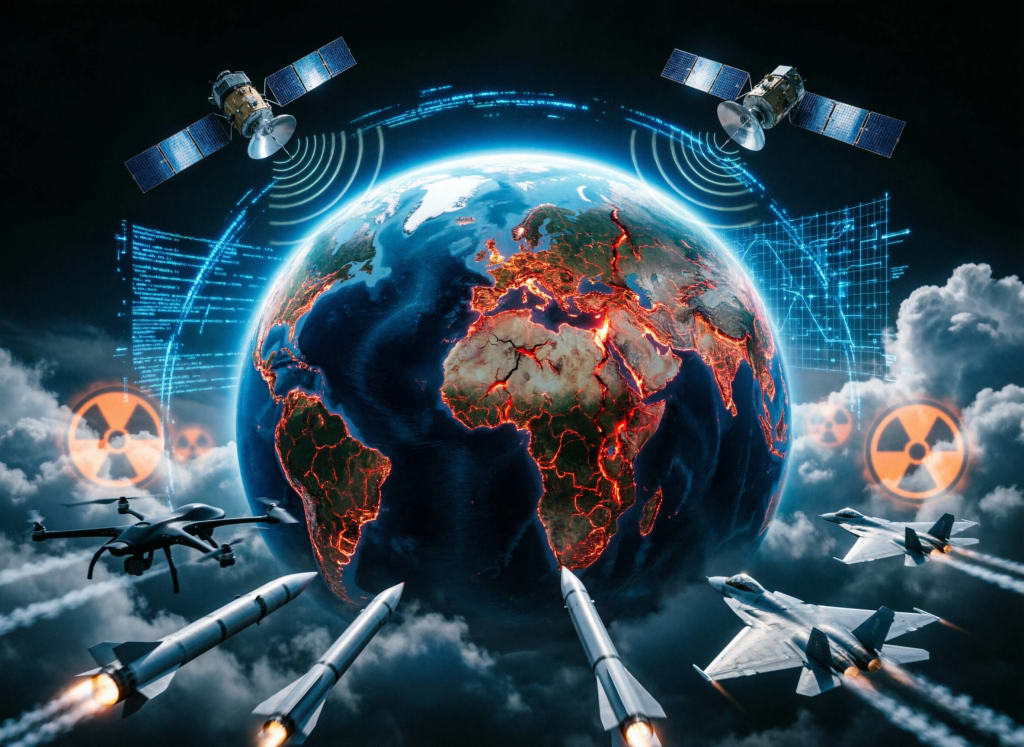
World War III will not begin with a formal declaration, a single invasion, or a dramatic announcement on television. If it comes, it will begin quietly—through alerts, miscalculations, automated systems, and decisions made under extreme pressure. The early hours of a global war will feel confusing, fragmented, and unreal, long before the world understands what has happened.
Today’s conflicts are no longer isolated. Regional wars are tightly woven into global power structures. When tensions rise in one region, alliances activate elsewhere. A missile launched in one country can trigger radar alarms thousands of kilometers away. A cyberattack on financial systems can paralyze markets across continents within minutes. In this environment, escalation does not require intent—only momentum.
The modern battlefield is no longer limited to land, sea, and air. It now includes cyberspace, artificial intelligence, satellite networks, and financial systems. Militaries increasingly rely on AI-assisted threat detection, automated targeting, and rapid-response command systems. These technologies are designed to react faster than humans ever could—but speed also removes time for judgment, reflection, and restraint.
Imagine the opening hours. A regional conflict intensifies overnight. Drones swarm contested airspace. Missiles are intercepted, but debris falls on civilian infrastructure. Cyber units disrupt communications, causing blackouts and confusion. Social media floods with unverified footage, panic spreads faster than facts, and governments struggle to control the narrative.
At the same time, early-warning systems across nuclear-armed states move to higher alert levels. Satellites detect unusual activity. Algorithms flag potential threats. Military commanders are forced to interpret incomplete data under immense pressure. In such moments, the difference between a drill, a false alarm, and an actual attack can be dangerously thin.
History has already shown how close the world has come to disaster through misunderstandings alone. In a future shaped by AI, the margin for error becomes even smaller. Automated systems do not feel fear—but they also do not feel doubt. If fed flawed data, they can recommend catastrophic responses with perfect confidence.
Another dangerous factor is alliance obligation. When one major power enters a conflict, others feel compelled to respond—not always because they want war, but because credibility, deterrence, and survival are at stake. A failure to act may be interpreted as weakness. Action, however, may provoke retaliation. This spiral is how regional wars become global.
Economic warfare will unfold alongside military conflict. Global trade routes will be disrupted. Energy prices will spike. Stock markets may crash within hours. Sanctions, asset freezes, and currency shocks will hit civilians far faster than soldiers. For millions of people, World War III would begin not with bombs, but with empty shelves, frozen bank accounts, and loss of livelihoods.
Civilian populations will be caught between information warfare and physical danger. Deepfake videos, AI-generated speeches, and manipulated footage will blur the line between truth and deception. Trust in institutions will erode rapidly. In the fog of digital war, even peace signals may be dismissed as traps.
The greatest danger is not malice—it is compression of time. Decisions that once took days now take minutes. Leaders may have only seconds to choose between restraint and escalation. In such moments, systems designed to protect nations could instead accelerate catastrophe.
World War III, if it begins, will not feel like history books describe. There will be no clear front lines, no immediate understanding of scale, and no sense of control. It will feel like the world slipping into chaos through a series of small, irreversible steps.
The question facing humanity is not whether war technology will advance—it already has. The question is whether wisdom, restraint, and international cooperation can advance faster than the machines we have built. Because once the first hours pass, control may no longer be in human hands.
About the Creator
Wings of Time
I'm Wings of Time—a storyteller from Swat, Pakistan. I write immersive, researched tales of war, aviation, and history that bring the past roaring back to life
Keep reading
More stories from Wings of Time and writers in Chapters and other communities.
How World War III Could Begin in Our Time
The First Sparks: How World War III Could Begin in Our Time World War III may not start with a single declaration or one massive attack. Instead, it could begin quietly, through a series of connected crises, misunderstandings, and power struggles already happening today. The world is more connected than ever, but that connection also makes global conflict easier to spread.
By Wings of Time a day ago in Chapters
The Guardian Chapter V
Alexander left his Coming of Age ceremony with Cronos and the elders with as many new questions as he had answers for his old questions. Cronos had confirmed his suspicions were correct. Not only was there a link between the Beast Masters and the inhabitants of the Citadel, but it was the Citadel's fault that the Beast Masters existed in the first place. Instead of banishing the law breakers which allowed them to wreak havoc on the rest of humanity, the Citadel elders should have stripped them of their powers before they became too strong. Now Alexander would need to battle the Beast Masters and the Jikininki. It would be difficult for him to forgive the Citadel Elders because their poor decisions led to the deaths of his parents and more than half the planet's human population.
By Mark Gagnon16 days ago in Chapters


Comments
There are no comments for this story
Be the first to respond and start the conversation.