
What impact could the death of Iran's Supreme Leader have on the Muslim world?
Iran Politics Islamic Revolutionary Guard Corps Hezbollah Global Security International Relations Political Analysis War and Conflict World News Shia Islam Foreign Policy Proxy Warfare Regional Instability

Following the killing of Iran’s Supreme Leader Ayatollah Ali Khamenei in US and Israeli attacks, Iranian President Masoud Pezeshkian said in a message that “this great crime will be answered” and that “with all our strength and determination, and with the support of the Muslim Ummah and the free people of the world, we will make those responsible for this great crime regret their actions.”
Pezeshkian said that Khamenei had led “the front of Islam with wisdom and insight” for 37 years and that after his martyrdom Iran would go through a difficult period.
The 86-year-old Khamenei was Iran’s Supreme Leader, but he also had a large number of followers among the Shia community in Pakistan and many other countries.
In Iraq, Pakistan, Syria and other Muslim countries, Shia Muslims are often seen carrying Khamenei’s pictures during rallies.
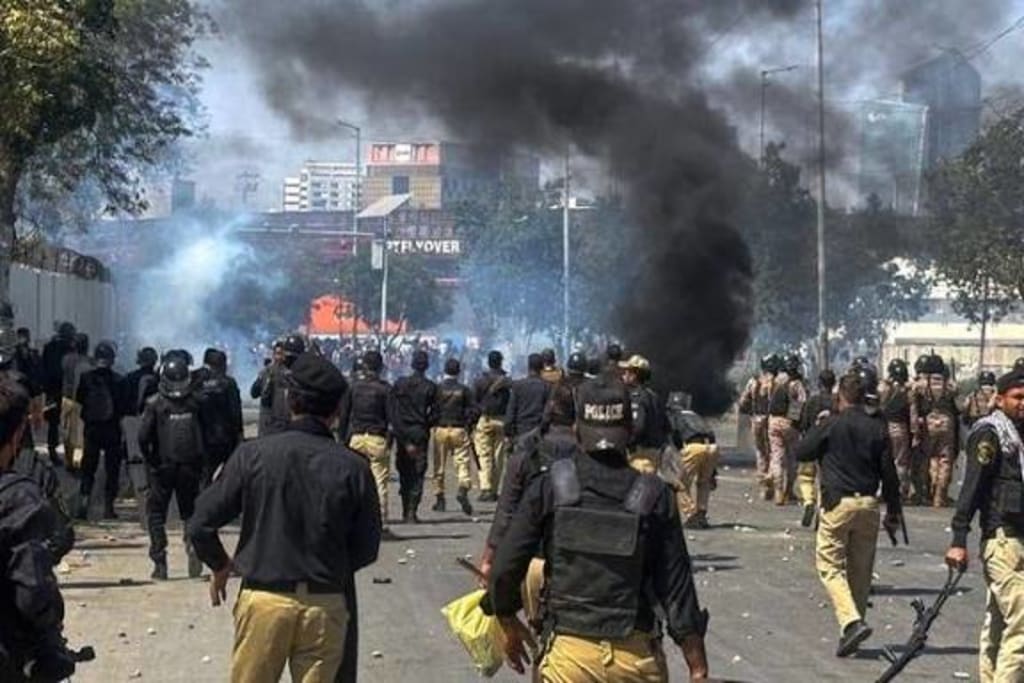
On Sunday in Pakistan, firing broke out outside the US Consulate in Karachi when protesters breached the outer security perimeter, entered the premises and carried out vandalism, resulting in nine deaths. In addition, during violent protests in Gilgit-Baltistan, United Nations offices and other properties were set on fire.
This raises the question: what impact will Khamenei’s death in US and Israeli attacks have on the world?
In the past, during periods of tension between Iran and Israel, groups such as Hezbollah, the Houthi rebels, and similar organizations in the Middle East supported Tehran. However, over the past two years, these groups have suffered heavy losses in military operations by the United States and Israel.
Dr. Kamran Bokhari, Senior Director at the New Lines Institute in the United States and a close observer of Middle Eastern politics, believes that Khamenei’s death could pose risks to the US and its allies.
He said, “However, it depends on what capabilities the Islamic Revolutionary Guard Corps and its Quds Force now have, and how much strength their proxies in other countries still possess.”
“In recent months, we have seen Israel eliminate the entire central leadership of Hezbollah, the government of Bashar al-Assad fall in Syria, and Iran was unable to do anything to help them.”
He believes that Shia Muslims around the world will certainly mourn Khamenei’s death, but in countries like Iraq, Lebanon and Syria, the number of followers of Ayatollah Sistani is greater than those of Iran’s Supreme Leader, “and they do not favor clerics entering politics.”
Other analysts closely watching the Middle East share similar views to Dr. Bokhari.
Simon Wolfgang Fuchs, Associate Professor of Islam in South Asia and the Middle East at the Hebrew University, says, “There is a possibility that Hezbollah may stop being a silent spectator in this situation, or that Iraqi armed groups may begin attacking US forces in Iraq or elsewhere.”
However, he believes that since October 2023, Hezbollah and other groups have weakened and can no longer significantly disrupt the balance of power.
According to him, “Some segments of the Muslim world support Khamenei’s anti-imperialist stance, but I do not think they will shed tears over his death—especially those who have suffered from Iranian intervention in Syria, Lebanon, and Gulf countries.”
What Impact Will Khamenei’s Death Have on the Iranian Government?
Observers believe that Khamenei’s death will not completely collapse Iran’s current system of government, but “it will never be the same again.”
Dr. Kamran Bokhari says, “The Supreme Leader was the central pillar of this system. However, he had been ill for several years and relied heavily on the Revolutionary Guards or the Iranian military to run state affairs.”
Dr. Bokhari believes that the Revolutionary Guards are now less powerful than in the past.
He said, “Khamenei’s death marks the end of an era. The current system will not immediately be dismantled, but changes will certainly come.”
US President Donald Trump has already indicated what kind of system he would like to see in Iran.
Announcing the killing of Iran’s Supreme Leader, he said, “We are hearing that many members of the Revolutionary Guards and other security and police forces no longer want to fight and are seeking forgiveness from us.”
President Trump also expressed hope that Iranian security forces would join “patriotic citizens” to restore the country to greatness.
During his lifetime, Khamenei consistently viewed the West—especially the United States—with distrust, and researchers believe that change after him is inevitable.
Simon Wolfgang Fuchs says, “With Khamenei in power, there was no possibility of meaningful reforms in Iran or improved relations with the United States. But in the future, Iran’s new Supreme Leader will have the freedom to change the country’s direction.”
What Changes Could Come to Iran’s System of Governance?
Only time will tell what changes will occur in Iran’s system of government, but Khamenei’s death could certainly cause concern for other countries.
Phillip Smyth, who researches Iran-backed groups worldwide, says, “When you confront the hardline ideology of the Islamic Revolution, you cannot ignore the concept of Wilayat al-Faqih. These ideas are religious, political, and social.”
“The Revolutionary Guards know that these ideas can be used to mobilize people on multiple fronts, including sectarian ones.”
According to Smyth, the issue was that Khamenei wanted to become the leader of the entire Muslim Ummah, but he “was not truly an Ayatollah in the strict sense and ranked lower compared to Ayatollah Sistani.”
That is why, after Khomeini’s death, Iran amended its constitution to remove the requirement that the Supreme Leader must be a marja (source of emulation).
It is important to understand the concept of Wilayat al-Faqih.
Khamenei was a follower of Ayatollah Ruhollah Khomeini, under whose doctrine clerics are considered deputies of the Hidden Imam and, as experts in Islamic jurisprudence and religious sciences, a source of political authority.
Traditionally, in Shia religious and political thought, any state power established during the occultation of the Hidden Imam was often considered illegitimate. However, Ayatollah Khomeini argued the opposite—that until the reappearance of the Hidden Imam, it was not possible to abstain from government or political power. Therefore, according to him, clerics and jurists needed to step forward, take power, and reform society.
Smyth says that Iran used Wilayat al-Faqih as a tool to mobilize people and employed it politically beyond its borders.
He said, “Using this doctrine, they established Hezbollah in Lebanon; under the same framework, there are groups like Kata’ib Sayyid al-Shuhada in Iraq, and similarly Lashkar-e-Zainebiyoun in Pakistan.”
Perhaps Khamenei was not the spiritual leader of all Shia Muslims worldwide, but it cannot be denied that his death will impact the lives of his followers.
Professor Simon Wolfgang Fuchs says, “Even if people in Pakistan, India, Iraq, and Lebanon did not strictly follow his religious rulings in their daily lives, he will be remembered among his followers there as a symbol of pride and strength.”
About the Creator
Keep reading
More stories from Real content and writers in Chapters and other communities.
Karachi Violence During Anti-US Protests: 9 Killed as Pakistan Reacts to Iran Conflict Escalation
Protests are continuing in various cities across Pakistan, including Karachi and Islamabad, against the attacks by the United States and Israel on Iran and the killing of Supreme Leader Ayatollah Ali Khamenei.
By Real contenta day ago in Chapters
Valentine's Dates Over the Years
Colin grinned as Brooklyn slipped into the living room. “Is it all set?” he asked. The twenty-one year old grinned. She was in her last year of college and Colin knew that Lincoln was proud of her. Although she had been away at college, she’d eagerly helped Colin plan his surprise for Lincoln. “I’m so glad you’re finally doing this,” she said.
By Reb Kreyling18 days ago in Chapters
Tatt~Master
— Assembly Line Tatt Machine ~ Impressions to Impress — As I begin to understand more about the Tattoo Phenomenon. I've written silly, yet verbatim, dating site anecdotes in 'Frazzled.' So let me ask you: Would you be More attracted to someone slathered with tattoos, or Less?
By Jay Kantora day ago in Humor


Comments
There are no comments for this story
Be the first to respond and start the conversation.