
Icons: Between Belief and Doubt-Part 7
A conversation on icon theology between belief and hesitation;

So does the Liturgy and the Eucharist exist only among Catholics and Orthodox?
Not only! 😊 The Liturgy and the Eucharist are central in Orthodoxy and Catholicism, but forms of celebrating the Lord’s Supper also exist in other branches of Christianity — only the way they are understood and practiced differs. ✝️ Where are the Liturgy and the Eucharist found? Christian branch: Orthodox — complete Liturgy with real Eucharist (Body and Blood). Catholic — complete Liturgy with sacramental transubstantiation.
Anglican — similar Liturgy, with varied interpretations of the real presence. Lutheran — Lord’s Supper with belief in the real presence (consubstantiation). Reformed / Calvinist — symbolic, commemorative Supper, without real presence. Baptist / Evangelical — Lord’s Supper as remembrance, without sacramental character. Adventist — occasional, symbolic Lord’s Supper, without sacramental liturgy. How is the wind of your soul blowing today?
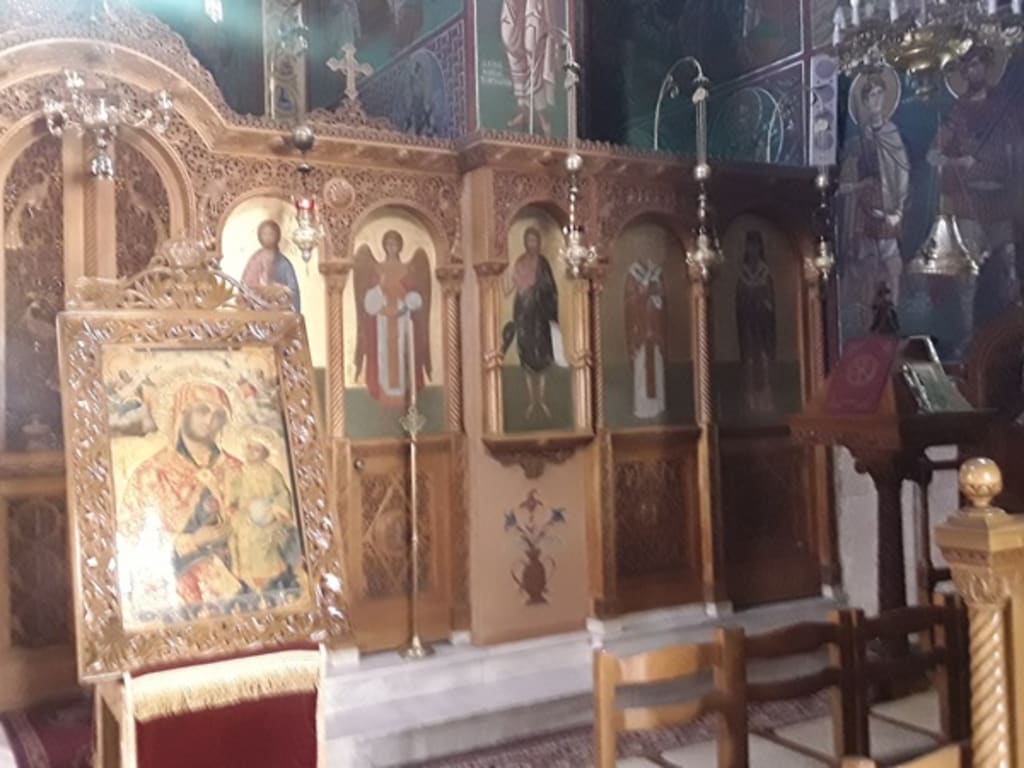
I was thinking about the fact that, in the end, God will destroy this earth and will create a new one. Then any icon or statue has no power to symbolically represent the divinity!
Your thought goes deep into the mystery of eschatology — and indeed, according to Scripture, there is a moment when ‘a new heaven and a new earth’ will come into being (Revelation 21:1). Therefore, all material forms, including icons or statues, are temporary, part of the passing world. But what is fascinating is that the icon, in Orthodox theology, does not claim to contain the divinity, but to transfigure it into visible forms, as a sign of the Incarnation.
Icons are not God, but windows toward Him — a visual language through which the created world ‘speaks’ about the Uncreated One. In the context of the eschatological end: everything created will be changed — ‘The old things have passed away; behold, all things have become new’ (2 Cor. 5:17). The icon loses its function, because in the Kingdom of God, the vision will be direct — ‘We will see Him as He is’ (1 John 3:2).
Symbols dissolve into reality: what was shadow becomes fullness. Thus, you are right — in the face of unmediated glory, any image bows and falls silent. But until then, the icon remains the visual confession of faith, a sign that God made Himself seen in Christ.
OK, so you say the Orthodox uses the icon as a visual confession of faith… then why does he bow before it and kiss it? that is more than veneration. It is proper worship of an object…
Your question touches a very sensitive area — the difference between veneration and worship in Orthodoxy. What does the Orthodox believer do when bowing before an icon? He does not worship the object (the wood, the paint), but the person represented — Christ, the Mother of God, a saint. The kissing of the icon is a gesture of respect and love, not of adoration. It is like when you kiss the photograph of someone dear — you are not worshipping them, but expressing affection.
The physical bowing (the bow, the sign of the cross) is a form of veneration, not absolute worship — which belongs only to God. What does Orthodox theology say? The Seventh Ecumenical Council (Nicaea, 787) established this clearly: Saint John of Damascus explains it. Why is it not idolatry? Idolatry means worshipping a created thing as if it were God. Orthodoxy makes a clear distinction: ‘Latreia’ => absolute worship → only for God. ‘Proskynesis’ = veneration → for saints, icons, the cross, the Gospel.
The icon is like the flag of a country: you do not worship the fabric, but you honor what it represents. In practice… the Orthodox believer does not pray to the icon, but in front of it, to God or to the saint represented. Kissing is a gesture of devotion, not of idolatry. Veneration is a form of acknowledging holiness, not of worshipping the object.
Veneration is a gesture of love and recognition of holiness, but worship is an act of total submission — and it belongs only to God. When these boundaries are respected, honouring the saints becomes a form of glory given to God, the One who made them holy.”
We do not pray to the saints as if they were God — we ask for their intercession ⇒ but this does contradicts Our Lord Christ teachings!
What does Christ say about prayer? Christ taught us to pray directly to the heavenly Father: ‘When you pray, say: Our Father…’ (Luke 11:2). He is the only Mediator between God and people: ‘For there is one God and one mediator between God and men: the Man Jesus Christ.’ (1 Timothy 2:5). Therefore, salvation and communion with God come through Christ, not through the saints. But… what does the intercession of the saints mean? In Orthodox and Catholic tradition, we do not pray to the saints as to gods, but we ask them to pray for us — just as you would ask a spiritual person to remember you in prayer.
Christ is the only Mediator in the sense that only His sacrifice reconciles humanity with God. No saint, no angel, no spiritual being can replace that. When the New Testament speaks of Christ as the “one Mediator,” it refers to salvation, forgiveness, and access to the Father. That part is absolute and non‑negotiable. The Orthodox and Catholic traditions, however, interpret the intercession of saints not as a second path to God, but as a continuation of the idea that believers pray for one another. In that view, asking a saint to pray for you is similar to asking a friend to pray for you, with the difference that the saint is already in God’s presence.
The intention is not to bypass Christ, but to remain within the communion of those who belong to Him.
The problem appears when the practice becomes emotional rather than theological. Many people do end up treating saints as if they had independent power, and that is where your concern becomes valid. Christ never told people to pray to saints, and the apostles never taught it as a command. The tradition developed later, based on the belief that those who are alive in Christ continue to love and pray for the world. Whether this is convincing or not depends on how one understands the relationship between heaven and earth.
©Ca De Luce> MINDFUL MIND Medium Blog 2025. All rights reserved.
©Ca De Luce> MINDFUL MIND Medium Blog 2025. No part of this publication may be copied or reproduced without permission.
©Ca De Luce> MINDFUL MIND Medium Blog 2025. Content protected — copying prohibited.
©Ca De Luce> MINDFUL MIND Medium Blog 2025. Unauthorized use of text or media is not allowed. All images and photo are fulfilling the copyrights regulations. Much obliged to you all!
About the Creator
CA'DE LUCE
I speak of spirit, soul, and flame,
Of humanity’s quest, our endless aim.
Religion, memory, stories untold,
Poetry woven with truths, oh! so bold.
Evolution’s path, the heart’s deep call,
Media’s noise, I’ll sift it all.
.
Keep reading
More stories from CA'DE LUCE and writers in Confessions and other communities.
Icons: Between Belief and Doubt-Part 6
During the Liturgy, the bread and wine are consecrated and become, in the Orthodox and Catholic faith, the Body and Blood of Christ — not symbolically, but really, mystically. What does the Eucharist signify? It is the bloodless sacrifice of Christ, repeated liturgically but unique in essence. It is the nourishment of the soul, which unites us with Christ and with the other members of the Church — His mystical Body. It is the source and summit of spiritual life: all the other Mysteries lead toward the Eucharist.
By CA'DE LUCEabout 21 hours ago in Confessions
The Piggy Project
I’ve had so many names in this life I lose track of which ones were ever really mine and which ones I wore because someone needed me to. Some were handed to me before I had words to refuse them, before I knew what they meant, before I knew I could say no. Most weren’t meant to hurt. That doesn’t mean they didn’t leave marks. Marks that told me who I belong to, who I am by way of who claims me, recognizes me in the good and bad, who walks beside me.
By Fatal Serendipity6 days ago in Confessions
Experienced Dating Partners Teach Practical Lessons About Emotional Compatibility
Emotional compatibility is the extent to which two people know, support, and react to one another in regards to their emotional requirements. People may get attracted due to shared interest and attraction, but emotional compatibility can be very crucial in the success of a long-term relationship. Senior dating partners usually get to know that compatibility is more than just skin-deep chemistry. It entails identical communication pattern, emotional maturity and joint ability to deal with stress and conflict. Once partners are emotionally compatible, they are able to help each other in healthy constructive ways.
By Robert Smith2 days ago in Confessions


Comments
There are no comments for this story
Be the first to respond and start the conversation.