
Schools, Hospital, and UNESCO Sites Damaged in US-Israel Strikes
New satellite imagery and verified videos show widespread destruction in residential areas, hospitals, and public buildings.

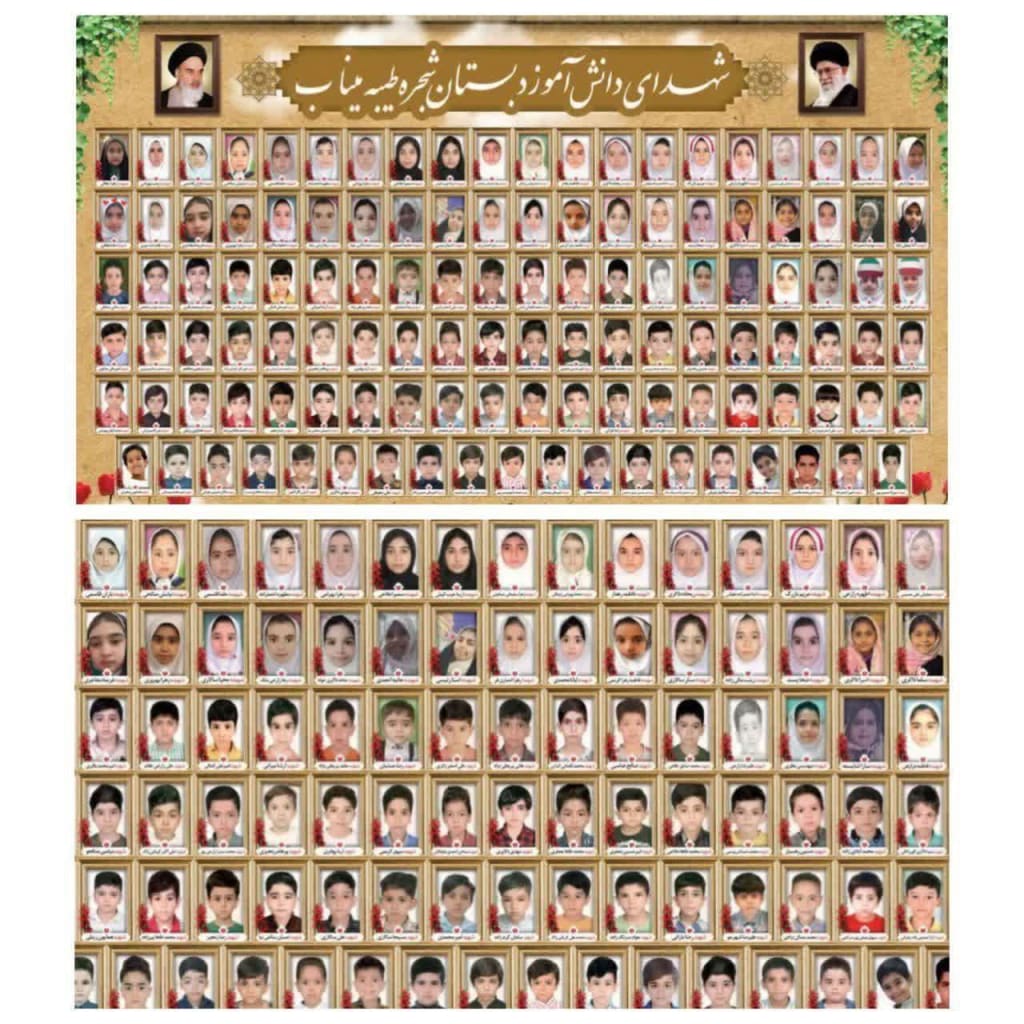
Satellite images and verified videos show that since the start of U.S. and Israeli attacks on Iran on Saturday, schools, a hospital, and historical monuments have suffered severe damage, while reports indicate that the number of civilian casualties continues to rise.
According to the U.S.-based Human Rights Activists News Agency (HRANA), 1,168 civilians have been killed, including 194 children.
Due to the Iranian authorities imposing an almost complete internet shutdown, it has become very difficult to communicate with people inside Iran and to access videos.
However, residents of Tehran who were able to connect to the internet say that Thursday night was the most intense night of bombing in the capital and the most terrifying night of the war so far. Because of the intensity of the attacks, many people stayed awake all night.
One person described the night as “hell on earth.”
Israel and the United States reportedly targeted a hospital, sports facilities, a UNESCO World Heritage site, and two schools, one of which, according to Iranian authorities, saw 168 people killed on Saturday morning.
Iran says 13 medical centers were targeted, 9 of which belonged to the Red Crescent.
Verified images also show damage to another school building in the northwestern Iranian region of Urmia.
Among other buildings destroyed since the attacks began is Tehran’s Gandhi Hospital, which was targeted on Sunday.
A verified video from the hospital shows the building heavily damaged, with civilians seen watching debris and shattered glass falling.
A spokesperson for Iran’s Foreign Ministry called such attacks a “clear war crime.” Meanwhile, World Health Organization Director-General Dr. Tedros Adhanom Ghebreyesus said the incident was “extremely concerning.”
Images taken immediately after the attack show the area covered in rubble, with patients including a baby in an incubator being taken out of the hospital.
Mohammad Raiszadeh, head of Iran’s Medical System Organization, told state media that the hospital’s in vitro fertilization (IVF) department was destroyed in the attack.
Images taken after the strike show flames rising in a staircase-like pattern and thick columns of black smoke rising from the upper floors. Photos taken inside the building show broken windows and damaged interior walls.
The Israeli military acknowledged that a nearby “military facility” was the target and said the hospital sustained “minor damage.”
The hospital is located opposite the studios and offices of the Islamic Republic of Iran Broadcasting (IRIB), which may have been the intended target of the strike.
An aerial map of Gandhi Hospital and the surrounding area shows the site before (left) and after (right) the attack, highlighting a television broadcasting tower (marked in yellow) that was destroyed.
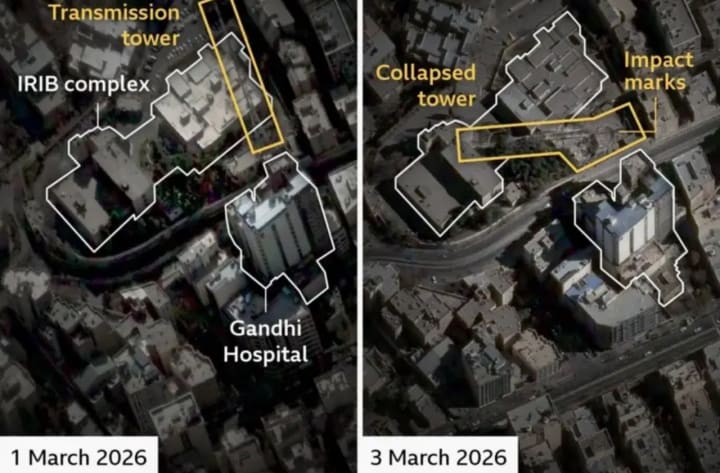
Satellite images recorded on March 3 show that a television broadcasting tower within the Iranian Broadcasting Corporation compound had collapsed, along with visible signs of the strike.
The front section of the hospital where videos show the most extensive damage is not visible in the satellite imagery.
Describing the effects of the bombings, a Tehran resident said that “the constant sound of explosions is exhausting” and drains a person’s energy.
Another person explained how destabilizing the attacks have been for vulnerable people in Iran. He said:
“My uncle has a mental illness. The poor man convinced himself that he had died.”
Elsewhere, in the southern coastal city of Lamerd, Iranian state media reported that 20 people were killed in an explosion at a sports hall on Saturday.
A video taken shortly afterward shows extensive damage to the building, with burn marks visible on the walls and smoke slowly rising from outside the structure.
Other images show damage to buildings less than 300 meters away, suggesting that multiple strikes occurred in the area.
In the city, a base of the Islamic Revolutionary Guard Corps (IRGC) is located north of the sports hall. The base is separated from the hall by a wall. The low-resolution satellite images available do not show any clear damage to the base.
Photos taken on March 2 in the city center show a large funeral published by Tasnim News Agency, with hundreds of people carrying pictures of the deceased and former Iranian Supreme Leader Ali Khamenei.
The footage ends with a wide shot of mourners bowing their heads before at least 18 coffins draped in the flag of the Islamic Republic of Iran.
In Tehran, at least three sports complexes were heavily damaged after Thursday’s attacks. Among them is the 12,000-seat Azadi Sports Complex, which images show is close to being destroyed.
Israel’s Foreign Ministry said the building was being used as a “rest facility” for Iranian forces.
Similar scenes of destruction were seen in other parts of the city, including Beit and Ismaili Stadium.
Commercial businesses, including shops and stores across the country, have also been targeted.
Verified videos show a café in central Tehran severely damaged, with the owner seen walking around the ruins looking extremely distressed.
The café may have been damaged by a strike on a police station across the street, which was completely destroyed.
In Tehran’s historic center, an old bazaar and a UNESCO World Heritage-listed palace were also damaged.
A verified video on Monday shows broken glass and burned walls inside the Grand Bazaar, a vast and complex network of centuries-old shops and chambers.
Images of Golestan Palace, a former royal residence and one of the oldest buildings in the Iranian capital, show extensive damage.
Photos broadcast by Iranian state media on Tuesday show shattered glass scattered across the palace grounds, with damage to the exterior and its heavy wooden doors.
Both the palace and the bazaar are located near the complex where Iran’s judiciary and Supreme Court are situated, which also sustained heavy damage.
UNESCO said the building was damaged due to a strike on nearby Arg Square, where the judicial complex is located.
The organization added that it has provided the locations of all World Heritage sites to all parties, reminding them that “cultural property is protected under international law.”
A resident of Tehran said the city had become a “ghost town.” The streets are empty and the smell of gunpowder fills the air.
Another person referred to the recent violent crackdowns in the country and said:
“The fear of war is better than the fear of the Islamic Republic.”
The United Nations refugee agency said on Wednesday that around 100,000 people fled Tehran within the first 48 hours of the attacks.
The organization added that between 1,000 and 2,000 cars leave the city every day, most heading toward the northern regions of the country.
Dr. Michael Becker, Associate Professor of Law at Trinity College Dublin, said that deliberate attacks on civilian areas are illegal under international law unless they are being used for military purposes.
“We have seen Israel bombing civilians in Gaza, and the same Israel has deliberately bombed civilians in Iran as well.”
According to the monitoring group NetBlocks, an almost complete internet blackout across the country remains in place, meaning only limited information is emerging from inside Iran.
“We have noticed that after the internet shutdown in Iran, a large wave of user-generated content usually does not appear because people either found a way to post it when it was necessary, deleted it for their own safety, or chose to ignore it.”
About the Creator
Keep reading
More stories from Real content and writers in Criminal and other communities.
The True Fight against Crime Begins in the Human Conscience
Every society searches for ways to fight crime through laws, institutions, and systems of justice. Yet one essential truth is often overlooked: the real battle against crime begins long before a courtroom or a police investigation.
By A.Petrovski3 days ago in Criminal



Comments
There are no comments for this story
Be the first to respond and start the conversation.