
The Knock That Wasn’t Meant for Him
One wrong door. One mistaken identity. A lifetime of scars.

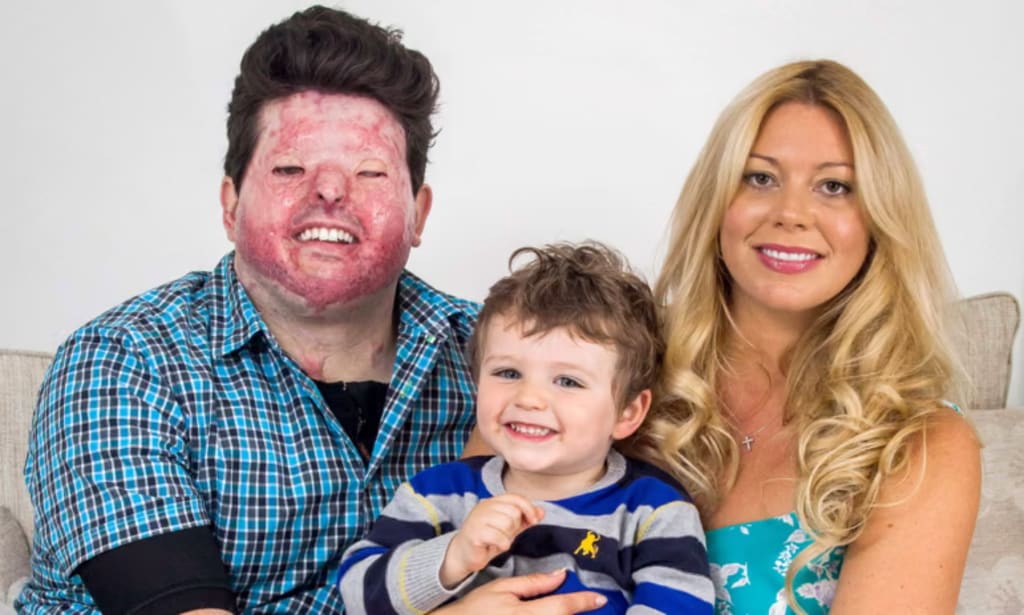
December 2014. Truro, England...
It was a quiet afternoon, the kind that carries no warning or danger sign
A knock sounded at the door.
Forty-eight-year-old Andreas Christopheros wasn’t expecting anything unusual. Maybe a delivery. Maybe a neighbor. Something ordinary.
He walked toward the door without hesitation.
That’s how life changes sometimes - not with a dramatic buildup, but with a familiar sound you’ve heard a thousand times before.
When he opened it, a stranger stood there holding a container.
There was no time to process what he was seeing. No time to question why.
The liquid came flying toward his face.
It wasn’t water.
It wasn’t paint.
It was sulphuric acid.
His shirt didn’t just burn, it disappeared.
His skin didn’t just blister, it melted.
Sulphuric acid doesn’t behave like fire. It doesn’t flare and fade. It eats. It dissolves. It continues destroying tissue even after the initial impact.
As Andreas screamed, the attacker reportedly muttered, “This is for you, mate.”
But it wasn’t.
It wasn’t for him.
The men who came to that address were looking for someone else. They had the wrong house. The wrong door. The wrong man.
And yet, the innocent person who answered still became the one who would carry the scars.
Doctors doubted he would survive the night.
The burns were catastrophic. Much of his face was destroyed. His eyelids were lost. His nose and ears severely damaged. His vision permanently affected.
But Andreas survived.
What followed was not recovery in the simple sense of the word. It was reconstruction.
Over the years, surgeons rebuilt around 90% of his face using skin grafts from his legs, scalp, and neck. He underwent dozens of operations. His eyelids have had to be reconstructed multiple times due to scar tissue complications.
The physical pain was relentless.
But there is another kind of pain that doesn’t show up in medical charts.
When your face changes, your relationship with the world changes.
Strangers stare.
Children look confused.
Conversations shift.
Your reflection in the mirror becomes someone you must learn again.
Facial identity is deeply tied to recognition. It is how we move through society. Losing it is not just a medical trauma it is an existential one.
There are two survivals in stories like this.
The first is surviving the attack.
The second is surviving everything after.
The surgeries.
The isolation.
The psychological weight.
The daily awareness of being visibly altered because of someone else’s violence.
Many people would choose to disappear from public life.
Andreas did not.
He has spoken openly about what happened. He has allowed the world to see him not because it is easy, but because silence would let the violence define the story.
That decision matters.
It reframes him not as a victim frozen in tragedy, but as a man who continues to live forward.
There is something deeply unsettling about mistaken identity crimes.
We tell ourselves that the world makes sense and that actions connect to consequences, that wrongdoing has direction.
But randomness disturbs us.
Because randomness means it could have been anyone.
It could have been a different door.
A different afternoon.
A different life altered forever.
If the attackers had knocked next door, this would be someone else’s story.
Instead, it is his.
Courage doesn’t always look heroic.
Sometimes it looks like attending another surgery.
Sometimes it looks like walking outside despite knowing people will stare.
Sometimes it looks like waking up each day and choosing not to let bitterness take root.
Andreas Christopheros did not deserve what happened to him.
But every day since, he has chosen not to let that moment be the final chapter.
That is a different kind of strength; the quiet, ongoing kind.
We scroll past headlines quickly: acid attack, mistaken identity, survivor.
But behind those words is a human being who opened his door expecting nothing extraordinary.
Just an ordinary afternoon.
And in one irreversible second, everything changed.
The question that lingers is not just about violence.
It’s about randomness.
About how fragile normalcy really is.
And about how, sometimes, the greatest courage is simply refusing to let someone else’s darkness erase your future.
If stories of survival and human resilience stay with you long after you finish reading, this is one of them.
What unsettles you more; the violence itself, or the fact that it was never meant for him?
Let me know your thoughts.
About the Creator
Lori A. A.
Psychological analysis | Identity & human behavior | Reflection over sensationalism
Keep reading
More stories from Lori A. A. and writers in Criminal and other communities.
The First Nazi Concentration Camp
The Nazi Concentration Camps were one of the worst things to have ever happened in human history. In my opinion, they come only second to the nuclear weapon that was used on the Japanese City of Hiroshima. These are ‘incidents’ that will never be forgotten (or be allowed to be forgotten) within the “History Book” of humankind.
By Ruth Elizabeth Stiffa day ago in Criminal


Comments
There are no comments for this story
Be the first to respond and start the conversation.