
Air Pollution Linked to Declining Arctic Ice
New research suggests that pollution particles from industrial regions may be accelerating the melting of Arctic sea ice, highlighting the global reach of environmental challenges.

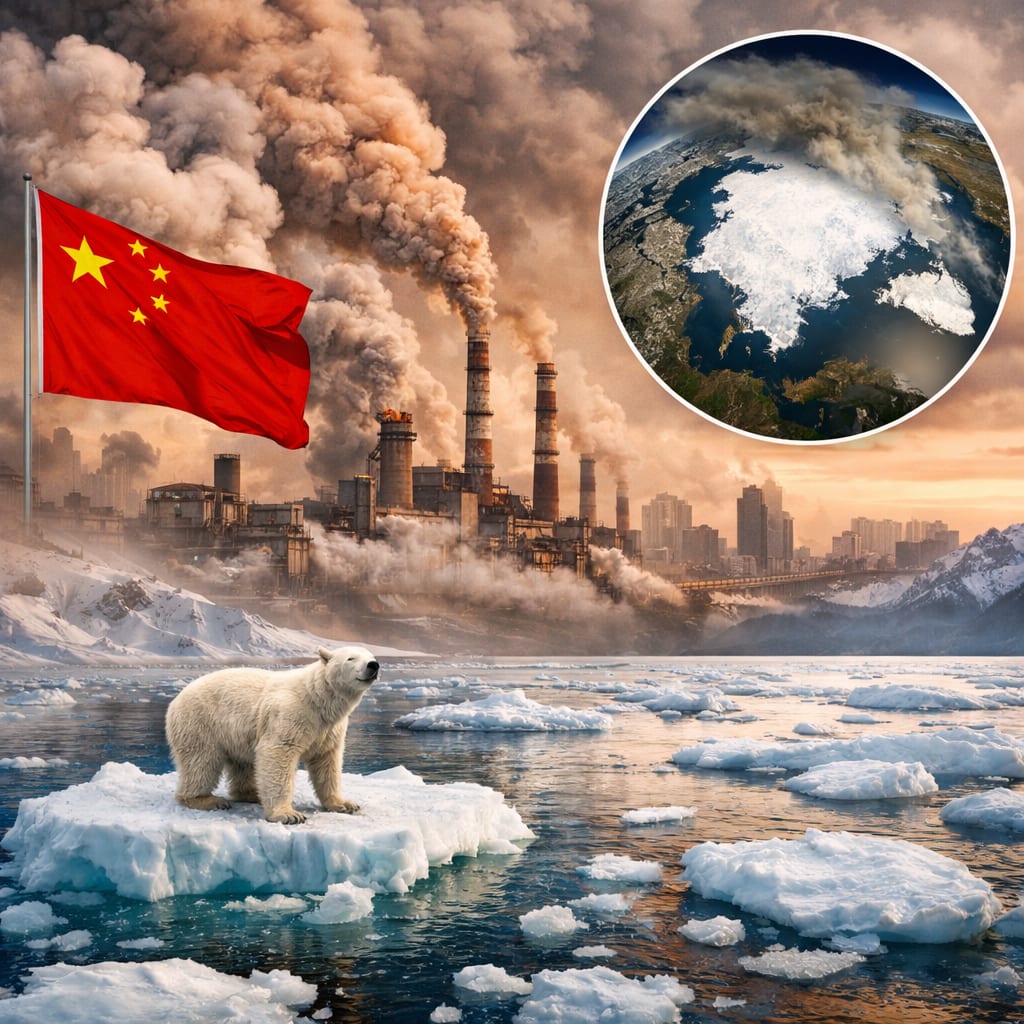
Air pollution has long been considered a major threat to human health and ecosystems around the world. However, new scientific findings suggest that its effects extend far beyond the regions where pollution is produced. Recent research indicates that air pollution from industrialized areas, particularly in China, may be contributing to the loss of sea ice in the Arctic. This connection highlights how environmental problems in one part of the world can have serious consequences thousands of kilometers away.
Scientists have been studying the rapid decline of Arctic sea ice for decades. While rising global temperatures caused by climate change remain the primary factor, researchers have increasingly focused on the role of airborne pollutants. Tiny particles released by factories, vehicles, and coal-burning power plants can travel long distances through the atmosphere. When these particles eventually settle on snow and ice in the Arctic, they can significantly accelerate melting.
One of the most important pollutants linked to this process is black carbon, commonly known as soot. Black carbon is produced when fossil fuels, biomass, and coal are burned incompletely. In heavily industrialized regions, including parts of China, black carbon emissions are particularly high. Once released into the atmosphere, these particles can remain suspended for days or even weeks, allowing winds to carry them across continents and oceans.
When black carbon reaches the Arctic, it settles on the bright white surface of snow and ice. Normally, these surfaces reflect a large portion of sunlight back into space, a process known as the “albedo effect.” However, when dark particles such as soot cover the surface, they reduce this reflectivity. As a result, the snow and ice absorb more solar radiation, causing temperatures at the surface to rise and the ice to melt more quickly.
Researchers have used climate models and atmospheric tracking systems to study how pollution travels from East Asia to the Arctic. Their findings show that air currents can transport pollutants from industrial regions in China across the Pacific Ocean and toward the polar region. During certain seasons, particularly in late winter and early spring, these atmospheric pathways become even stronger, allowing larger amounts of pollution to reach the Arctic.
The impact of this process is significant because the Arctic is warming at a much faster rate than the rest of the planet. Scientists estimate that the region is heating up nearly four times faster than the global average. The loss of sea ice not only affects wildlife such as polar bears, seals, and walruses but also influences global weather patterns. Arctic ice plays a critical role in regulating the Earth’s climate by reflecting sunlight and stabilizing ocean currents.
As sea ice continues to shrink, darker ocean water is exposed, which absorbs more heat than ice. This creates a feedback loop: warmer water leads to more melting, which in turn exposes even more ocean surface. Pollution particles that accelerate the initial melting can therefore amplify this already dangerous cycle.
The issue also highlights the global nature of environmental responsibility. While China is one of the world’s largest sources of industrial emissions due to its large manufacturing sector, pollution from many other regions—including Europe, North America, and parts of South Asia—can also reach the Arctic. Scientists emphasize that the melting of Arctic ice cannot be attributed to a single country but rather to the cumulative impact of emissions worldwide.
In recent years, China has taken steps to reduce certain types of air pollution by implementing stricter emissions standards, promoting renewable energy, and closing older coal-fired power plants. These measures have already led to improvements in air quality in several major cities. However, experts say continued efforts are needed, not only in China but globally, to reduce pollutants that contribute to climate change and Arctic warming.
International cooperation will be essential to address the issue. Environmental agreements and collaborative research programs are helping scientists better understand how pollution moves through the atmosphere and how it affects remote ecosystems like the Arctic. By improving monitoring systems and reducing emissions of black carbon and other pollutants, governments may be able to slow the loss of Arctic ice.
Ultimately, the link between air pollution and Arctic melting serves as a reminder that the Earth’s climate system is deeply interconnected. Actions taken in one region can have far-reaching effects on environments thousands of kilometers away. As scientists continue to uncover these connections, the need for coordinated global action to protect the planet becomes increasingly clear.
About the Creator
Irshad Abbasi
Ali ibn Abi Talib (RA) said 📚
“Knowledge is better than wealth, because knowledge protects you, while you have to protect wealth.
Keep reading
More stories from Irshad Abbasi and writers in Earth and other communities.
A Green Solution to Urban Pollution
Air pollution has become one of the most serious environmental challenges facing modern cities. Rapid industrialization, increasing vehicle emissions, and expanding urban populations have significantly degraded air quality around the world. Polluted air not only harms ecosystems but also poses severe health risks to humans, contributing to respiratory diseases, heart conditions, and reduced life expectancy. Among the many strategies proposed to combat this problem, planting and preserving trees stands out as one of the most natural, cost-effective, and sustainable solutions.
By Irshad Abbasi about 7 hours ago in Earth
Nuclear Transmutation: The Accidental Dream of Making Gold
Picture a laboratory humming with quiet intensity, banks of instruments blinking in the low light, and somewhere inside a shielded reactor chamber, something almost magical is happening. An element is changing. One thing is becoming another. What was mercury is now, atom by atom, becoming gold.
By CurlsAndCommas4 days ago in Earth


Comments
There are no comments for this story
Be the first to respond and start the conversation.