
Climate Change: The Defining Challenge of Our Time
Understanding the causes, impacts, and global response to a rapidly changing planet.

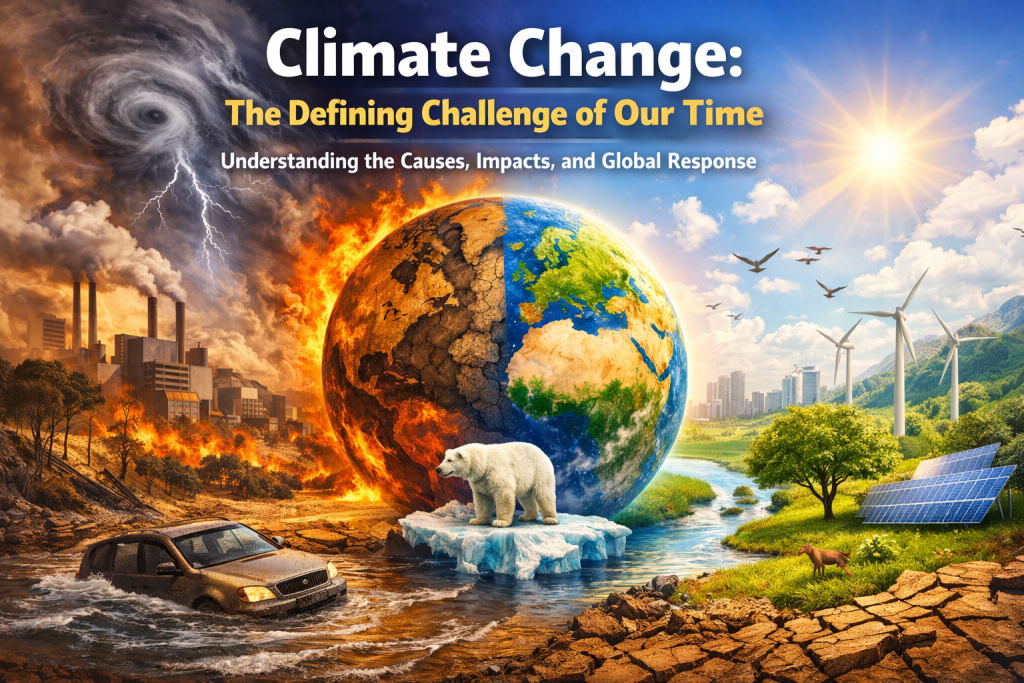
Climate change is one of the most pressing issues facing humanity in the 21st century. It refers to long-term changes in Earth’s temperature, weather patterns, and climate systems. While the planet’s climate has naturally changed throughout history, the changes observed today are occurring much faster and are largely caused by human activities. Scientists around the world warn that if these changes continue unchecked, they could have severe consequences for ecosystems, economies, and societies.
At its core, climate change is driven by the increase of greenhouse gases in the Earth’s atmosphere. Greenhouse gases such as carbon dioxide, methane, and nitrous oxide trap heat from the sun and prevent it from escaping back into space. This natural process, known as the greenhouse effect, keeps the planet warm enough to sustain life. However, human activities—especially since the Industrial Revolution—have significantly increased the concentration of these gases in the atmosphere, intensifying the greenhouse effect and leading to global warming.
One of the main contributors to climate change is the burning of fossil fuels. Coal, oil, and natural gas are widely used to produce electricity, power vehicles, and fuel industries. When these fuels are burned, they release large amounts of carbon dioxide into the atmosphere. Deforestation is another major factor. Trees naturally absorb carbon dioxide and help regulate the climate, but large-scale logging and land clearing reduce the number of trees available to perform this vital function. As forests disappear, more carbon dioxide remains in the atmosphere, accelerating climate change.
The impacts of climate change are already visible across the globe. One of the most noticeable effects is the increase in global temperatures. Over the past century, the average temperature of the Earth has risen significantly. This warming has led to the melting of glaciers and polar ice caps, contributing to rising sea levels. Coastal communities around the world are increasingly at risk of flooding and erosion as the oceans slowly expand.
Climate change is also linked to more extreme weather events. Hurricanes, heatwaves, droughts, and heavy rainfall events are becoming more frequent and more intense in many parts of the world. These disasters can destroy homes, damage infrastructure, and threaten food and water supplies. Farmers, in particular, face major challenges as shifting weather patterns disrupt growing seasons and reduce crop yields.
Another serious consequence of climate change is its impact on biodiversity. Many plant and animal species struggle to adapt to rapidly changing environmental conditions. Some species migrate to cooler regions, while others face extinction because they cannot survive in the new climate. Coral reefs, which support a vast range of marine life, are especially vulnerable to warming ocean temperatures and ocean acidification.
Human health is also affected by climate change. Rising temperatures can increase the spread of certain diseases carried by insects, such as mosquitoes. Heatwaves pose serious risks, especially for elderly people and vulnerable communities. In addition, air pollution associated with fossil fuel use contributes to respiratory and cardiovascular diseases.
Despite these challenges, there is growing global awareness and action to address climate change. Governments, organizations, and individuals are working to reduce greenhouse gas emissions and transition to cleaner sources of energy. Renewable energy technologies such as solar power, wind energy, and hydroelectric power are becoming more common and affordable. These energy sources produce little or no greenhouse gases, making them an important part of the solution.
International cooperation is also crucial in the fight against climate change. Agreements such as the Paris Agreement on Climate Change aim to bring countries together to limit global temperature rise and reduce emissions. Under this agreement, nations commit to taking steps to cut greenhouse gases and support sustainable development.
Individuals can also play an important role in addressing climate change. Simple actions such as conserving energy, using public transportation, reducing waste, and planting trees can collectively make a significant difference. Education and awareness are key to encouraging more sustainable lifestyles and protecting the planet for future generations.
In conclusion, climate change is a complex and urgent global challenge that affects every part of the world. Its causes are closely tied to human activity, but its solutions also lie in human innovation, cooperation, and responsibility. By reducing emissions, protecting natural ecosystems, and embracing sustainable technologies, humanity can work toward a healthier and more stable planet. The choices made today will shape the future of Earth for generations to come.
About the Creator
Irshad Abbasi
Ali ibn Abi Talib (RA) said 📚
“Knowledge is better than wealth, because knowledge protects you, while you have to protect wealth.
Keep reading
More stories from Irshad Abbasi and writers in Earth and other communities.
The Sky Adorned with Stars: Nature’s Most Beautiful Crown
On a clear night, when the lights of cities fade and the air grows still, the sky reveals one of nature’s most breathtaking sights — a vast canvas filled with shining stars. The phrase “the sky adorned with stars” perfectly captures the beauty of this moment, as if the heavens themselves are wearing a glittering crown. For thousands of years, humans have gazed upward in awe, wondering about the countless lights scattered across the darkness.
By Irshad Abbasi a day ago in Earth
Amid European Energy Fears, Coal Creeps Back Into Favour
Europe’s energy landscape is shifting as fears over supply security and rising costs drive some countries back toward coal, a fossil fuel many had hoped to phase out entirely. The resurgence comes amid heightened tensions over energy imports, particularly natural gas, as the war in Ukraine and geopolitical friction with Russia have exposed vulnerabilities in the continent’s energy systems. Germany, long seen as a leader in renewable energy adoption, recently announced plans to keep several coal-fired power plants online longer than initially scheduled. Officials cited winter energy demands and the need to maintain a reliable baseload while natural gas supplies remain constrained. Similar considerations are emerging in Poland, the Czech Republic, and other nations that rely heavily on imported energy. “The energy crisis has forced governments to make difficult choices,” said Dr. Klaus Weber, an energy policy analyst at European Energy Institute. “While the climate goals remain important, ensuring citizens have access to electricity and heat this winter has become a more immediate priority.” The return to coal is not simply a response to price spikes. Energy security has become a pressing concern after European reliance on Russian gas pipelines was disrupted, prompting countries to diversify sources and store reserves. Coal, abundant in Europe and globally traded at competitive prices, provides a short-term buffer against shortages. At the same time, rising electricity costs have placed enormous pressure on households and industries. According to recent statistics from the International Energy Agency, European electricity prices surged by nearly 40% in the past year, prompting governments to subsidize energy bills and rethink fuel strategies. Coal-fired generation, though more polluting, offers predictable output and can be ramped up quickly to stabilize grids. Renewable energy advocates have expressed concern that this shift could undermine Europe’s climate leadership. Coal emits roughly twice the CO₂ per unit of energy compared to natural gas, posing challenges to achieving net-zero targets. Critics warn that extending coal use—even temporarily—risks locking in infrastructure that is inconsistent with long-term decarbonization goals. “Every megawatt-hour produced from coal is a step backward for Europe’s climate ambitions,” said Maria López, senior campaigner at Greenpeace Europe. “Governments need to pair any temporary measures with accelerated renewable deployment to avoid backsliding on emissions reductions.” Some nations are attempting to balance these pressures by deploying cleaner coal technologies. Advanced coal plants with carbon capture and storage (CCS) can reduce emissions by capturing a significant portion of CO₂ before it enters the atmosphere. Germany and the Netherlands are investing in pilot projects to integrate CCS into existing power plants, though critics note that large-scale implementation remains costly and complex. Analysts suggest that Europe’s return to coal is likely to be temporary. Once gas supplies stabilize and renewable infrastructure expands, reliance on coal is expected to decline. Yet the episode has highlighted the fragility of energy systems in the face of geopolitical shocks and the tension between short-term energy security and long-term climate goals. Meanwhile, citizens and businesses are feeling the immediate impact. Many households in Eastern and Central Europe face sharply higher heating costs this winter, and industrial manufacturers are warning that energy-intensive production could be scaled back if prices remain high. Policymakers are caught between the urgent need to maintain supply and the imperative to meet climate commitments. The European Union is working on strategies to mitigate these challenges. Measures include expanding LNG import terminals, investing in cross-border electricity interconnectors, and boosting renewable energy capacity. However, the gap between energy supply and demand, exacerbated by geopolitical tensions, means coal may remain a stopgap solution for months to come. Europe’s cautious return to coal underscores a broader reality: energy transitions are never linear. Even as governments and citizens push toward a greener future, external shocks—conflict, supply disruptions, and price volatility—can temporarily alter priorities. The key challenge for policymakers will be ensuring that short-term reliance on fossil fuels does not derail long-term climate ambitions.
By Fiaz Ahmed 2 days ago in Earth
The Politics of Playing Dress-Up
Well, to start off I'd like to say a happy world book day to all who celebrate. I know I haven't really posted anything on my socials about it but I'm not a jubilant kind of person. I lay low most of the time. Let's start off with a popular anecdote from the vaults...
By Annie Kapur4 days ago in Geeks



Comments
There are no comments for this story
Be the first to respond and start the conversation.