
Human Revenge: A Hidden Cause Behind the Decline of Snow Leopards
Across the high mountains of Asia, conflict between humans and wildlife is pushing the elusive snow leopard closer to danger.

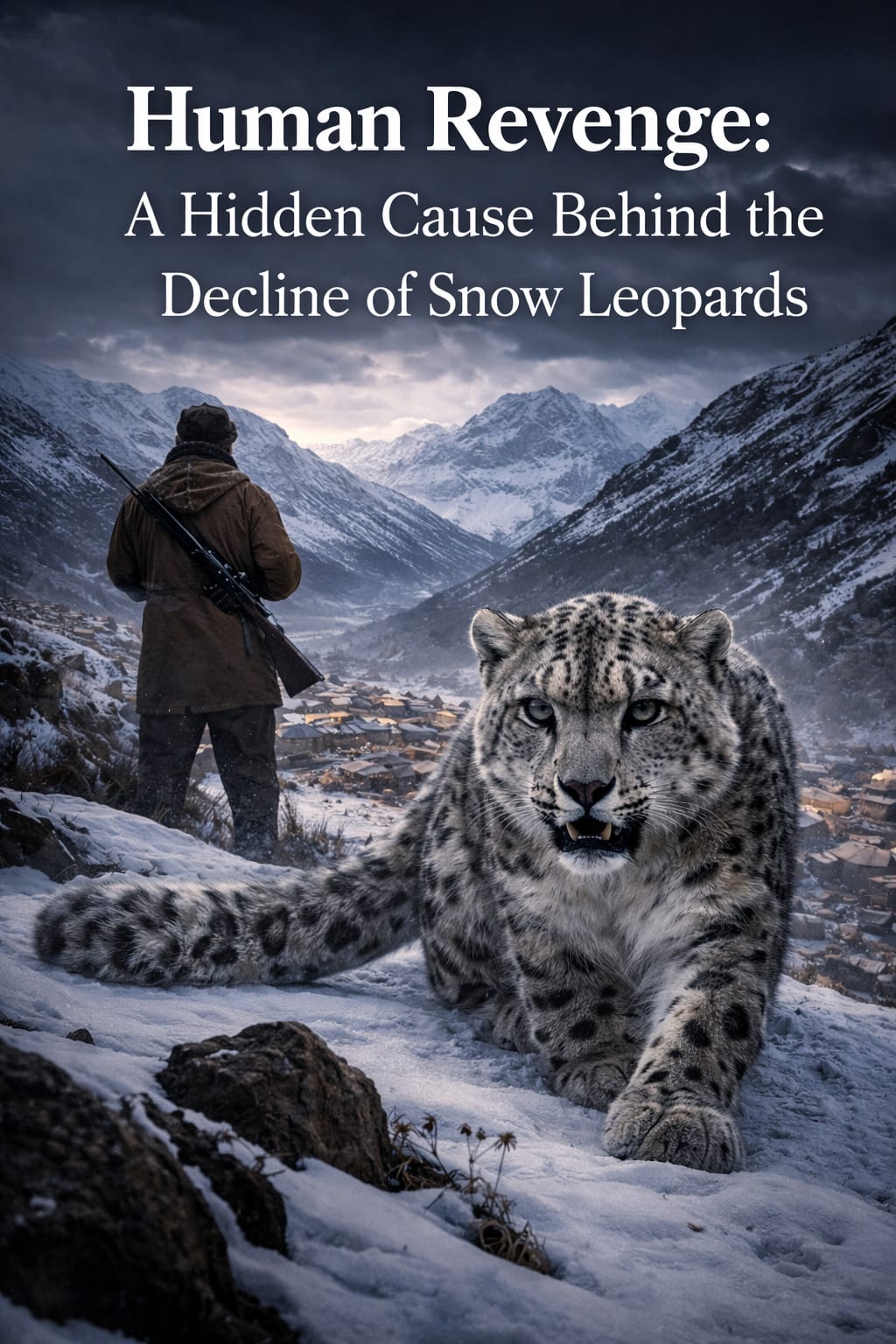
High in the rugged mountains of Central and South Asia lives one of the world’s most mysterious and beautiful big cats—the snow leopard. Known for its thick grey-white fur, long tail, and incredible ability to blend into rocky landscapes, this elusive predator has fascinated scientists and wildlife lovers for decades. Yet despite its beauty and ecological importance, the snow leopard faces a growing threat: human revenge.
Snow leopards inhabit remote mountain regions across twelve countries, including Pakistan, India, China, Nepal, and Mongolia. These cats are perfectly adapted to harsh environments, living at elevations between 3,000 and 5,500 meters where few other large predators can survive. Their main prey includes wild animals such as ibex, blue sheep, and mountain goats. However, as human populations expand deeper into mountain regions, encounters between snow leopards and local communities are becoming more frequent.
One of the biggest causes of snow leopard decline is retaliation by livestock herders. Many communities living in mountainous areas depend heavily on animals such as sheep, goats, and yaks for their livelihoods. When a snow leopard attacks and kills livestock, it can represent a serious financial loss for a family that may already be living in poverty. In response, some herders kill the predator responsible in what they see as an act of revenge or protection.
This human-wildlife conflict has become a significant conservation challenge. A single snow leopard may occasionally kill several animals in one attack, especially if livestock are kept in poorly protected enclosures at night. Such incidents can cause anger and frustration among herders, leading them to hunt or poison the cat. Although snow leopards are protected by law in many countries, enforcement in remote mountainous areas can be difficult.
Another factor intensifying this conflict is the decline of natural prey. Overhunting of wild animals by humans has reduced populations of species that snow leopards normally hunt. When wild prey becomes scarce, snow leopards may turn to easier targets—domestic livestock. This increases the chances of confrontation with humans and often leads to deadly consequences for the predator.
Climate change is also affecting snow leopard habitats. Rising temperatures are altering fragile mountain ecosystems, pushing tree lines higher and changing the distribution of vegetation and prey species. These environmental changes can force snow leopards to move into new areas where they are more likely to encounter humans and their animals.
Despite these challenges, conservationists around the world are working to protect the snow leopard and reduce conflict with local communities. One successful approach has been the introduction of livestock insurance programs. Under these schemes, herders contribute small amounts of money to a community fund. If a snow leopard kills livestock, the owner receives compensation from the fund. This reduces the motivation to kill the predator in revenge.
Improved livestock protection has also proven effective. Many conservation organizations help communities build stronger night-time enclosures known as predator-proof corrals. These structures use stronger materials and secure roofs to prevent snow leopards from entering. In areas where such corrals have been introduced, livestock losses have decreased significantly.
Education and community involvement are also key components of conservation efforts. By raising awareness about the ecological role of snow leopards, conservation groups aim to encourage local people to see the animal not as an enemy but as a valuable part of their natural heritage. In some regions, snow leopard tourism has even provided new income opportunities for communities, giving them a financial incentive to protect the species.
Globally, scientists estimate that only around 4,000 to 6,500 snow leopards remain in the wild. Because these animals live in remote and difficult-to-access areas, exact population numbers are difficult to determine. However, experts agree that human conflict remains one of the most serious threats to their survival.
The story of the snow leopard highlights a broader challenge in wildlife conservation: finding a balance between protecting endangered animals and supporting the livelihoods of local people. For mountain communities, livestock often represents survival. For conservationists, preserving species like the snow leopard is essential for maintaining healthy ecosystems.
Ultimately, the future of the snow leopard depends on cooperation between governments, conservation organizations, and local communities. By reducing human-wildlife conflict and creating systems that benefit both people and nature, it may still be possible to ensure that this magnificent “ghost of the mountains” continues to roam the high peaks of Asia for generations to come.
About the Creator
Irshad Abbasi
Ali ibn Abi Talib (RA) said 📚
“Knowledge is better than wealth, because knowledge protects you, while you have to protect wealth.
Keep reading
More stories from Irshad Abbasi and writers in Earth and other communities.
Life at the Top of the World: Glimpses of the North Pole
The North Pole is one of the most remote and mysterious places on Earth. Located at the northernmost point of the planet, it lies in the middle of the Arctic Ocean, surrounded by thick sheets of drifting sea ice. Temperatures here can fall far below freezing for most of the year, and for months at a time the region is plunged into darkness during the long polar night. Despite these harsh conditions, the North Pole and the surrounding Arctic region are home to a surprising variety of life. These glimpses of life in one of the world’s most extreme environments reveal the resilience of nature and the delicate balance of Arctic ecosystems.
By Irshad Abbasi about 6 hours ago in Earth
The Heat We Inherited
Long before satellites circled the Earth and scientists measured carbon in the sky, humanity lived closely with nature, reading its moods through wind, water, and fire. The changing of seasons guided harvests. The rhythm of rain shaped survival. Today, however, that rhythm is faltering. The planet’s climate—once steady enough to nurture civilizations—is shifting in ways both subtle and catastrophic. Global warming is no longer a distant warning whispered by experts; it is the defining story of our era.
By LUNA EDITH6 days ago in Earth


Comments
There are no comments for this story
Be the first to respond and start the conversation.