
The Three Stages of Charcoal Production Evolution
From Traditional Kilns to Modern Machines
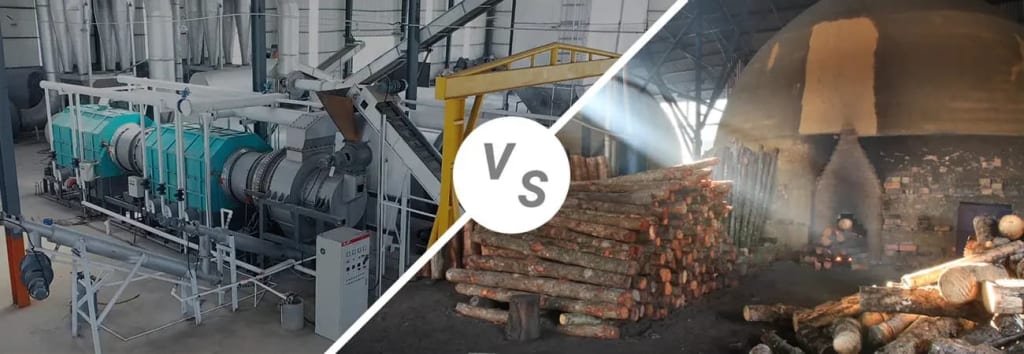
Charcoal production has come a long way from its humble beginnings, evolving through three major stages—from primitive methods to modern industrial processes. Let’s dive into how charcoal production has advanced and the technology that’s shaping its future.
A. Traditional Earth Mound Kilns
The earliest method of charcoal production involved simple Earth Mound Kilns. This technique is considered the traditional "wood-burning" approach where logs were stacked into large piles on the ground and covered with a layer of earth, leaving small ventilation holes for airflow.
Drawbacks:
While it was effective in its time, this method had significant limitations. The efficiency was low, with only about 5-10 pounds of wood producing one pound of charcoal. Furthermore, this technique resulted in considerable pollution, as all the volatile byproducts, including wood tar and wood vinegar, were released directly into the atmosphere.
While it remained a common method for centuries, the environmental impact and low yield of this approach eventually led to the development of more efficient and cleaner alternatives.
B. Mechanical Kilns / Batch Carbonization Furnaces
With the industrial revolution came Mechanical Kilns, or Batch Carbonization Furnaces. These kilns are made of steel, offering better sealing properties than their earthen predecessors, allowing for more controlled carbonization.
Improvements:
One of the major advancements with this method was the ability to collect by-products. With the addition of condensers, it became possible to recover valuable substances such as wood vinegar (a natural deodorizer and pesticide) and wood tar (an important industrial raw material). This marked a significant step forward in charcoal production, making the process more resource-efficient and environmentally responsible.
While batch kilns were more effective than traditional methods, they still had limitations in terms of scale and efficiency. The need for larger-scale production and continuous output drove further innovation in the industry.
C. Continuous Carbonization Machines
Enter the continuous carbonization machine—the current leading solution in the industrial charcoal production world. This modern technology is designed for high-volume, continuous production, using a conveyor-belt-like system that constantly feeds raw materials into the carbonization chamber while simultaneously producing charcoal.
Key Advantages:
The continuous carbonization machine stands out for its impressive efficiency and automation. By streamlining the production process, it can handle large quantities of wood and other biomass materials, transforming them into high-quality charcoal with minimal labor input.
Moreover, this machine can run around the clock, making it ideal for large-scale industrial applications. Its automated system ensures uniformity in production, reducing waste and improving yield.
Additional Benefits:
Higher Yield: The continuous process optimizes fuel consumption and carbonization time, ensuring that more charcoal is produced from the same amount of raw material.
Energy Efficiency: Modern carbonization machines are designed to maximize energy usage, reducing costs in the long run.
Improved Safety Features: These machines are equipped with advanced safety systems to protect both operators and the environment. Features like automatic shutdown mechanisms in case of malfunction, temperature controls, and emergency pressure relief valves ensure that the carbonization process is safe and stable. This minimizes the risk of accidents and ensures a safe working environment.
Environmental Responsibility: While producing charcoal, the continuous carbonization machine still allows for the recovery of byproducts like wood vinegar and wood tar, ensuring that valuable materials are not wasted.
Conclusion: The Future of Charcoal Production
From humble earth kilns to highly advanced continuous carbonization machines, the evolution of charcoal production reflects broader trends in industrialization, efficiency, and sustainability. Today’s continuous carbonization machine represents the pinnacle of these advancements, offering a highly effective, scalable, and environmentally friendly method for producing charcoal at an industrial level.
As demand for cleaner, more efficient production methods grows, we can expect even more innovations in the field of charcoal production. The continuous carbonization process is a testament to how far we’ve come and where we’re heading in the future of sustainable energy and industrial manufacturing.
About the Creator
This Is What I Do When People Throw Rocks At Me
Rocks have been thrown at me for a greater part of my life. Some have been small and missed hitting me. When people don't get a reaction from me, they throw bigger rocks with a better aim. Many have been hurled at me with precision over the years. For a long time, I thought my only options were to dodge them or be crushed by them.
By Margaret Minnicks5 days ago in Confessions


Comments
There are no comments for this story
Be the first to respond and start the conversation.