
How the Sun Formed from a Nebula: The Incredible Story of Our Solar System's Birth
The Sun is the center of our solar system and the primary source of energy for life on Earth. It provides light, heat, and the energy that drives weather systems, ocean currents, and plant growth. But the Sun was not always shining in the sky. Around 4.6 billion years ago, it did not exist at all. Instead, our solar system began as a vast cloud of gas and dust known as a nebula. Over millions of years, this cloud collapsed and transformed into the Sun and the planets that orbit it today. The story of how the Sun formed from a nebula is one of the most fascinating chapters in astronomy and helps scientists understand how stars and planetary systems are born throughout the universe. This article explores the complete process of how the Sun formed from a nebula and how that process eventually created the solar system we live in today.

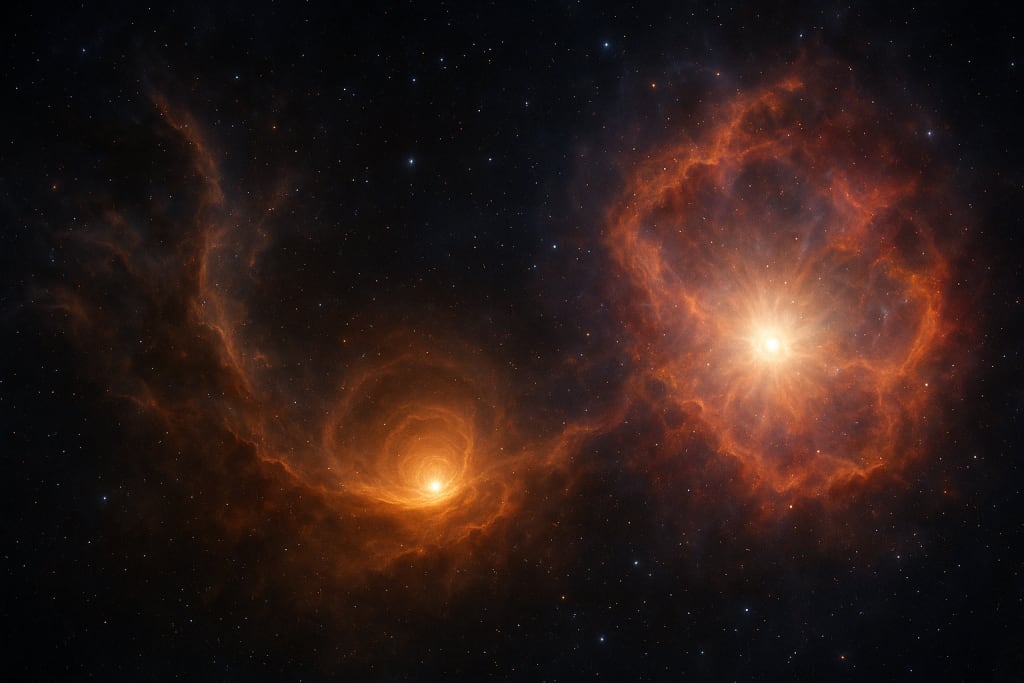
What Is a Nebula?
A nebula is a massive cloud of gas and dust that exists in space. These clouds are primarily made of hydrogen and helium, the two lightest and most abundant elements in the universe. Nebulae also contain small amounts of heavier elements and microscopic dust particles.
Nebulae are often referred to as the birthplaces of stars. Inside these enormous clouds, gravity can cause regions of gas and dust to collapse and form new stars. Some nebulae stretch across hundreds of light-years and contain enough material to create thousands of stars.
The nebula that eventually formed the Sun is called the solar nebula. Scientists believe it formed from the remnants of earlier generations of stars that exploded in powerful supernova events. These explosions scattered elements throughout space, contributing to the material that later formed our solar system.
________________________________________
The Beginning: Collapse of the Solar Nebula
The formation of the Sun began when a portion of the solar nebula started to collapse under the force of gravity. This collapse may have been triggered by a nearby supernova explosion or by gravitational disturbances within the galaxy.
As gravity pulled the gas and dust inward, the nebula began to shrink and spin faster. This happens because of a physical principle known as conservation of angular momentum. As the cloud contracted, its rotation increased, much like an ice skater spinning faster when pulling their arms inward.
Over time, the collapsing cloud flattened into a rotating disk of material. At the center of this disk, a dense region began to form. This region would eventually become the Sun.
________________________________________
Formation of a Protostar
As more gas and dust fell toward the center of the collapsing nebula, the pressure and temperature in that region increased dramatically. The growing central mass became extremely hot and dense.
At this stage, the forming star is known as a protostar. A protostar is essentially a young star that has not yet begun nuclear fusion.
The protostar continued to gather material from the surrounding disk. Gravity pulled enormous amounts of gas inward, causing the temperature in the core to rise to millions of degrees. The increasing pressure caused the protostar to glow and emit energy.
This stage lasted for several million years as the young Sun continued to accumulate mass and heat.
________________________________________
The Birth of the Sun: Nuclear Fusion Begins
Eventually, the temperature at the core of the protostar became high enough to start nuclear fusion. Nuclear fusion is the process in which hydrogen atoms combine to form helium, releasing huge amounts of energy in the process.
When nuclear fusion began in the Sun's core, the protostar officially became a true star.
This moment marked the birth of the Sun.
The energy produced by fusion generated outward pressure that balanced the inward pull of gravity. This balance, known as hydrostatic equilibrium, stabilized the Sun and allowed it to shine steadily.
Since that moment roughly 4.6 billion years ago, the Sun has continued producing energy through nuclear fusion and will likely continue doing so for another 5 billion years.
________________________________________
Formation of the Protoplanetary Disk
While the Sun was forming at the center of the nebula, the remaining material in the rotating disk did not disappear. Instead, it played a crucial role in forming the planets, moons, asteroids, and comets of our solar system.
This rotating disk of gas and dust is called a protoplanetary disk.
Within the disk, particles of dust began colliding and sticking together through electrostatic forces. Over time, these particles formed larger objects known as planetesimals.
As planetesimals grew larger, gravity helped them attract even more material. Eventually, some of these bodies became large enough to form planets.
This process led to the creation of the eight planets in our solar system, including Earth.
________________________________________
Formation of the Inner and Outer Planets
The temperature differences within the protoplanetary disk played a major role in determining the types of planets that formed.
Near the Sun, temperatures were extremely high. Only metals and rocky materials could survive in this region. As a result, the inner planets—Mercury, Venus, Earth, and Mars—formed as rocky terrestrial planets.
Farther away from the Sun, temperatures were much lower. In these outer regions, gases and ices could condense. This allowed the formation of the giant planets—Jupiter, Saturn, Uranus, and Neptune.
These outer planets grew large enough to capture huge amounts of hydrogen and helium gas, becoming gas giants and ice giants.
________________________________________
Clearing of the Solar System
After the Sun ignited and began producing strong solar winds, much of the remaining gas and dust in the solar nebula was blown away.
Solar wind is a stream of charged particles constantly emitted by the Sun. These powerful winds helped clear leftover material from the solar system, leaving behind the planets, moons, and smaller objects that had already formed.
Over time, the solar system stabilized into the structure we observe today.
________________________________________
Evidence Supporting the Solar Nebula Theory
The theory explaining how the Sun formed from a nebula is known as the Solar Nebula Theory. Several pieces of scientific evidence support this theory.
First, astronomers observe similar star-forming regions in other parts of the universe. Using powerful telescopes, scientists can see young stars forming inside nebulae surrounded by protoplanetary disks.
Second, meteorites found on Earth contain materials that date back to the earliest stages of the solar system. These ancient rocks provide clues about the conditions present during planetary formation.
Third, computer simulations of nebula collapse closely match what scientists observe in star-forming regions across the galaxy.
Together, these observations strongly support the idea that our Sun formed from a collapsing nebula.
________________________________________
The Sun Today
Today, the Sun is a stable main-sequence star located at the center of our solar system. It contains about 99.8 percent of the total mass of the solar system.
The Sun is composed primarily of hydrogen and helium and produces energy through nuclear fusion in its core. Every second, the Sun converts millions of tons of hydrogen into helium, releasing enormous amounts of energy in the process.
This energy travels through space as sunlight and solar radiation, supporting life on Earth and influencing planetary climates.
________________________________________
Why Understanding the Sun's Formation Matters
Studying how the Sun formed helps scientists answer many important questions about the universe.
First, it provides insights into how stars and planetary systems develop. Since billions of stars exist in the Milky Way galaxy alone, understanding stellar formation helps astronomers understand the structure of the universe.
Second, learning about solar system formation helps scientists search for planets around other stars. Many of these distant planetary systems likely formed through processes similar to those that created our own.
Finally, studying the Sun helps scientists predict its long-term future and understand how stellar evolution affects planetary environments.
________________________________________
Conclusion
The Sun's formation from a nebula is one of the most remarkable processes in cosmic history. Beginning as a vast cloud of gas and dust, the solar nebula collapsed under gravity, forming a protostar that eventually ignited nuclear fusion.
As the Sun was born, the surrounding disk of material formed the planets, moons, and other objects that make up our solar system today. Over billions of years, this system evolved into the dynamic environment we observe now.
Understanding how the Sun formed not only reveals the origins of our solar system but also helps scientists understand how countless other stars and planets are born across the universe.
The next time you see sunlight shining in the sky, remember that it began billions of years ago in a swirling cloud of cosmic dust—an extraordinary beginning that shaped everything we know today.
About the Creator
Keep reading
More stories from shahkar jalal and writers in Education and other communities.
Why Solar Radiation Varies: Understanding the Changing Energy from the Sun
What Is Solar Radiation? Solar radiation refers to the electromagnetic energy emitted by the Sun. This energy travels through space in the form of light, heat, and other types of radiation. When solar radiation reaches Earth, some of it is absorbed by the atmosphere, some is reflected back into space, and the rest reaches the surface.
By shahkar jalalabout 10 hours ago in Education
The Meaning Behind the Rules: What a Law Explains in Society
A law explains how people should behave within a society and what consequences may follow when they ignore those rules. Governments create laws to guide actions, protect rights, and maintain order. Because communities include people with different interests and values, clear rules help prevent conflicts and confusion. Therefore, laws serve as written standards that explain what society expects from its members.
By Juan Monteverde5 days ago in Education
Rockwell International Corp: A Legacy of Innovation in Aviation and Aerospace
The aviation and aerospace industries have evolved through the work of several pioneering manufacturers that introduced groundbreaking engineering technologies. One of the most influential companies in this field was Rockwell International, an American industrial giant that contributed significantly to aircraft manufacturing, defense systems, and space exploration.
By Beckett Dowhana day ago in Education


Comments
There are no comments for this story
Be the first to respond and start the conversation.