
I <3 Irasutoya
The website that filled in the hole clip art left in my heart

If you live in Japan, you've seen Irasutoya images everywhere. It's on posters, it's on flyers, it's on internet adverts, it's truly everywhere. You've probably seen it once or twice if you don't live in Japan. It's cute, it's simplistic and it somehow manages to get succinct points across really clearly and concisely.
I love Irasutoya and in this blog post I'm going to make you realise why I love it, what I use it for and some fun ways you can use it in your own lessons.

R.I.P. Clip Art
I used to make PowerPoint presentations for fun. I was a strange kid. I'd make them about comic book characters, about stories I wanted to write, about how to play video games properly. I even once made a whole adventure game using in-document hyperlinks.
Word was boring, excel was complicated, access confused me but I could make PowerPoint sing.
And what better way to illustrate all of these wonderful things than with Clip Art. The stock library of random, useful and sometimes downright weird pictures that Microsoft provided with office.
Then, in 2014, Microsoft cancelled Clip Art. I was crushed. I was in my second year of university at the time and although I was thinking "When was the last time I actually used Clip Art for a presentation?" I was also weirdly upset about the loss of a selection of fun images to use. Even if they weren't relevant to me, and I was beginning to prefer more cohesive design in my presentations and lesson materials, I still felt a little bit like this was a bad call on Microsoft's part.
Discovering Irasutoya
For about ten years I mostly used photos in my lesson slides. It was fine. Stock images mostly, a few I'd just found on the internet. It felt boring, it felt uninteresting it felt a little soulless.
That changed when I moved to Nagasaki and started teaching at a university.
Not immediately of course, I was still using photos for the first two or three years or so. But, as I said at the start, I was living in Japan so I was constantly seeing these cutesy cartoon characters. I had no idea what they were or what they meant but I knew they were all over the place and I knew they were popular. I assumed that you needed to buy a license or something. I didn't even know what they were called until a colleague said "Oh yeah, I see irasutoya pics everywhere,".
Well, now I had a name so I googled it and ... it was free?
It was all free?

Making My Lesson Slides
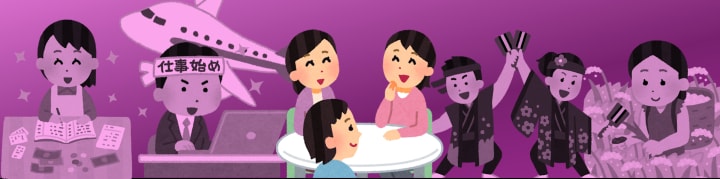
The most obvious thing to do with them was sprucing up my lesson slides. Like I said, I want to have a consistent design and all of irasutoya shares a cartoony aesthetic that helps get points across cleanly and clearly and also adds a bit of graphical interest to my slides.
The most obvious thing I use Irasutoya images for is to add consistent characters and make it clear, from a glance, what kind of slide is on screen if it's important. I'll use a teacher for lesson aims, a calendar when discussing timetables and an animal in a Rambo headband when giving homework instructions.
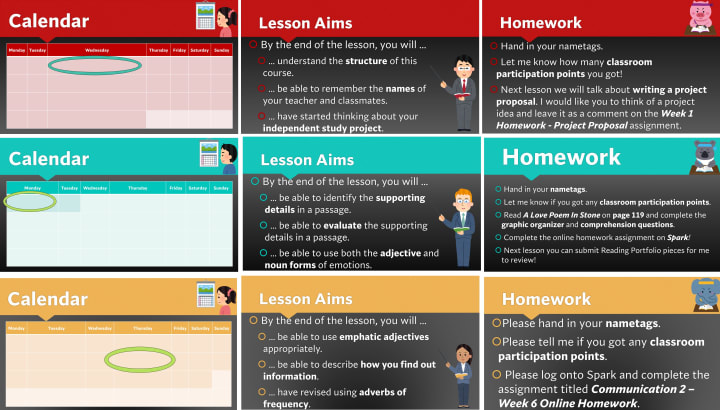
I find this is a good way to grab student's attention if their focus is lessening. They can tell this is about homework, or the next few lessons or the aims for today so they can just glimpse the slide changing and know they need to pay attention for something a little more important.
Some slides I go with almost the opposite approach. If there's a certain activity I use frequently (maybe you have a certain activity that your textbook likes to use a lot, or an in-class test) I might add a little image related to the context of the activity rather than the actual activity itself.
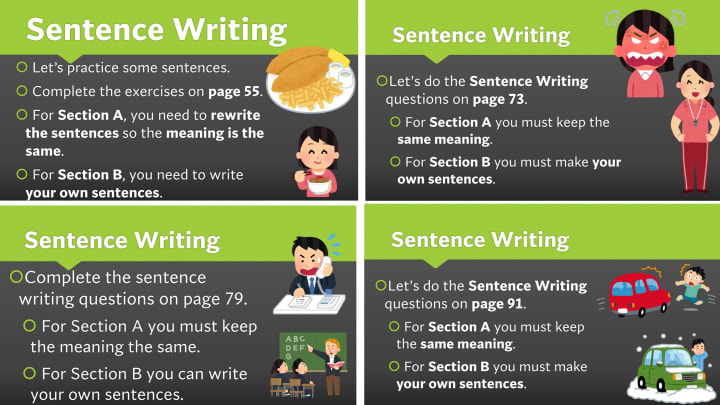
This is done less to highlight what's going on, usually I try to have every student's attention before we move on to a new task but to make the slides a little more interesting and to help get the student's thinking about the tasks in front of them from a content point of view rather than a grammatical one which I find helps them approach problems in a new direction if they struggle with grammar. It can also help "nudge" visual learners towards what the answer might be.
Some things to note ...
I learnt a couple of things from my use of Irasutoya.
Firstly, there's a lot of images. Like a lot. As well as all the stuff you'd expect like kids playing sports and smiling people in various different uniforms there were some unusual ones like a centaur and a reverse centaur doing calligraphy, the characters from Tekken, or a man opening the demon core. You will probably be able to find something to suit your purposes. If you can't you might be able to find something that ... tangentially relates to it.
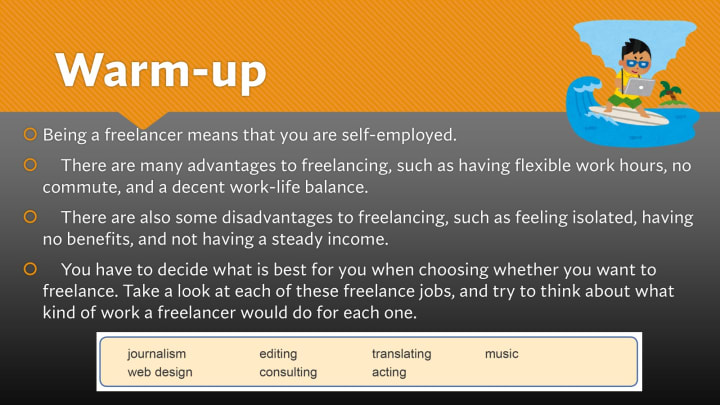
Speaking of searching, you're going to want to learn Japanese. I usually have to type something into Jisho.org to find the right word. There is an English search function but it isn't quite as good and it runs through Google making it a bit clunky and difficult to use.
It's also a Japanese website, there's a lot of good pictures for Japanese thigns such as holidays, locations or cultural things but there are much less for those from other countries which can make it a little more difficult to find relevant images for English teachers teaching about English-speaking countries, or even teaching in countries other than Japan.
Lastly, some stuff just ... disappears? There's one or two images that are just dead links and some stuff that's just unsearchable. They used to have pictures of pretty much every country's flags, but recently took those off of their website for some reason.
Activities I Use
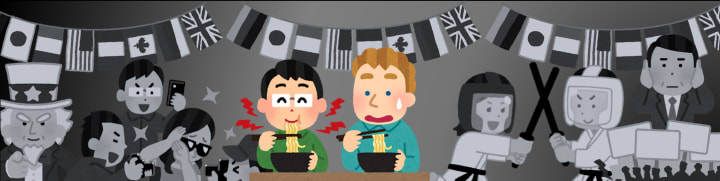
As well as lesson slides I've used Irasutoya as the basis for some classroom activities and materials.
A fun review activity to test vocabulary is to play pictionary. You can find a bunch of Irasutoya pictures related to a certain topic. Split your class into pairs, show the picture to one member of the pair and have them describe it to their partner.
Another review activity is to make flashcards for students to complete. Adding an irasutoya picture on one side and then having them fill in the English can really help your more visual learners. Keeping these as a picture also helps as students may have different interpretations over what the picture is. You can get verb forms, noun forms, maybe even different words entirely. Getting students to compare their different answers encourages a bit of peer-teaching and can help them figure out different forms and uses of words they already know.

Final Thoughts
I <3 Irasutoya.
It's fun, it's useful and it makes me feel a little more professional when I do use it.
It's not for everyone, but I do think every teacher should at least give it a look and see what they can find. Maybe there's something for you in there.

What do you think?
So what do you think? Are you interested in irasutoya? What do you think you'll use them for?
Perhaps you already use their images? If so how?
Leave a comment and let me know below!

About the Creator
Max Brooks
My name is Max, English teacher in Japan, lover of video games, RPGs and miniature painting.
Keep reading
More stories from Max Brooks and writers in Education and other communities.
Clear Paths to Discover Your Purpose in Life
Finding direction in life is a common human search. Many people want their work and daily actions to feel meaningful. When you discover your purpose in life, you gain a sense of direction and inner peace. Purpose does not appear in a single moment for most people. It often grows through reflection, action, and learning. Small steps can lead to deep insight.
By Philip Raymond Baquie2 days ago in Education
Who is your "Person"?
It's important to recognize that you cannot go through life as easily on your own. My name is Elizabeth and I'm a survivor of child abuse and horrific trauma. Healing from trauma is not a quick fix and recognizing that it will take time, is part of the struggle.
By Elizabeth Woods3 days ago in Psyche


Comments
There are no comments for this story
Be the first to respond and start the conversation.