
Why the Sun Will Become a Red Giant: The Future of Our Solar System Explained
Discover why the Sun will eventually become a red giant star. Learn how stellar evolution will transform our Sun and what it means for Earth and the solar system.

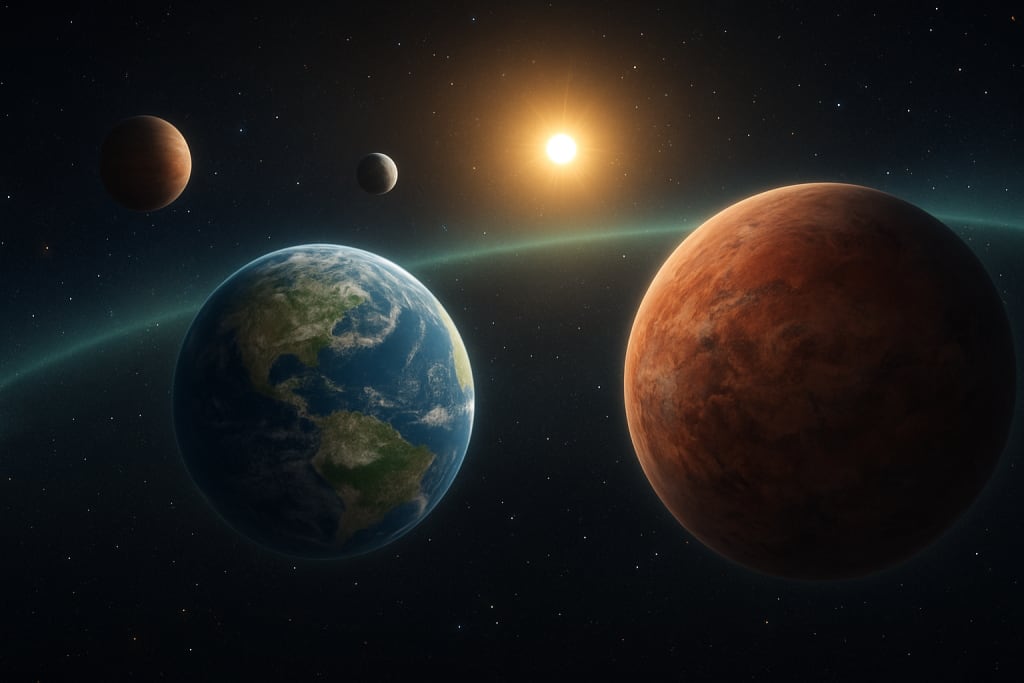
Every morning, the Sun rises as it has for billions of years, bathing Earth in light and warmth. To us, it feels permanent and unchanging. Yet in the vast timeline of the universe, the Sun is only halfway through its life.
Billions of years from now, the calm yellow star that sustains life on Earth will transform dramatically. It will grow larger, brighter, and far more unstable. Eventually, the Sun will expand into a massive red giant star, engulfing nearby planets and reshaping the entire solar system.
This transformation is not unique to our Sun. It is a natural stage in the life cycle of many stars across the universe. By studying stellar evolution, astronomers can predict what will happen to the Sun in the distant future.
Understanding why the Sun will become a red giant reveals the incredible processes that govern stars and shows how even the most stable celestial objects eventually change.
________________________________________
The Life Cycle of a Star
Stars are not eternal. Like living organisms, they go through a life cycle that includes birth, growth, and eventually death.
The life cycle of a star depends primarily on its mass. Massive stars live fast and die young, often exploding as supernovae. Smaller stars burn their fuel slowly and can survive for billions or even trillions of years.
The Sun belongs to a category known as medium-sized stars, often called yellow dwarf stars. These stars spend most of their lives in a stable phase known as the main sequence.
During this stage, the Sun produces energy through nuclear fusion in its core, converting hydrogen into helium. This process has powered the Sun for approximately 4.6 billion years.
However, the Sun cannot fuse hydrogen forever. Eventually, the fuel in its core will begin to run out, triggering the next phase of its evolution.
________________________________________
Nuclear Fusion: The Engine of the Sun
To understand why the Sun will become a red giant, we first need to understand how it currently generates energy.
Inside the Sun’s core, temperatures reach about 15 million degrees Celsius. At these extreme temperatures, hydrogen atoms collide with enough force to overcome their natural electrical repulsion.
When this happens, hydrogen nuclei fuse together to form helium.
This process releases enormous amounts of energy in the form of light and heat. The outward pressure created by this energy balances the inward pull of gravity.
This balance keeps the Sun stable. Astronomers call this state hydrostatic equilibrium.
But this balance depends on one crucial factor: the availability of hydrogen fuel in the core.
________________________________________
What Happens When Hydrogen Runs Out?
Over billions of years, the Sun gradually converts hydrogen into helium in its core.
Eventually, most of the hydrogen in the core will be used up. When this happens, nuclear fusion in the core will slow dramatically.
Without the outward pressure from fusion, gravity begins to dominate again. The core starts to contract and collapse inward under its own weight.
As the core shrinks, it becomes hotter and denser. Meanwhile, the outer layers of the Sun begin to react to these changes.
The energy produced by the contracting core pushes the Sun’s outer layers outward, causing the star to expand enormously.
This marks the beginning of the red giant phase.
________________________________________
Expansion into a Red Giant
As the Sun enters the red giant stage, its outer layers will expand dramatically.
Scientists estimate that the Sun could grow hundreds of times larger than its current size.
The expanding atmosphere of the Sun may extend beyond the orbits of Mercury and Venus, and possibly even Earth.
Despite becoming much larger, the surface of the Sun will actually become cooler. This is why the star will appear reddish in color, giving rise to the name "red giant."
Red giant stars glow with a deep orange or red hue because their outer layers have lower temperatures compared to their earlier stages.
________________________________________
Helium Fusion Begins
As the Sun’s core continues to contract, temperatures eventually become high enough to ignite a new type of nuclear fusion.
Instead of fusing hydrogen, the Sun will begin fusing helium into heavier elements, such as carbon and oxygen.
This process is called helium fusion.
For a time, this new fusion process stabilizes the star again. The Sun will continue shining, though in a much larger and brighter form.
However, the Sun does not have enough mass to continue fusion beyond this stage indefinitely.
Eventually, helium will also run out.
________________________________________
The Fate of the Solar System
When the Sun expands into a red giant, the inner solar system will change dramatically.
Mercury and Venus will almost certainly be swallowed by the expanding Sun.
The fate of Earth is less certain. Some models suggest Earth may also be engulfed, while others suggest it might survive but become a scorched, uninhabitable world.
Even if Earth escapes being swallowed, the planet’s oceans will have long since evaporated due to the Sun’s increasing brightness.
The surface temperature would rise to extreme levels, destroying any remaining life.
Farther out in the solar system, conditions will also change. Planets like Jupiter and Saturn may experience warmer temperatures as the expanding Sun emits more energy.
________________________________________
The Final Stages of the Sun
After the red giant phase, the Sun will shed its outer layers into space.
These layers will form a glowing cloud of gas known as a planetary nebula.
Despite the name, planetary nebulae have nothing to do with planets. Early astronomers simply thought they resembled planets through telescopes.
At the center of this expanding nebula, the remaining core of the Sun will remain.
This dense object is known as a white dwarf.
White dwarfs are incredibly hot but very small, roughly the size of Earth. They slowly cool and fade over billions of years.
________________________________________
Why This Process Is Inevitable
The Sun becoming a red giant is not a possibility—it is a certainty based on well-understood laws of physics.
Astronomers observe thousands of stars at different stages of stellar evolution across the universe.
By comparing these stars, scientists can reconstruct the life cycle of stars like the Sun.
The same processes of nuclear fusion, gravitational collapse, and energy balance operate throughout the cosmos.
In other words, the Sun is following a path that countless stars have followed before.
________________________________________
What This Means for Humanity
Although the transformation of the Sun sounds dramatic, it is nothing to worry about for billions of years.
Human civilization, and even Earth itself, will likely change dramatically long before the Sun reaches the red giant stage.
However, studying the future of the Sun helps scientists understand stellar evolution and the long-term fate of planetary systems.
It also helps astronomers search for habitable planets around other stars by understanding how stellar lifetimes influence planetary environments.
________________________________________
Why Studying the Sun Matters
The Sun is the closest star to Earth and provides an ideal laboratory for studying stellar physics.
By observing the Sun in detail, scientists can better understand:
• How stars produce energy
• How planetary systems form
• How stars evolve over time
• How stellar changes affect planetary climates
This knowledge helps astronomers understand the broader universe and the potential for life beyond our solar system.
________________________________________
Conclusion
The Sun may appear stable and eternal from our perspective, but like all stars, it is constantly evolving.
Over billions of years, nuclear fusion in the Sun’s core will gradually consume its hydrogen fuel. When that fuel runs out, gravity will cause the core to collapse, triggering the dramatic expansion of the Sun into a red giant star.
During this phase, the Sun will grow enormously, transforming the solar system and possibly engulfing the inner planets.
Eventually, the Sun will shed its outer layers and leave behind a dense white dwarf surrounded by a glowing planetary nebula.
While this transformation lies far in the future, it reminds us that even the most powerful stars are part of a cosmic life cycle.
The Sun’s journey—from its birth in a cloud of gas to its eventual expansion into a red giant—reveals the incredible processes that shape our universe and the stars that illuminate it.
About the Creator
Keep reading
More stories from shahkar jalal and writers in Education and other communities.
How the Sun Influences Climate: The Hidden Force Shaping Earth’s Weather and Environment
Every morning, sunlight spreads across the horizon, warming the land, oceans, and atmosphere. It feels simple and familiar, yet this daily event is driven by one of the most powerful forces shaping our planet: the Sun.
By shahkar jalalabout 3 hours ago in Education
The Impact of Virtual Reality on Healthcare Innovation and Medical Practice
Virtual reality is steadily transforming the healthcare industry by offering immersive digital environments that support medical education, treatment planning, and patient care. Unlike traditional tools, VR allows healthcare professionals to interact with highly detailed simulations that replicate real medical situations. These interactive experiences provide opportunities for learning and preparation that were previously difficult to achieve through conventional training methods.
By Alex Kipman2 days ago in Education
TUS NUA - ch 53
TUS NUA – ch 53 New Beginnings – Mia and Midnight (*)(*)(*) Finola knew Ali’s brother-in-law needed to put his mind at rest. She fed her arm through his and led him outside. “We’ll sit here. If you like, I can put a block around us so our conversation will be private.”
By Margaret Brennan6 days ago in Fiction


Comments
There are no comments for this story
Be the first to respond and start the conversation.