
Medusa's Nest That Never Sleeps
The first snake woke before dawn, as it always did.
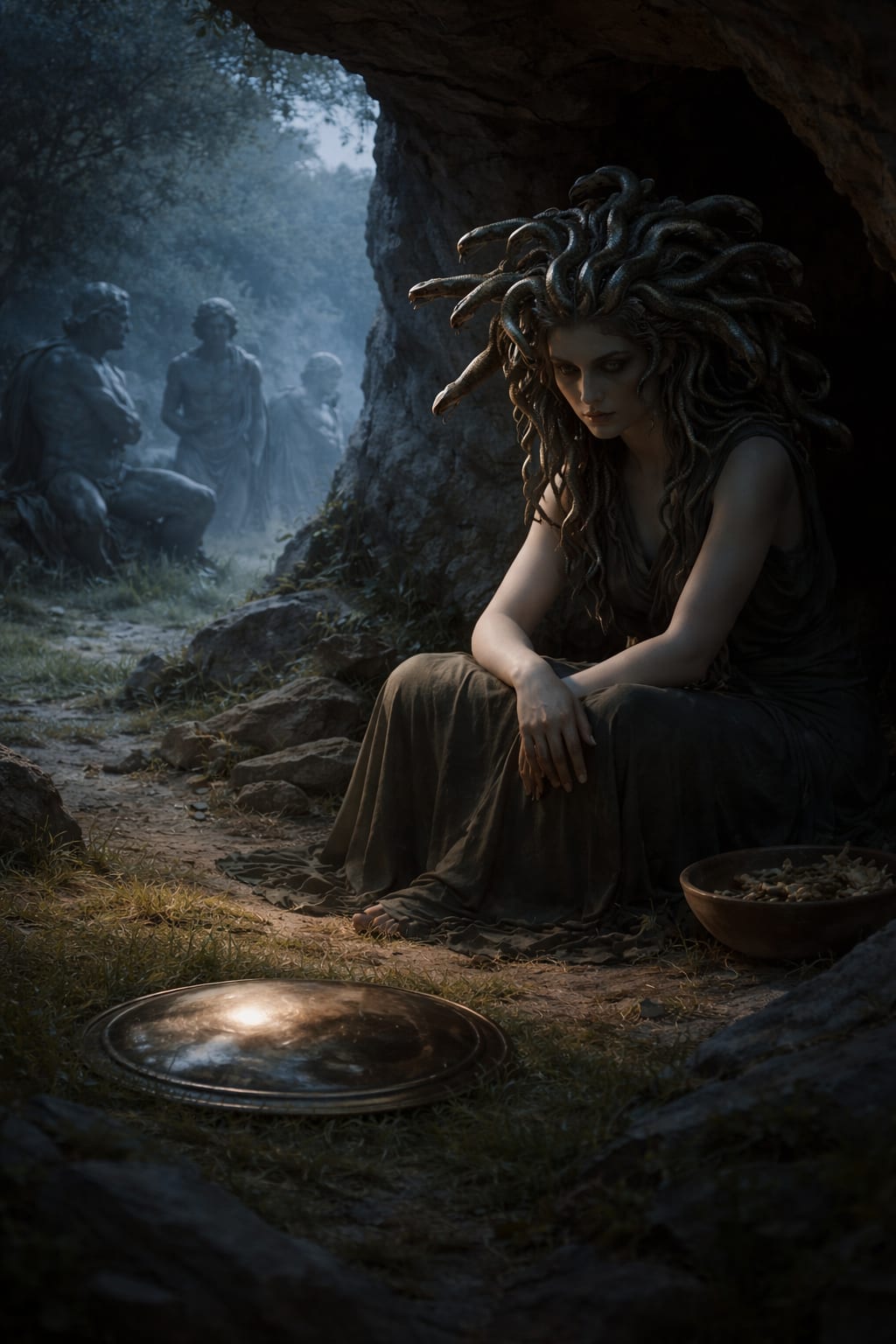
Medusa felt Kestrel wake before she did, a slow tightening near her left temple, the turn of a narrow head testing the dark. She had given that one the kestrel’s name for its hunting patience, for the way it surveyed the middle distance as though the cave wall might suddenly take flight. The tongue began its work at once, sampling the cavern’s stale breath and bringing back its report. Cold stone, mouse droppings tucked behind the eastern wall, the mineral trace of yesterday’s rain.
She kept her eyes closed and tried to hold on to the last scrap of sleep she had managed upright against the rock. Her neck rested in the carved olive wood cradle she had created and took over three long months to build. It was the only thing she had ever built for herself, a shallow fork worn satin smooth, fitted to the back of her skull so the serpents could coil and drape without being crushed. Without it they woke aching, and an aching serpent woke screaming, thrashing, biting, leaving chaos in its wake.
Another stirred. Then another.
The nest came alive like a field of small earthquakes, each body rousing at its own pace, each mind surfacing with its own irritations and needs. Their awakenings arrived before she had gathered herself enough to claim the morning.
She opened her eyes.
Dawn painted the cave in a dim color, a light soft enough to make the serpents beautiful. Scales held a faint sheen, bodies tracing slow arcs as they oriented themselves to the day. Twelve in all. She had named them over the years, not from tenderness exactly, more from necessity. Names helped her chart their moods. Kestrel at the temple. Reed and Loom crowning her skull. Spool and Thorn at the nape, broad, heavy, quickest to anger when hunger sharpened them. The others spread across her scalp like the borders of a country she had never sought to rule.
She reached for the clay bowl beside her.
Seven mice lay within. She had trapped them the previous evening in a wicker cage and ended their lives an hour ago with the clean efficiency of long practice. Once she had tried to summon feeling for the task. She learned that feeling drained her more than it gave back.
Spool first. Always Spool.
She lifted a small carcass and brought it forward with care, letting Spool taste the scent before the offering came close. Recognition mattered. Rush the ritual and teeth would answer. Spool’s indignation could travel through the nest in an instant, setting off a chain of alarm as swift as wildfire.
“Here,” she said, letting her words vibrate low in her throat. The serpents understood no words, yet they recognized that sound as safety.
Spool took the mouse in a dignified motion. Around her skull the others could smell the scent of fresh meat. Thorn followed, then Loom, then the four she called the Younger Ones, who had emerged last and retained a streak of volatility even now. Each feeding required negotiation. Move too slowly and impatience pressed teeth against her skin. Move too quickly and someone felt slighted, and resentment in a creature ruled by hunger could turn sharp in an instant.
Reed accepted its mouse sideways, a sign of one of its moods.
By the time she reached Copper at her right ear, always last and nearly patient, dawn had lifted into a clearer sky. Her knuckles ached from cold and from the precision demanded by the work. She set the empty bowl aside.
There would be forty minutes perhaps before the next rise of need. The serpents existed at varying distances from urgency. They were never entirely free of it.
Outside, the morning carried the scent of a distant sea below the cliffs. She walked the circuit of her garden, the serpents riding her motion with alert grace, twelve sets of eyes surveying twelve portions of hillside. A rabbit crouched near the low wall and was logged by eleven separate minds before she consciously noticed it. Attention shifted across her scalp like compass needles aligning.
“Later,” she said.
The rabbit fled anyway.
The garden had grown by accident. She had chosen a cliff and a cave and solitude. For several years that had been possible. Then the heroes began to arrive.
The first came with a sword and terror forged into resolve. She had turned him to stone mid lunge, because she knew no other response. The petrifying force required no effort. It existed the way her serpents existed, an aspect of her being rather than a decision. She had once tried to unravel its mechanism, whether it radiated outward or lay dormant until triggered. The answer changed nothing.
The second hero came prepared, shield polished to mirror brightness. He believed reflection would grant him safety. He caught her image in bronze and advanced without direct sight. She turned him to stone when he drew close enough to threaten her. He still stood at the eastern border of the garden, shield raised, hope frozen across his face in a way that hurt her to look upon.
The statues proved useful. During shedding the serpents favored rough stone, scraping their loosening skins along rigid surfaces. This morning Loom dragged itself over the bent arm of hero number six, working at a stubborn patch near the neck. There was an odd satisfaction in watching instruments of her attempted death serve the maintenance of her living crown.
She completed her circuit and settled near the cave entrance where sunlight pooled once it cleared the ridge.
The latest hero’s shield lay in the grass. He had arrived three weeks ago, brimming with certainty. She had been swifter. Now he stood at the western boundary, surprise fixed upon his features, bronze fallen from his grasp.
She had ignored the shield. She had no need of defense, and turning weapons into cookware felt beneath the object’s dignity.
Today the sun struck it at a different angle.
She saw herself.
The bronze curved the image, bright at the center and fading toward its rim. She appeared more shape than woman, a dark outline crowned with living motion that continued even as she stood still. Kestrel worked through some private preoccupation, head turning in measured arcs. Reed remained coiled near the crown. The Younger Ones clustered together for warmth, arranging themselves with instinctive precision.
She noticed something she hadn't seen before.
They leaned toward her.
She had always framed her care as management, keeping the nest from turning against itself, staying ahead of hunger, tracking temperaments. In the bronze she saw Spool resting fully against the back of her skull, settled at the warmest point. She saw Reed, despite its earlier mood, positioned close to her ear as though tuned to the rhythm within her head. The Younger Ones formed a loose ring around her nape, their heads angled outward in watchfulness. They had eaten. They were secure. Their attention faced the world.
Her reflection held none of the terror that drove men up her cliff. The myth described her as monster, curse, hazard to be eliminated. What she saw instead was a woman worn thin by broken sleep, mornings that began before she wished them to, a life braided with twelve other nervous systems that rarely slept in concert. The nest never fully rested. Someone always surfaced with a sudden turn or twitch that pulled her from drifting.
She had not chosen any of it. The stories argued over causes, divine wrath, transformation, blame laid at her own misstep or another’s violence. She possessed no access to the true version. She possessed only the result, this body, this garden, this crown, this ready stone whenever the world got too close.
In the bronze Reed slowly loosened its coil and settled beside Kestrel. The two rested together in a calm that required no effort.
She remained there as the sun rose. Warmth gathered across the serpents’ scales and traveled downward, a collective transaction that left her warmer as well. It registered as pressure that was almost comforting.
A thought rose in her, dangerous in its softness. She had trained herself against such things, against letting any feeling take root.
The myth declared her lethal. The myth cast her as obstacle for some chosen champion with divine assistance and polished bronze. The myth told a story from beyond the garden walls.
The stone was real. The serpents were real. Her presence posed difficulty for those who came too close. All of that remained true.
Yet the myth omitted the feeding at dawn, the careful order of offerings, the scrape of shedding against cold statues, the steady rest of Spool against her skull.
She bent, lifted the shield, and turned it face down in the grass. She required no mirror today. Heroes would continue to arrive. Somewhere another blade was being honed, another prayer offered to a distant god. Such cycles belonged to the world.
She returned to the cave to ready the next meal.
Behind her Kestrel tested the morning once more, mapping the scents of thyme, sea, and stone, cataloguing the small intricacies of a complicated life and carrying them back to her, whether she desired the knowledge or not.
About the Creator
Tim Carmichael
Tim is an Appalachian poet and cookbook author. He writes about rural life, family, and the places he grew up around. His poetry and essays have appeared in Beautiful and Brutal Things, his latest book.
Keep reading
More stories from Tim Carmichael and writers in Fiction and other communities.
The Persistence of Elpis
Everything disastrous in that household had been Epimetheus's idea, and Myrto had worked for the family long enough to know that when the master of the house said something like it's perfectly safe, just don't open it, the correct response was to begin mentally cataloguing which of your personal belongings could be easily replaced.
By Tim Carmichael2 days ago in Fiction
Flower Bloom 369
FLOWER Bloom 2/25/26 Wednesday By Mariann Carroll Karen had been with Tony for 7 years. Tony started acting strangely after her surgery. He would mow the lawn in the rain and be on his cellphone. He started pushing Karen away. Tony came clean about seeing someone. Karen moved out two months later. Karen moved in with a friend. She felt betrayed.
By Mariann Carroll5 days ago in Fiction
Cassie and Johnny
I’m the kind of dame you notice. I’m no femme fatale, but you can’t ignore me, at least not until I warn you about what’s coming, then everybody ignores me. Hell, they usually blame me afterwards and give Johnny all the credit for saving the day, but my Johnny couldn’t save a seat at the movies without my help. Sure, he’s brawny, but brainy? Not so much. Like that time I asked him to spot me five bucks, and he said he didn’t see it anywhere on me, and believe you me, he looked but good.
By Harper Lewis4 days ago in Critique


Comments
There are no comments for this story
Be the first to respond and start the conversation.