
More Orangutans
A city devoid of privacy creates the perfect citizen

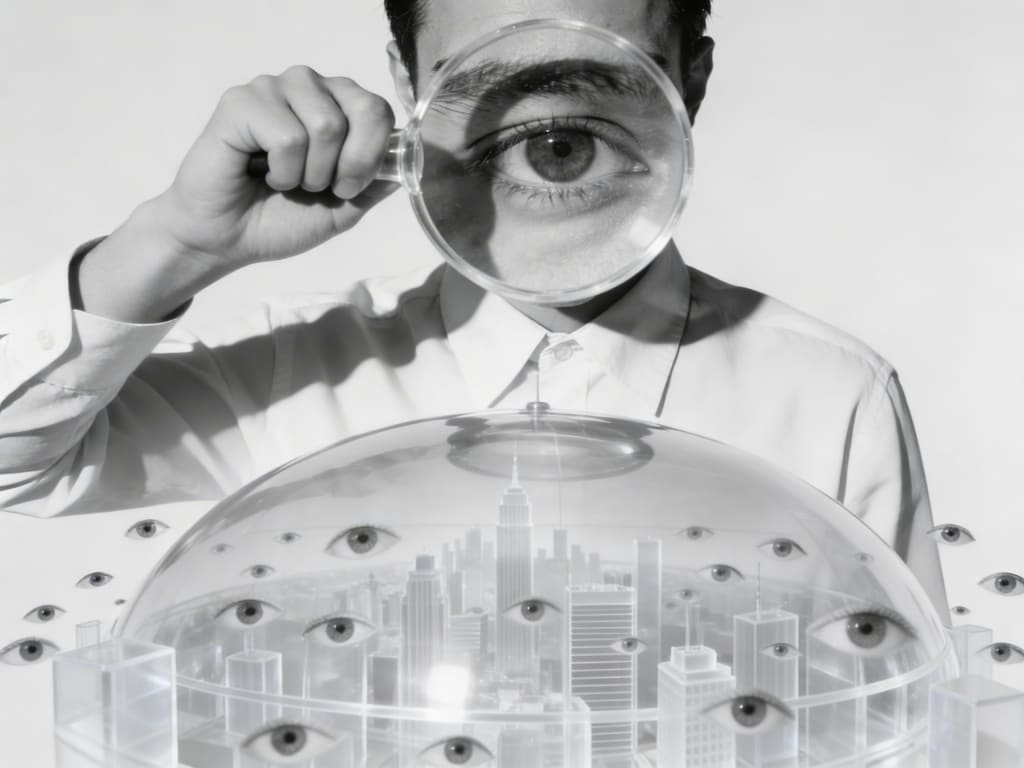
Ernie watched himself get out of bed.
It was part of his morning routine: he opened his eyes to the sky-mirror, and peeled the translucent covers from himself. He slept in pajama pants, and a matching pajama shirt, because he didn’t want the others to see his bare, milky body through the glass roof.
Before getting up, he looked around the reflective dome-ceiling to see who else was awake. If he wanted to zoom in on anyone in particular, he could utilize the otioscope by his desk, but he rarely used it for this. He could tell who was awake simply by perusing the sky-mirror (that is what most people called it), and noting the movement from the houses. After all, one could see the entire city from any place in the dome. Thus was the genius of the sky-mirror’s design.
Step two was to swing his legs over the bedside and stand up. When he was about halfway through this process, his pudgy soles smudging the glass floor, he usually liked to look down at his father in the first story of the house.
His father woke a tad earlier than he did, reliably dressed in a colorful athletic polo and beige khaki shorts.
“Good morning,” Ernie would mumble quietly.
The house, designed to magnify the slightest of sounds, would carry his near-silent message faithfully downward, and his dad would reply something cheeky, like, “Well, look who’s finally awake!”
Step three was oral hygiene, accomplished via a glass toothbrush and glass sink. There was a glass toilet as well, which got used very sparingly, for obvious, perceptual reasons.
Showers were accomplished in phases. First, Ernie removed his pajama shirt and washed and scrubbed his torso, then he did the same with his lower half. He could crimp his body in certain ways in the latter step, shielding his genitals from most viewable angles.
Concealing oneself was illegal in the dome, but concealing a part of oneself, especially if it seemed unintentional, would usually be accepted.
Like most people Ernie knew, he had experienced a great anxiety about the dome's sky-mirror in his youth, and he had even rebelled against it in his teen years. He had tried placing his clothes over the glass roof to cover himself. This, of course, had been noticed, and the shame of his punishment had cured him thoroughly.
The otioscope by his desk was a device given to everyone within the dome. It had the shape of a tennis racket, with its shaft extending about three feet from the round interface at the top. When one used it to zoom in, the scope magnified the user’s eye, such that it grew to encompass their entire face. Ernie had always found this unnerving, to look up into the sky-mirror, and see those dismembered eyes on the shoulders of his neighbors' bodies, peering directly at him.
Some nights, a dream recurred of the punishment he had suffered as a teen: He came awake. The dome’s lights were dimmed. Slumbering hours. He looked up at the sky-mirror, and saw that each house had its lights activated except for his. On the shoulders of every person, in every house— an eye— each one judgmental, each one unblinking— hung over him. Pouring from the communication speakers of his otioscope, there was static. It was a droning, sinister static, contained within the walls of his house like pooling water, threatening to drown him. He tried to leave his bed, but the eyes loomed over him with such weight that he was rendered immobile.
He had been on the other side of this punishment as well— he had been one of the judgmental eyes.
Whatever law was broken in the dome, the punishment was the same. Subjection to the complete disapproval of one’s peers had proven more effective correctionally than even solitary confinement. Therefore, it was impressed upon all dwellers of the dome to participate in these public perceivings whenever necessary.
Because of this punishment, Ernie’s father had nicknamed the sky-mirror, ‘the god replacement’.
His father had been born outside the dome, and considered it a point of pride that he could say things like, “You don’t know how good you have it, being born in this dome.”
He called the sky-mirror ‘the god replacement’ because, according to him, people outside the dome had once convinced their children to believe in a person named ‘God,’ who watched everything they did, even when no other physical person was around to perceive them.
“Ever since the dome, though,” his father would say chummily, “we haven’t really needed God.”
Later that day, Ernie and his father went to the commissary. It was a gargantuan cylinder that reached the ceiling, with six, equidistant windows studding the base of it. The bottom half of the cylinder was made of stainless steel, and therefore could not be spied through. The top half, like the rest of the structures in the dome, was made of translucent glass.
Six lines of people formed, protruding from each respective window. Those in line glanced around at each other with their otioscopes, or looked up into the transparent half of the cylinder to see the dome’s resources being transported pneumatically. Food went down, while waste and laundry went up.
The commissary served as a central hub for everyone’s needs. All services could be ordered here, from food dispensation, to home repairs, to laundry and waste disposal. A popular question among dwellers was who exactly ran the commissary.
At the windows, one’s order was taken, and their food prepared, by robots. The same robots performed the laundry functions as well, and as far as anyone knew, they had never erred, so the humans who managed them had never needed to show themselves. When repairs were ordered, a human from the surface came to repair things, but it was against the policy of the dome to communicate with them. Someone had tried communicating with a plumber once, and the usual punishment had been applied.
Around the commissary: glass tables, with glass benches attached. Ernie and his father occupied one of these after ordering an asian salad and a hotdog. Ernie ate the salad, while his father regaled him, yet again, with an emapssioned comparison of hotdogs made outside the dome to those made inside the dome. Ernie knew the science of it: the bitter aftertaste he experienced from all food served in the dome was a result of supplemented vitamins. They served to counteract the effects of living without sunlight, and breathing recycled air so often. Hotdogs without these vitamins, according to his father, were exponentially tastier.
Ernie was like many born in the dome, who half-believed in the conspiracy theories that things like “sunlight”, "un-recycled air”, and “birds” were only a myth. Some even extrapolated further, suggesting that the entire outside world was a myth, and those who claimed to have lived outside it before were perpetuating some nefarious psyop.
Ernie didn’t buy into this, mostly because his father was not nefarious. His father could barely keep his eyes open after 1:00 PM each day, let alone maintain some grand, secretive plot. In fact, nobody in the dome had such a capacity. They would all go back to their homes after this, and activate the entertainment functions on their otioscopes.
The entertainment functions held every type of image and scenario that could ever appeal to mankind. When Ernie activated the entertainment function on his otioscope, he saw in the whirling interface of the device encounters with violent sea creatures, beautiful women dancing suggestively, debates where his side won, debates where his side lost, feats of human strength, failures of their stupidity, extreme violence, miracles, the incomprehensible. He felt fear, lust, pride, anger, triumph, hilarity, disgust, amazement. He saw orangutans in trousers, getting frightened by other orangutans, and tripping over the trousers as they tried to run. He saw other people reacting to those same orangutans.
The emotional stimulation of the images would deplete overtime, until he was little more than a nerve ending, callused over, watching the images roll by.
By this time, the dome lights would be dimmed. Ernie’s eyes would feel glazed and heavy. His brain would feel sluggish, as though it were thinking its way through mud. Looking down, he'd see his father asleep. He'd feel it was time to join him, and collapse into bed.
Next morning:
Step one, he watched himself peel the covers away.
Step two, his feet on the glass floor, looking down to see his father…
Strange, he thought, his father had broken the routine. He glanced at his bed below to be certain that he hadn’t just slept in. It was empty, and his reliable lineup of polos lay displayed on the bedsheet.
‘Purple’ was missing. The color of confidence.
Ernie took up his otioscope, and began scanning the sky-mirror for any source of purple.
Before he could spot any, he noticed that the other dwellers were utilizing their scopes as well. He glanced, without zooming, at the reflected cityscape. Numerous white, shimmering, globules began blinking into view. Their accumulation was rapid, and they all began to hone in on the same thing, moving fixedly toward it. Ernie followed their lead until, at last, he honed in on it himself:
At the base of the commissary, viciously attempting to pull one of the machines through a window— was his father.
That unmistakable mesh of purple strained against sinewy back muscles, as he yanked the tubular arm of the robot. It swatted him ineffectively with the other arm.
It had not been designed to defend itself against a kidnapping.
Ernie activated the communication setting on his otioscope, and the voice of his father wedged sharply through the speakers. He was shouting madly: “Let me out goddamnit! I want to see the sun again! I want to taste a hotdog again! Not this bitter, bullshit artifice you keep feeding us!”
For perhaps the third or fourth time in his life, Ernie ran. He practically slid down the stairs— the individual steps in a glass house had never been easy to discern— and ran through his front ‘door’, which was only an archway, as doors were not necessary in the dome.
The commissary was a quarter-mile from his house. An odyssey for his neglected heart and lungs. He threw his arms about wildly, unsure where to put them while his legs did the running. He breathed as though hyperventilation was his goal.
In shambles, he arrived at the commissary. A crowd of cyclopes had encircled his father and the robot, peering through their otioscopes at him. Ernie shoved his way through, uncomfortable with the warmth of brushing shoulders.
His father now managed to pull the robot, which looked like an industrial-sized vacuum with arms, almost completely through the window. He heaved repeatedly, but the robot’s wheels were caught on the opening.
Ernie tried calling out to him, but it emerged as a wheeze. Everything burned. His face tingled. His blood glugged in his veins like ketchup.
His father snapped the robot downward, and its wheel came free from the rest of it.
It whirred disapprovingly as it crashed to the ground.
Before Ernie could get close enough to stop him, his father dove through the window into the commissary, into the place where no citizen had ever gone. Ernie hobbled, allowing himself to fall chest-first on the lip of the window, his head poking through. There were white sparks interrupting his vision, and the world hadn’t stopped being a centrifuge yet, but he managed to wheeze out: “Dad…”
Ernie’s father turned around, he was standing beside the entrance to one of the pneumatic tubes, labeled ‘laundry’.
“Son?” he replied, “What are you doing here? You never wake up this early.”
“Dad… why… are you…” he spoke in exasperated bursts.
“Don’t worry about me, son,” he said, “You have it good here. It's like I always said: you don’t know how good you have it. You never got to see the outside world.”
“Dad… don’t—”
The pneumatic tube made a sound, a sound that only pneumatic tubes can make. Something like: phungk!
The numerous, floating eyes tracked Ernie’s father as he ascended. A few zoomed on his face, finding him in ecstasy— his eyes closed, his smile radiant— like a heaven-bound soul being raptured.
Many of the scopes shifted down now.
Also ascending through the tube, was Ernie. He had followed without thinking.
As he looked down, he met the familiar image from his nightmare: a sea of eyes, all focused on him. Blinking. Judging.
His heart rate began to slow, as his breathing normalized. His ears were clogged from the pressure, and he heard only the muffled squeegeeing of the tube as his body slid against it. It smelled mildly of mold and body odor.
After a surreal two minutes of ascension, the tube spat them out. Ernie’s father dropped first, not into a basket of dirty socks and sweatshirts, as he’d imagined, but onto a gymnastics pad. The basket had been moved.
Before him stood a familiar man, with familiarly crossed arms, and a familiar red crew cut. His suit had a gorilla lapel pin, to let folks know he was the king of his respective jungle.
“Deputy Doug!” Ernie’s father cheered.
“Hello Ernest,” said the man cordially “I’m actually the minister now if you can believe it. Uh– would you move over please?”
He did, and Ernie fell into the freed space just beside him, horrified.
“Hello, Ernie,” said the king of the jungle.
“Ernie,” chimed his father, “this is deputy– eh– Minister Doug. He was the man who offered me my position in the dome.”
Ernie glanced around, dumbstruck by his dissolved reality.
“He’ll probably need a minute to adjust,” said Minister Doug, “How are you holding up, Ernest?”
“Not well at all,” Ernie’s father replied, “You’re killing us with the whole ‘absence of sunlight’ ordeal. And why can’t we have at least one day of the week where we’re allowed real food?”
Minister Doug laughed, “It's part of the process, Ernest! Don’t worry.”
“Don’t worry? That’s all you have to say?”
“Yes, that’s all I have to say, ‘don’t worry,’ because it's part of the process, and the process is done. You’ve finished it. You passed! That’s why you shouldn’t worry!”
“What?” Ernie’s father said.
“You’ve passed! We’ve proven that the system works!” shouted Minister Doug, waiting with his arms outstretched for the blank stare to evolve into something else, “Now don’t tell me you’ve forgotten what this whole project was about in the first place, Ernest.”
Ernie’s father squinted, halfway suspicious, halfway attempting to recollect a conversation from three decades ago.
“Come with me to the window. You too, Ernie.”
Ernie, cajoled from his frozen awe, followed his father and the gesturing minister to the window. It was made of glass. The rest of the room was made of mysteries: There was a hairy rectangle on the glossy platform that encompassed what he knew as, ‘the floor’. There was a bladed contraption spinning violently over a desk, which was made of something brown, splotched with rippling ring designs...
There were corners.
“Take a look down there,” the minister said.
Ernie looked through the window, set at an incline, such that he could see directly below himself.
He could see his dome! Moreover, he could see into his dome! The mirror on the inside had been a one-way mirror all along!
Around its circumference, the dome hosted a black trail, and from that trail, way down below, there seemed to be people looking into it, people he had never been aware of, observing his neighbors. How many had observed him without his knowledge, he wondered.
“You see, Ernest?” the minister asked Ernie’s father, “Do you remember now?”
Ernie’s father nodded slowly, his memory appearing to thaw.
“I’ll be damned,” he said, “I’ll be truly damned…”
“What, Dad,” Ernie asked
“I can finally remember why I said yes to the dome,” he said, “Depu— I mean Minister Doug came to me when I started working for the Ministry of Order some thirty years ago.”
“That’s right,” chimed Minister Doug, nostalgically.
“He said they were going to be trying a social experiment to create the 'perfect citizen’. He said I would make one hell of a candidate if I enlisted.”
“And I was correct,” Minister Doug said, “You passed the whole damn thing!”
“Apparently I did…” Ernie’s father said, “But— how? How did I ‘pass’ anything? I fled the experiment for a chance at a hotdog.”
“That’s the point!” Minister Doug said, “the perfect citizen is a combination of things. We want them to be modest and law-abiding, of course, but we don’t want them to be completely docile either. We want them to have courage, to know the importance of freedom, the joy of doing things on their own terms. You, Ernest, have exemplified these qualities outstandingly! You played by the rules, right up until you decided enough was enough. That's what we want.”
Ernest bowed his lips in a self-impressed mien.
“Well,” he said, “wouldn’t you know it, son? Your old dad is the ‘perfect citizen’”.
Ernie’s view retracted from the black matrix of colorful rectangles below— which he would eventually know as a ‘parking lot’ — and returned his gaze to the minister.
“Yes Ernie?”
“What… happens now?” Ernie asked.
“Well, first we’re going to get your father a hotdog. Then, he and I are off to a press conference.”
“And... my home… The experiment?”
“Oh, we’ll have you sent back down shortly. Don't worry.”
“Back down? After this? You aren’t worried I’ll skew the results by telling people, or cause an uprising, or something?”
“No, Ernie,” the minister laughed, “The otioscopes guard against that sort of thing."
"They do?" Ernie asked.
"Absolutely! As long as the entertainment function works, people aren’t that interested 'truth' or 'uprisings'. They just want to see more orangutans.”
About the Creator
Noah Husband
Hey there,
I'm a cellular biologist by day, and an aspiring author by evening/night/2:00 in the morning when I drink too much coffee.
Sometimes a short story comes out of it, and finds itself here.
Keep reading
More stories from Noah Husband and writers in Fiction and other communities.
A Wall in a House. Runner-Up in If Walls Could Talk.
If walls could talk, this one would ask you for a goddamn cigarette right about now. I’m joking, of course. Even if you could supply me with one, I’ve got no arms to light it with, no mouth to suck in the smoke with, and no lungs to be blackened by it, because in case I wasn’t clear- I’m a goddamn wall!
By Noah Husband3 years ago in Fiction
I wanted to title this something different, but worried that my chosen title might cause problems entering the United States in the future so this is the new title. It's the greatest title. No one has ever written a title better than this. (All titles unrelated to content).
Let me be honest. I am finding this difficult. Now, I like a challenge, a stretch, a bit of an obstacle course. “Write about the decline of the British Empire in the form of a narrative poem in which your protagonist is an artichoke” I read, and flex my fingers. “Write a haiku to evoke the sensation of sibilance using only the first half of the alphabet.” “Well”, I think to myself, “this should be fun.” But “write about a system that isn’t working”? A system that isn’t working? Now? In 2026? ONE system? My favourite system that isn’t working? The sexiest system that isn’t working? The one giving me the most angst day to day? The one giving me the most existential dread? I am, as I say, finding this difficult. I will own that I have contemplated writing a thousand words on why the steady “all on” setting on my fairy lights is the EIGHTH of seven options which must be sequentially activated to get there, because that is a system that some fool came up with and it definitely doesn’t work, and now who is paying the price, eh? But how can I write about my fairy lights when…. When…. When….
By Hannah Moore4 days ago in Humans




Comments
There are no comments for this story
Be the first to respond and start the conversation.