
Our 33 distinct senses. Not five as the myth suggests.
Myth and wrongness.


"We only uses five senses Kliff - have we not always been taught this, why do you insist that there are more. Where is your proof"?
"Oh come on Klara, look around you. Tell me if you do not see the signs of much more happening, so much which can explain our innate intelligence and ability to explore the wonders of the vast universe".
"Ok. I am game...enlighten me - open my eyes to those possibilities which I cannot see as clearly as you do...please".
Well...Humans have always been taught of our five senses. But now, learning that we possess “more than five senses” isn’t just a fun fact, it’s a story about how a simple idea from antiquity became a cultural default, and how that default stuck around long after science moved on. This is where we are delving deeper into the story about how traditions, repetition, and cognitive shortcuts shape what we think we know, even when the evidence says otherwise.
🌿"Where did the “five senses” idea come from anyway".
Aristotle named sight, hearing, smell, taste, and touch as the senses. That list was elegant, easy to teach, and matched the visible organs of perception. It became embedded in philosophy, religion, education, and eventually childhood learning.
But modern neuroscience shows that this list is only a fraction of what humans actually perceive. Research now identifies dozens of senses, depending on how finely you categorize them. These include proprioception, the sense of where your body is in space, and nociception, the sense of pain.

🧩 "Why did the myth persist".
The persistence of the “five senses” myth is a perfect example of how false facts survive:
By Tradition - because Aristotle’s authority carried enormous weight, and his categories became canon.
Simplicity maybe - Five is a tidy number. It fits on a poster, a lesson plan, a children’s book.
And Repetition - Once a concept is taught early and often, it becomes “obvious truth.”
Then there is Cognitive bias - People accept information that aligns with what they already believe or have heard many times.
This is the same mechanism behind many persistent myths: the brain prefers a familiar story over a complex one.
🧠"But what does the fuller sensory picture actually look like"?
Modern research suggests humans may have up to 33 distinct senses, depending on how you define a “sense.” Some of the most important ones include:
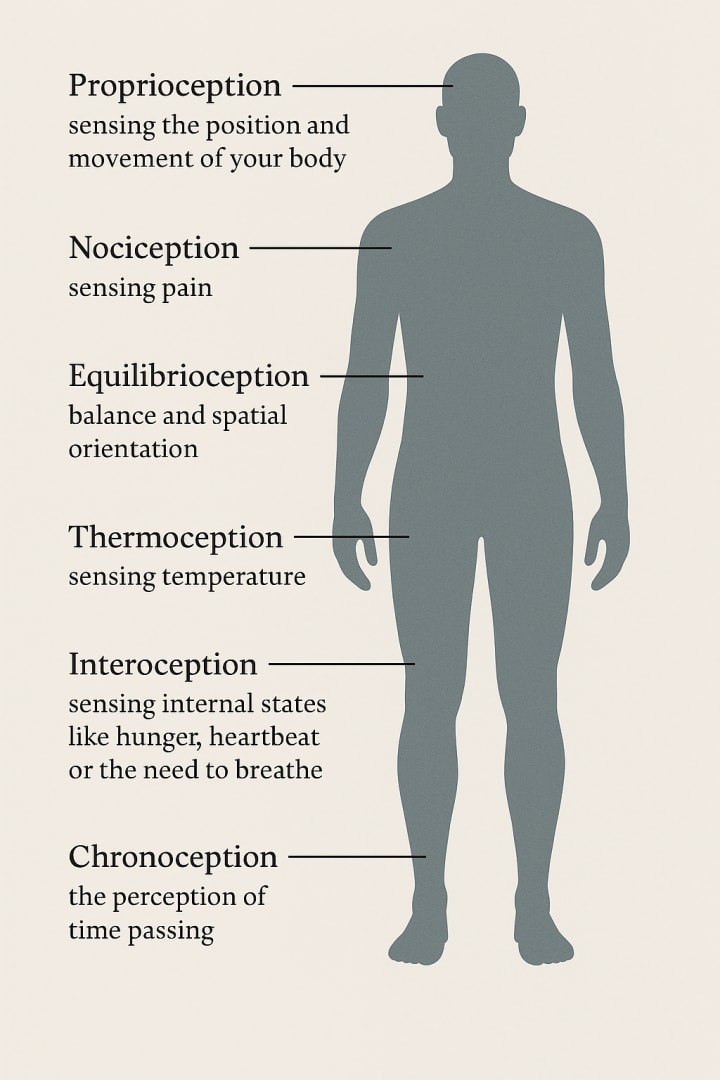
- Proprioception ...sensing the position and movement of your body.
- Nociception ...sensing pain.
- Equilibrioception ...balance and spatial orientation.
- Thermoception ...sensing temperature.
- Interoception ...sensing internal states like hunger, heartbeat, or the need to breathe.
- Chronoception ...the perception of time passing.

These senses operate continuously, shaping our experience of the world in ways we rarely notice. They also interact: what you feel affects what you see, and what you see affects what you taste. Human perception is multisensory, not a set of isolated channels.
📚 "So what is “the true story” behind this myth"?
It’s the story of how a simple ancient framework became a cultural truth, even though it was never scientifically accurate. It’s also a story about how humans build shared realities:
As a people, we prefer narratives that are easy to remember.
~ We trust ideas that come from authority, even long-dead authority.
~ We repeat what we learned as children.
~ We rarely question the categories we inherit.
The myth of “five senses” is a case study in how culture can overwrite complexity, and how our understanding of ourselves is shaped as much by storytelling as by biology.
Each of these “hidden senses” adds a different dimension to how a human body knows itself and the world. Together they form a layered, continuous map of embodiment that goes far beyond the old five-sense model.
🌿 Proprioception
Proprioception is the sense that lets you know where your limbs are without looking. It comes from receptors in muscles, tendons, and joints that constantly report stretch, tension, and movement. This sense is what allows you to touch your nose with your eyes closed, walk without watching your feet, or type without staring at the keyboard. It’s a quiet, background sense that creates the feeling of having a body rather than just observing one.
🔥 Nociception
Nociception is the detection of tissue damage or potential harm. It’s not “pain” itself but the raw sensory input that the brain interprets as pain. Specialized receptors respond to extreme heat, pressure, or chemical changes. Pain emerges when the brain integrates this signal with context, emotion, and expectation. Nociception is protective: it teaches, warns, and sometimes overreacts.
🌐 Equilibrioception
Equilibrioception is your sense of balance and spatial orientation. It comes from the vestibular system in the inner ear, which detects head movement, acceleration, and gravity. This sense stabilizes your gaze when you move, helps you stand upright, and tells you which way is “down.” When it glitches, the world tilts or spins.
❄️ Thermoception
Thermoception is the ability to sense temperature changes on the skin and inside the body. Different receptors respond to warmth and cold, and the brain integrates this with internal needs to maintain homeostasis. Thermoception is why you shiver, sweat, seek shade, or crave a blanket. It’s both environmental awareness and internal regulation.
💧 Interoception
Interoception is the perception of internal bodily states: heartbeat, hunger, thirst, breathing, fullness, nausea, and more subtle cues like emotional arousal. It’s the sense that underlies intuition about your own condition - “I feel off,” “I’m anxious,” “I need to rest.” Interoception is deeply tied to emotion, because emotions are partly interpretations of bodily signals.
⏳ Chronoception
Chronoception is the sense of time passing. It’s not located in a single organ but emerges from distributed neural processes that track rhythms, intervals, and sequences. Chronoception shapes anticipation, memory, and pacing. It speeds up under stress, slows down in boredom, and warps in altered states. It’s the sense that makes experience feel like a flow rather than a series of disconnected moments.

"Why do these senses matter together".
These senses form the scaffolding of embodied experience. They tell you where you are, what is happening inside you, how safe you are, and how to move through the world. They also shape identity: how you inhabit your body, how you feel emotions, how you perceive time, and how you navigate space.
Which of these feels true, most alive or intriguing to you right now?
"Well Kliff, I am quite fascinated by them all...but Chronoception I find very intriguing. With what is happening in the world these days, it seems we are perceiving time as speeding up so fast, it may just be leaving us behind. So now I do believe when you say we have many more senses which we are not aware of. We are sure going to need them as time and situations become more difficult and dangerous".
"Very true, Klara. Very true".
About the Creator
Novel Allen
You can only become truly accomplished at something you love. (Maya Angelou). Genuine accomplishment is not about financial gain, but about dedicating oneself to activities that bring joy and fulfillment.
Keep reading
More stories from Novel Allen and writers in Fiction and other communities.
A House with Good Bones
The house was the strangest thing I had ever seen. The 'for sale' sign had come loose and hung lopsided, waving slightly in the wind. How unusual that the agent had never bothered to mention this lovely place, or make it a priority. As we drove by, she casually alluded to it, noting that it was on the bottom of her list, trying hard to pass it off as a joke, but not succeeding.
By Novel Allena day ago in Fiction
Flower Bloom 369
FLOWER Bloom 2/25/26 Wednesday By Mariann Carroll Karen had been with Tony for 7 years. Tony started acting strangely after her surgery. He would mow the lawn in the rain and be on his cellphone. He started pushing Karen away. Tony came clean about seeing someone. Karen moved out two months later. Karen moved in with a friend. She felt betrayed.
By Mariann Carroll5 days ago in Fiction
I was in a Toxic Relationship, with my Workplace
“You got that?” My ex yelled. His hands were balled into fists at his side. At six foot three, he towered over me. A normal person would have been afraid, but I looked up a video of George Lopez repeatedly saying, “I got this,” and showed it to him. I had grown used to this treatment, so much so that I didn’t blink when he ripped the phone from my hand and threw it across the room.
By Jade M.4 days ago in Confessions




Comments (4)
WOW ♥️🌸💐♥️🌸💐♥️🌸💐♥️🌸💐♥️🌸💐♥️🌸💐♥️🌸💐♥️🌸💐♥️🌸💐♥️🌸💐♥️🌸💐♥️🌸💐♥️🌸💐♥️🌸💐♥️🌸💐♥️🌸💐♥️🌸💐♥️🌸💐♥️🌸💐♥️🌸💐
What an interesting concept. We just accept some info and never question it. Have we been using 33 senses all along. Very interesting...maybe there are even more.
Fascinating write up. Kind of a blend of philosophy, physiology, and psychology. Hadn’t heard many of these terms before, but they’re fun to learn and think about :)
💜Of course, I enjoy my senses being all the way live. I have always lived beyond the five senses -- my sources of peace and war. You are quite the encyclopedia. 💜