
The Hindu Kush: History, Myth, and the Story of “Two Hundred Thousand”
Separating Documented History from Viral Narratives

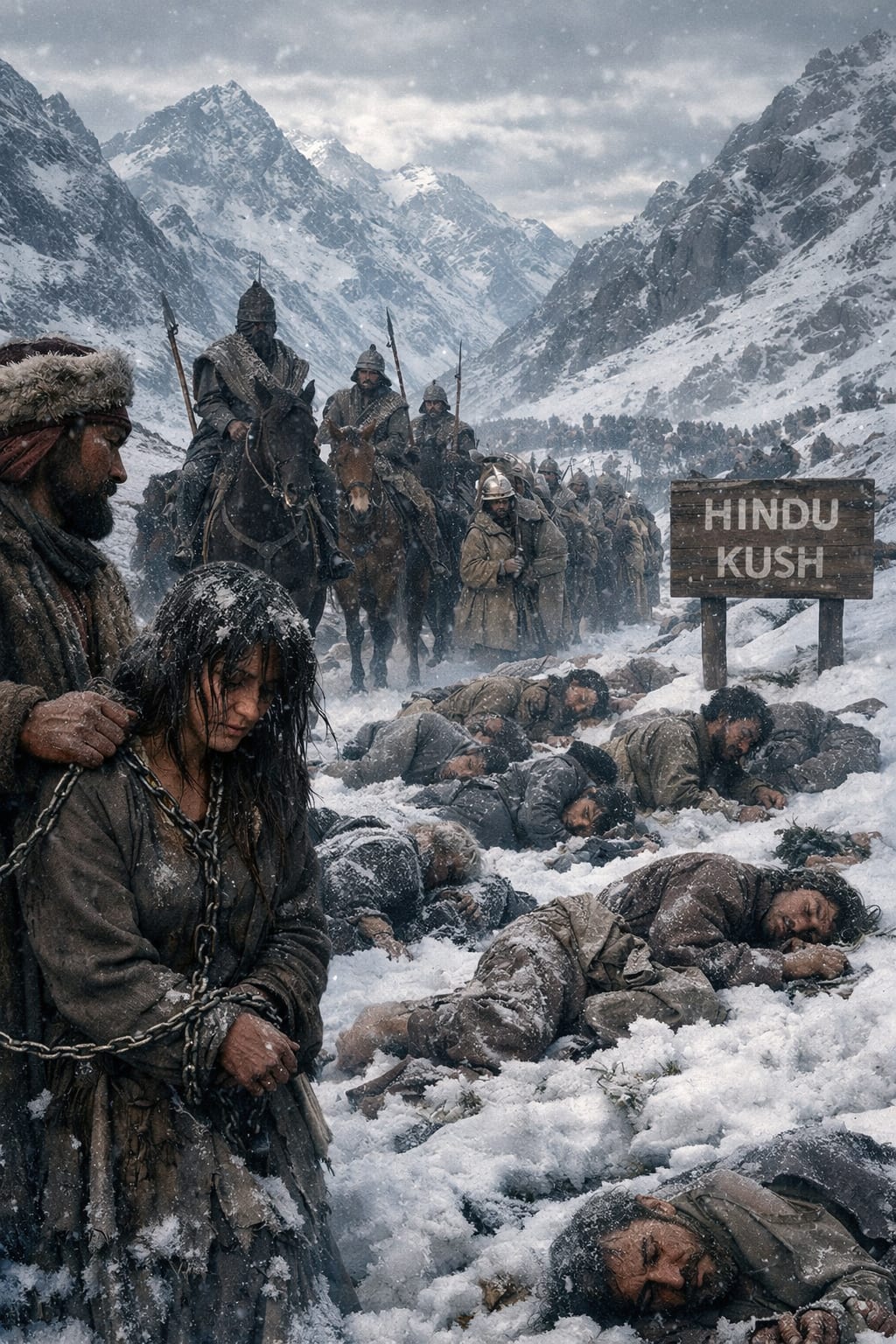
Across social media and messaging platforms, a dramatic historical claim frequently appears regarding the origin of the name “Hindu Kush.” The story states that during the reign of Sultan Muhammad bin Tughlaq, nearly 200,000 Punjabis—men, women, and children—were captured and marched across the mountains toward Afghanistan. According to the claim, they froze to death in extreme winter conditions, and the mountain range was therefore named “Hindu Kush,” allegedly meaning “Killer of Hindus.”
The narrative is emotionally powerful and framed as a suppressed historical truth. However, when examined carefully through historical sources, linguistic analysis, and medieval chronicles, the evidence does not support the claim in its dramatic modern form.
The Meaning of “Hindu Kush”
The Hindu Kush mountain range stretches across present-day Afghanistan into northern Pakistan. The name is Persian in origin. “Koh” (or “Kuh”) means mountain. The debate centers on the word “kush.”
One interpretation translates “kush” as “killer,” leading to the meaning “Killer of Hindus.” This explanation appears in the account of the 14th-century Moroccan traveler Ibn Battuta in his famous travelogue Rihla. He mentions that many enslaved people from India died while being transported across the mountains because of the extreme cold, and that this was associated with the name.
However, several important points must be understood:
Medieval travelers often recorded local explanations without linguistic verification.
The Persian root “kush” can mean “to kill,” but in compound geographical names meanings can shift.
Some scholars interpret “Hindu Kush” as “Mountain of Hind” or “Mountains near Hind,” rather than “Killer of Hindus.”
Place names often develop gradually over centuries and are not always tied to a single event.
Thus, while the “killer” explanation exists in historical writing, it is not universally accepted as the definitive origin.
The Claim of 200,000 Punjabi Deaths
The viral narrative specifically connects the name to Sultan Muhammad bin Tughlaq, who ruled from 1325 to 1351. He is widely known in history as an intelligent but controversial ruler of the Delhi Sultanate. Some of his policies caused hardship and instability.
However, the specific claim that:
He captured 200,000 Punjabis,
Marched them through the mountains,
And that all or most froze to death,
is not supported by reliable primary historical sources.
Medieval chroniclers such as Ziauddin Barani, who wrote about the Delhi Sultanate in detail, do not document such a massive single catastrophe. In medieval history, a death toll of 200,000 would have been extraordinary and likely recorded clearly in multiple sources.
While slavery, forced migration, and wartime captivity did occur in medieval South Asia—as they did across much of the world—the specific event described in the viral narrative lacks solid documentary evidence.
The Word “Hindu” in Medieval Context
Another important clarification concerns the word “Hindu.” In early Persian and Arabic usage, “Hindu” was primarily a geographical term referring to people living beyond the Indus River (Sindhu). It was not originally a strictly religious term.
Over time, it evolved into a religious identity. Therefore, when medieval texts refer to “Hindus” dying in the mountains, it may simply mean people from the Indian subcontinent, not necessarily adherents of a specific religion.
Were the Tughlaqs “Afghan Rulers”?
Modern narratives sometimes label the Tughlaq dynasty as “Afghan.” However, historical scholarship suggests they were of Turkic origin with Central Asian connections. Medieval political identity was dynastic and military, not national in the modern sense.
Applying modern ethnic or nationalist categories to 14th-century rulers can distort historical reality.
Why the Story Spreads
Stories like this spread because they are emotionally powerful and easy to remember. They combine identity, suffering, and the idea of suppressed truth. A simple explanation—“200,000 died, so the mountain is called Hindu Killer”—is far more dramatic than linguistic debate or historical uncertainty.
However, responsible historical study requires cross-verification, comparison of sources, and critical analysis.
What Can Be Said with Confidence
The Hindu Kush mountains were historically dangerous to cross.
Slave caravans and military movements likely suffered significant deaths due to cold and terrain.
Ibn Battuta recorded that Indian captives died in the mountains.
There is no strong historical evidence confirming a single event in which 200,000 Punjabis froze to death under Muhammad bin Tughlaq.
The exact origin of the name “Hindu Kush” remains debated among scholars.
Conclusion
History is complex and rarely fits into dramatic, simplified narratives. The Hindu Kush may indeed have witnessed great suffering over centuries. Many enslaved individuals likely died crossing its harsh passes. But the specific claim of a single catastrophic death of 200,000 Punjabis tied directly to the naming of the mountains is not supported by solid historical documentation.
Understanding history requires careful study rather than emotional certainty. When examining such narratives, it is essential to distinguish between recorded evidence, plausible traditions, and modern reinterpretations shaped by present-day concerns.
About the Creator
What Came First, Chicken Or Egg
What Came First What came first, the chicken or the egg? It is an old question, worn smooth by centuries of mouths repeating it, yet it still sits in the hand like a stone you cannot throw away. I have carried it with me since childhood. It followed me through fields, through classrooms, through quiet kitchens where steam rose from cups and the clock ticked like a patient witness.
By Marie381Uk about 8 hours ago in Fiction
A Historic Declaration
We the People of the Husbands of the United States of America, in Order to form a more perfect Union, and I mean you...with me...establish Justice, insure domestic Tranquility, provide for the common defence, promote the general Welfare, and secure the Blessings of Liberty to ourselves, after Puberty, do ordain and establish this Declaration of Co-Dependence.
By Gerard DiLeo5 days ago in Humans




Comments
There are no comments for this story
Be the first to respond and start the conversation.