

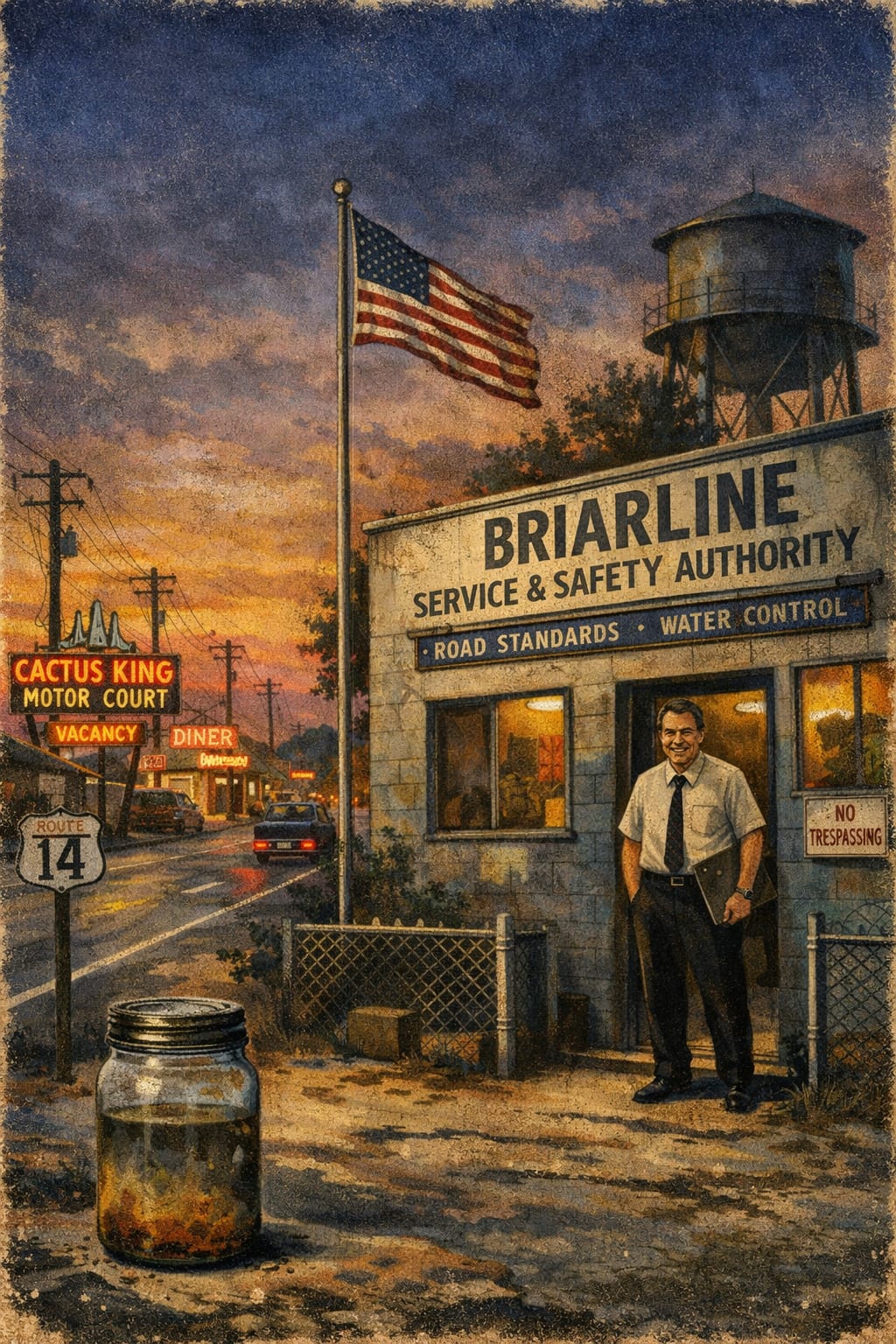
If you want to understand a highway town stretched thin over thirty miles, stop thinking of it as a town. Think of it as a long, tired receipt: itemized loneliness, subtotaled boredom, taxed hope.
They call it Briarline on the maps—if your map is new enough to include mistakes on purpose. Nine hundred people, give or take, distributed like spilled nails along Route 14: a gas station that sells sandwiches with the same confidence it sells antifreeze, a chain motel with a vacancy sign that never turns off, a diner that runs on coffee and the belief that “regulars” count as family, and a clinic that exists mostly as a story people tell themselves when they start feeling strange.
I keep the story straight because I keep the records.
My office is behind the Briarline Service & Safety Authority, which is an impressive name for a cinderblock building with a flagpole and an overflowing ashtray. The Authority is responsible for “Roadside Standards,” which includes signage, sanitation, and whatever else can be made to sound like public virtue when it’s really just control with a clipboard.
There’s a man here named Mr. Kroll, my supervisor. He is not elected. He is not appointed. He is simply there, like a speed limit sign. He wears short-sleeved shirts year-round and has the kind of smile that looks laminated.
Kroll says the highway is our lifeline.
He says the town survives because we are presentable.
He says the quickest way to die is to become “the kind of place people pass through without stopping.”
So we keep people stopping.
We keep them stopping with compliance—and compliance is easiest to produce when you make it feel like politeness.
Every morning, the Norm Loop begins:
A motel owner comes in because the county inspector is “due any day.” Kroll offers him a checklist and a friendly warning: fix the ice machine, repaint the trim, replace the linens. The owner asks how he’s supposed to afford it. Kroll says, softly, “You can apply for a low-interest improvement loan.” Then I hand the owner Form 22-C—five pages of tiny boxes and the unspoken promise that if he fills them wrong, his motel will quietly become “noncompliant,” and noncompliant buildings attract accidents the way trash attracts flies.
A waitress asks if the diner can get its grease trap serviced. Kroll asks whether the diner has been submitting its monthly sanitation self-reports. The waitress says she doesn’t know. Kroll smiles like he’s forgiving a child. “Then we don’t know where you are in the process,” he says, and writes PENDING in bold letters. “But thank you for being proactive.” Proactive is a sedative word. People swallow it and stop asking what it means.
A father asks about his son’s breathing—“He’s got this cough,” he says, the kind of cough that makes you look away because looking at it makes you feel responsible. Kroll says he’s sure the clinic will “handle it through proper channels.” Kroll always says proper channels. It’s his favorite ghost story.
We have a community currency here, and it isn’t dollars. It’s good standing.
Good standing gets you a loan, a service call, a towing discount, your name said kindly in public.
Bad standing gets you forgotten.
That’s the mind control. Not hypnosis, not voodoo. Just the highway’s version of church: do the rituals, receive the sacraments.
The protagonist of this particular receipt was Joan Pritchard, who ran the Cactus King Motor Court near mile marker 18. Joan was a widow with the posture of someone who has spent years leaning into other people’s problems without being paid extra. She had eight units, a broken neon crown, and a ledger where she kept track of who paid and who promised.
She came into my office one Tuesday with a jar.
Not a jar of water like the homestead story. This was a jar of something else: gray, gritty fluid from the motel’s “freshwater holding tank,” the tank that fed the ice machine and the guest room taps.
“Look at this,” she said, setting it on my desk like evidence.
The liquid had a faint rainbow sheen. It smelled like pennies and old paint. If you shook it, it didn’t foam; it separated.
Mr. Kroll leaned in, sniffed once, and smiled.
“Road dust,” he said. “Route 14 throws everything into the air. You know that.”
“I know what dust looks like,” Joan said. “This isn’t dust.”
Kroll’s smile held. “Well, that’s why we have procedures.”
He slid a form toward her. Water Quality Complaint — Preliminary Intake. It had a box for “Suspected Source,” and the options were printed in polite, bureaucratic categories: weather, plumbing, user error.
Joan stared at the options like they were a joke she wasn’t allowed to laugh at.
“I want it tested,” she said.
Kroll nodded, benevolent. “Certainly. After the holding tank inspection. After the maintenance log review. After we confirm your service contract is current. We can’t test a system that isn’t being maintained. That would be… misleading.”
Misleading. Another sedative word. It makes you feel guilty for wanting facts.
That was the first strange day.
The outsider arrived the next week, because outsiders always arrive when a system is confident enough to show off.
His name was Cal Rudd, a traveling field technician with a state health sticker on his truck and a habit of writing everything down even when it made people uncomfortable. He had nicotine-stained fingers and a small hearing aid that whistled if he leaned too close to his own thoughts.
His outsider habit was charming in a way that felt dangerous: he didn’t accept offered coffee unless he watched you pour it.
His outsider condition was the kind of thing the town pretended not to see: he had a rash on his wrists and he kept rubbing his eyes as if the air itself was sand.
Cal checked Joan’s tank, took a sample, and frowned.
“Your inlet line’s pulling from the same auxiliary feed as the diner,” he said. “And the gas station. And the Authority building.”
“Why?” Joan asked.
Cal looked past her, down the long highway. “Because it’s cheaper to hook everyone to one line than to build three.”
“What’s in it?” she asked.
Cal hesitated, then said the one thing Mr. Kroll never said: “I don’t know yet.”
That night, Joan couldn’t sleep. Neither could anyone else, judging by the headlights that kept drifting past the motel like slow, uneasy thoughts.
The next morning, the town began to correct her.
People in Briarline don’t shout you down. They tidy you away.
A supplier “forgot” to deliver towels to the motel.
A bank clerk told Joan her loan paperwork was “incomplete” and suggested she “take her time.”
A diner regular—friendly as always—told Joan she should stop “worrying folks.”
My own hand, when I filed her complaint, wrote POSSIBLE USER ERROR without my brain being asked.
Kroll came by the motel with a clipboard and a smile.
“I heard you’ve been asking about the line,” he said, as if the highway itself had gossiped.
Joan stood with her hands on her hips. “I’ve been asking about what my guests drink.”
Kroll nodded sympathetically, like a man listening to a child explain why the moon is broken. “And I appreciate your concern,” he said. “But you have to understand, we can’t have rumors. Rumors affect business.”
That was the mechanism in full view: scarcity of access dressed up as “reputation management.” In a highway town, reputation is oxygen.
The boundary violation happened almost by accident.
Joan drove down to the Authority building after hours. She didn’t break a window, didn’t steal a safe. She did something much worse: she went into the supply shed behind the building and photographed the auxiliary feed valve with the new gasket Kroll had installed.
The gasket had a brand stamp: INDUSTRIAL — NOT POTABLE.
Joan didn’t know what potable meant, not really. She knew enough to know it was a word that wasn’t meant to be used in a motel brochure.
She took the photos to Cal.
Cal went quiet. “This shouldn’t be here,” he said.
Joan smiled once, sharp and relieved. “So I’m not crazy.”
Cal didn’t smile back. “No. But you are in trouble.”
Two days later, Cal’s truck was gone. People said he got called upstate. People said he was “reassigned.” People said lots of things that all meant the same thing: the system had moved him.
Joan’s decline began the way polite disasters begin: with symptoms that can be blamed on personality.
Headaches, like a tight band.
Nausea, “probably nerves.”
A buzzing behind the eyes that made reading her ledger feel like staring into sunlight.
Then the cough—dry, stubborn, not dramatic enough to count as an emergency.
She went to the clinic, where Nurse Margo Lin took her temperature and told her she was “run down.”
Margo wasn’t cruel. Margo was trained.
“Lots of folks have been feeling off,” Margo said, flipping through a chart. “It’s the exhaust. The heat. The stress. You know how it is.”
Joan watched the chart, watched Margo’s pen hover. “Write down what I told you,” she said. “About the water.”
Margo’s eyes flicked to the doorway, where the hall was empty, and then flicked back. “I’ll note ‘patient concern,’” she said.
“Write ‘industrial gasket,’” Joan insisted.
Margo’s smile came out—small, professional, apologetic. “We don’t put that kind of language in a chart unless there’s a confirmed test.”
“Then test it.”
“We submit through proper channels,” Margo said, and I felt, even from miles away, the system’s voice speaking through her like ventriloquism.
Incubation took twelve days—shorter than you’d think, longer than you’d hope. That’s the sweet spot for denial: long enough that everyone can blame time, short enough that nobody has to change.
The Breaking Point arrived not with a confession, but with a piece of paper.
I found it in the Authority’s service binder while doing inventory. The binder lived in Kroll’s office, on the shelf behind his desk, where he kept things that were “too important” for general access. The binder smelled faintly of gasoline and lemon cleaner.
The page was a maintenance log for the auxiliary feed, dated two months back.
Under “Corrective Action,” someone—Kroll—had written:
Installed non-potable gasket. Reduced complaints.
Reduced complaints. Not reduced contamination. Not improved safety. Just complaints. As if the problem was not the water, but the talking.
I stared at the sentence until it stopped being words and started being a method.
Joan died in the motel laundry room, slumped against a stack of clean sheets like she’d tried to fold herself into something acceptable. The official cause was “acute illness,” which is the medical version of a shrug.
The actual cause, in the mouth of anyone brave enough to use it, would have been: chronic exposure—a steady intake of fuel and solvent residue leaching from improper components, plus whatever the line picked up along thirty miles of neglect. But bravery is not a resource we stock in Briarline.
After death comes Sanitization, and in a highway town, sanitization is almost a hospitality industry.
Kroll visited the motel the next day with a condolence card and a work crew.
The crew replaced the gasket with a “proper” one, but not before the crew photographed the old gasket as “evidence of unauthorized tampering.” Joan, posthumously, was blamed for the crime of noticing.
Kroll drafted a memo that said the auxiliary feed had been “updated as part of routine improvements.” He used the phrase routine improvements three times, as if repetition could bleach reality.
Margo’s clinic chart was edited: “patient concern” became “patient anxiety.” Anxiety is a useful diagnosis; it converts danger into embarrassment.
The town repeated the new script effortlessly: “Joan was under a lot of stress. Running that place alone. You know how it is.” People said it with sympathy, which is the cleanest way to bury someone.
I corrected the service binder myself. I replaced “Reduced complaints” with “Resolved issue.” It felt like lifting a heavy object off the floor and placing it on a shelf labeled Not My Problem.
That night, I drove the thirty miles from one end of Briarline to the other, counting the lights: diner, station, motel, dark, dark, clinic, dark, dark, billboard, dark, Authority, dark. A string of small illuminated lies holding back the prairie.
I stopped at the gas station and watched the attendant refill the coffee urn from the tap.
He offered me a cup.
I took it, because refusing is a kind of speech.
It tasted faintly of pennies and old paint.
Final Line
By morning, the valve was replaced, the memo was filed, and the highway kept stopping for coffee.
About the Creator
Jesse Shelley
Digital & criminal forensics expert, fiction crafter. I dissect crimes and noir tales alike—shaped by prompt rituals, investigative obsession, and narrative precision. Every case bleeds story. Every story, a darker truth. Come closer.
Keep reading
More stories from Jesse Shelley and writers in Fiction and other communities.
Lightning Never Strikes Twice
The distant rumble, the sudden deluge, the crescendo of sound, the flash of light, the explosive energy — it never gets old. I became an amateur storm chaser about two years ago. My wife, Cindy suggested it. Sort of. She said, "Alex, you know this cancer is killing me. I've come to terms with that, but you're smothering me. Go join a band, write a book, or become a storm chaser, for all I care. I love you, but you need a hobby."
By Julie Lacksonen3 days ago in Fiction
I wanted to title this something different, but worried that my chosen title might cause problems entering the United States in the future so this is the new title. It's the greatest title. No one has ever written a title better than this. (All titles unrelated to content).
Let me be honest. I am finding this difficult. Now, I like a challenge, a stretch, a bit of an obstacle course. “Write about the decline of the British Empire in the form of a narrative poem in which your protagonist is an artichoke” I read, and flex my fingers. “Write a haiku to evoke the sensation of sibilance using only the first half of the alphabet.” “Well”, I think to myself, “this should be fun.” But “write about a system that isn’t working”? A system that isn’t working? Now? In 2026? ONE system? My favourite system that isn’t working? The sexiest system that isn’t working? The one giving me the most angst day to day? The one giving me the most existential dread? I am, as I say, finding this difficult. I will own that I have contemplated writing a thousand words on why the steady “all on” setting on my fairy lights is the EIGHTH of seven options which must be sequentially activated to get there, because that is a system that some fool came up with and it definitely doesn’t work, and now who is paying the price, eh? But how can I write about my fairy lights when…. When…. When….
By Hannah Moore5 days ago in Humans




Comments
There are no comments for this story
Be the first to respond and start the conversation.