
The Weight of Wax
The part of the Icarus myth no one remembers.

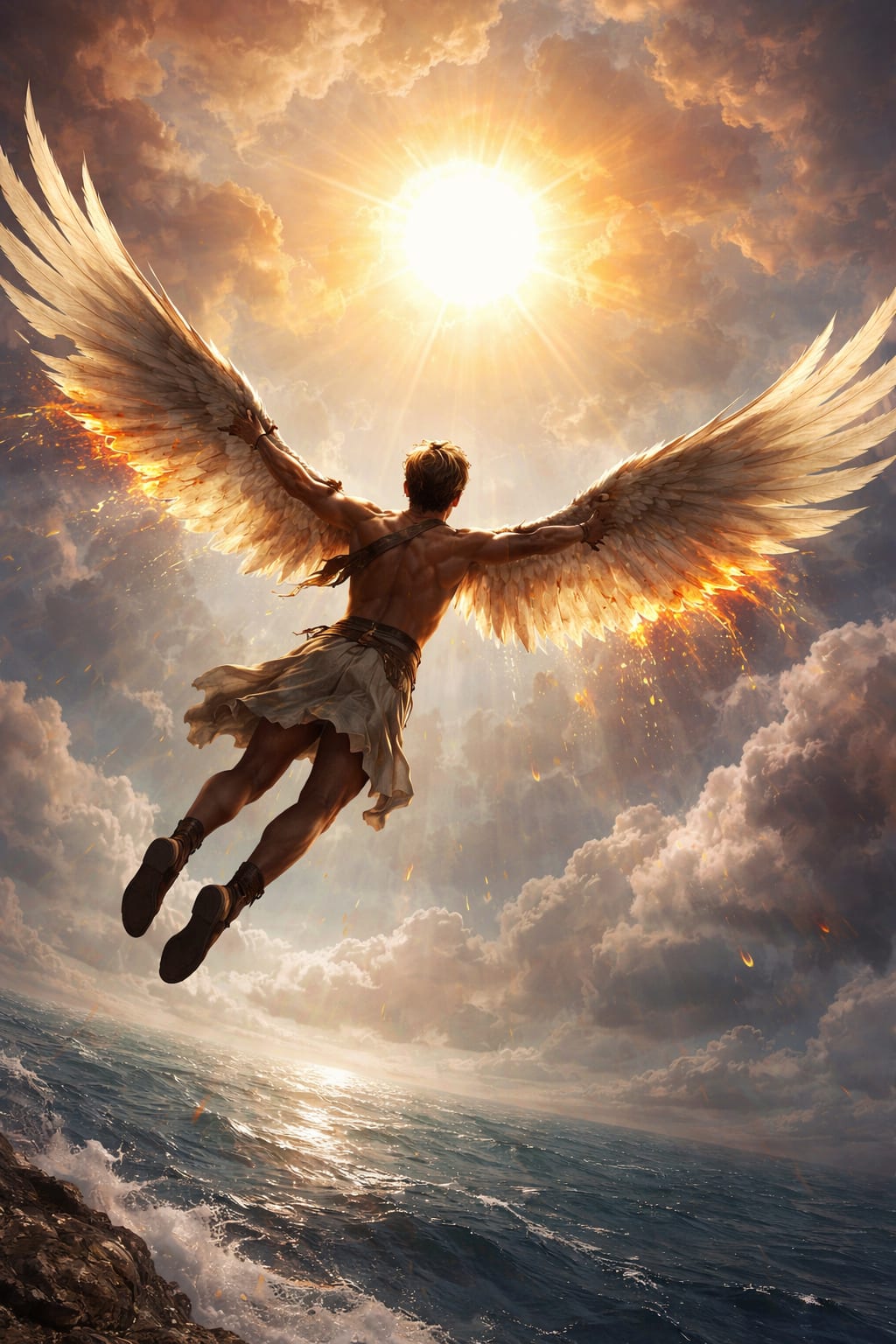
Everyone knows the story of Icarus.
They tell it to children like a warning wrapped in sunlight: a boy given wings who flew too close to the sun, ignoring his father's wisdom. Pride carried him upward. Heat melted the wax. The sea took him.
The lesson is simple.
Ambition is dangerous.
But simple stories survive because they leave things out.
And no one ever asks about the wax.
My name is Theron. You will not find it in the myths. I was a boy then, an apprentice in the workshop of Daedalus on the island of Crete. My hands smelled of melted beeswax for weeks, and if you look closely enough at the story of Icarus, you will find my fingerprints in it.
Not that anyone ever looks closely.
People prefer the myth.
Daedalus began gathering feathers from the courtyard--white gull feathers scattered along the stone. Then from the markets, then from fishermen who brought sacks of them in exchange for coins.
I sorted them by size.
The largest feathers went to the outer frame. The smaller ones layered beneath.
Icarus sat beside me most nights while we worked.
He was not reckless the way the poets say. He was thoughtful, always asking questions in a quiet voice.
"Why feathers?" he asked once.
"Because feathers know the sky," Daedalus replied without looking up.
"But wax melts."
The room went silent for a moment.
Daedalus kept stitching.
"Yes," he said finally.
King Minos had sealed the island around us like a locked box. No ships would take Daedalus away. No gates opened for his apprentices.
The Labyrinth had been built, and the king feared the man clever enough to design it.
So Daedalus decided we would leave through the only door Minos did not control.
The sky.
When he said it aloud for the first time, I laughed.
Icarus didn't.
He looked at the feathers piled around the room and then at the wings slowly taking shape on the wooden frame.
"You're serious," he said.
Daedalus nodded.
The wings were magnificent.
That world feels too small now, but I don't know another one.
Feathers layered like armor. A curved frame of wood and bone. Threads pulling everything together.
But the wax worried me.
Real wings don't need wax. Birds have hollow bones and muscles and instincts carved by generations of sky.
We had melted beeswax and hope.
I tested it one night after Daedalus left the workshop, I warmed a small seam near the fire and pressed my thumb into it.
It softened almost immediately.
Too soft.
The next morning, I showed him.
"We need stronger wax," I said. "Or resin. Something harder."
He stared at the wings for a long time.
"We don't have time," he said.
The myth says Daedalus warned Icarus not to fly too high.
That part is true.
But it leaves out the way his voice sounded when he said it.
The night before we left, he stood between the two finished sets of wings and spoke carefully, like a man building a bridge out of words.
"Fly neither too low nor too high," he said. "The sea will weigh down the feathers, and the sun will soften the wax."
So the myth remembers the second thing he said.
"The wings will not last forever"
Morning came pale and windy.
We climbed the cliffs before sunrise. The sea stretched out beneath us like polished metal.
Daedalus strapped his wings on first.
He stepped toward the edge and turned back once.
"Watch closely," he told Icarus.
Then he jumped.
For a moment he dropped like a stone.
Then the wings caught the wind.
He rose.
Not smoothly, not like a bird--but he rose.
Icarus laughed.
Not the wild laugh of a reckless boy.
The stunned laugh of someone realizing the impossible has just become real.
When it was his turn, I tightened the leather straps across his chest.
"You could stay," I told him quietly.
"With Minos?" he said.
I didn't answer.
He looked at the wings again.
"They'll hold," he said, more to himself than to me.
Then he stepped to the edge and leapt.
The first moments were perfect.
Two figures gliding across the open sky.
From the cliff they looked like birds learning a forgotten language.
The wind lifted them higher.
Higher than Daedalus intended.
He corrected immediately, angling downward.
But the currents were strong that morning. The sky is not empty--it moves and twists like a river, and it does not care about men with borrowed wings.
I saw Icarus adjust his angle, fighting the pull of the wind.
That part is important.
Because the myth says he chased the sun.
But from where I stood, it looked like he was trying to stay in control.
Then the feathers began to slip.
It started near the edge of the left wing.
One feather loosened.
Then another.
Wax softened under the rising heat of morning.
Not melting into liquid the way the poets describe.
Just soft enough.
Soft enough for gravity to begin its quiet work.
Icarus tilted sideways, trying to balance the strain.
For a moment it worked.
Then the wind struck again.
A seam split.
The wing folded.
And suddenly the sky had nothing left to hold him.
He fell faster than anyone expects.
Falling is quick.
Stories slow it down.
The sea does not.
Daedalus circled above the water screaming his son's name until the wind carried the sound away.
Then he turned west and kept flying.
The wings would not survive another hour.
Years later, the story changed.
Poets carved it into something smoother.
A warning about pride.
A boy who flew too close to the sun.
The sun is easier to blame than desperation.
Easier than flawed wax and a father racing against a king's prison.
And much easier than the truth.
The truth is that Icarus did not fall because he was arrogant.
He fell because the wings were never strong enough to carry a human dream across the sky.
But myths are not interested in truth.
They are interested in lessons.
And lessons prefer simple villains.
So the story keeps blaming the boy.
While the wax--soft, imperfect, and entirely human-- quietly disappears from memory.
Because myths remember heroes and warnings. But they forget the fragile things that actually break.
About the Creator
Keep reading
More stories from Lydia martinez and writers in Fiction and other communities.
The Borrowed Feelings Store
The line at the Borrowed Feelings Store wrapped around the block, but no one seemed bothered. People waited patiently, holding their empty jars, tapping their feet, checking their watches. A woman behind me hummed softly, the kind of tune someone uses to keep their hands warm.
By Lydia martinez21 days ago in Fiction
The Apple Gardener
Sally was ready to begin her compulsive schedule of doing an hour of work in the garden. Gardening is good for mental health. Gardening was her time to empty her mind. This was her time of meditation. She decided to do a 21-day challenge and journal her no-thoughts during mindful moving meditation. She noted the irony of this intention.
By Katherine D. Graham7 days ago in Fiction


Comments
There are no comments for this story
Be the first to respond and start the conversation.