
We Set a Place for Her Out of Habit
The habit began after she died.

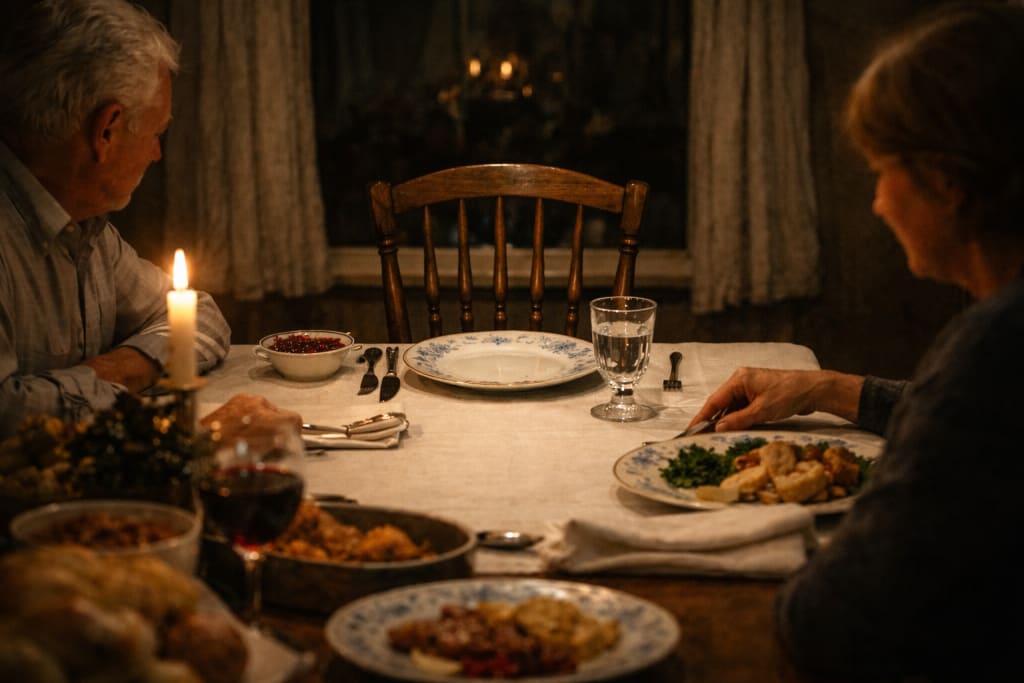
On the first Sunday after the funeral, my mother set out five plates instead of four.
She did it the way she did everything in the kitchen—without flourish, without apology, as if the act were too ordinary to notice. The roast came out of the oven. The green beans steamed in their bowl. The good napkins, still faintly smelling of starch, were folded into rectangles and laid beside the forks.
Then she opened the china cabinet and took down Evelyn’s plate.
Not one of the everyday ones. Not the thick white ceramic we used when it was just family and no one cared if something chipped. She took down the blue-edged plate with the small painted violets around the rim, the one Evelyn always used because she said food tasted better on pretty things.
My father saw it. I saw him see it.
He was standing at the sink peeling the label off a bottle of wine, a habit he had when he was nervous, though he would never have called it that. His hand stopped halfway down the glass. For a moment I thought he might say something.
Instead he asked, “You want me to cut the bread?”
My mother placed Evelyn’s plate at the far end of the table, under the window.
“Yes,” she said. “Thin slices.”
So that was that.
My brother Daniel came in carrying ice and looked at the table and then at me, his eyebrows lifting just slightly, a private question. He was two years older and had perfected the art of speaking entire paragraphs with his face during childhood, mostly in church and at school assemblies when we weren’t allowed to whisper.
I gave him the smallest shake of my head.
Don’t.
He understood. He always had.
We sat down at six, the way we always had on Sundays. My father at the head. My mother opposite him. Daniel to my left. Me to my right. And Evelyn at the end, where the window reflected the room back at us in the darkening glass.
There was no chair there.
Just the place setting. Plate, fork, knife, water glass, cloth napkin folded in a triangle. My mother had even set out the little dish for the cranberry relish Evelyn liked and no one else touched.
My father bowed his head.
“For what we are about to receive,” he said.
His voice did not break. My father did not break in front of people. Not at the funeral, not at the cemetery, not when the casseroles started arriving from neighbors in disposable aluminum trays. He had become quieter, though, as if some internal mechanism had decided speech was an unnecessary expense.
When he finished the prayer, my mother passed the roast as though nothing were unusual.
“Daniel, white meat or dark?”
“Dark.”
“Claire?”
“A little of both.”
She served me. She served my father. She served herself.
Then she lifted the spoon over Evelyn’s plate and paused, only for a second, before laying down two neat slices, a spoonful of beans, and a scoop of potatoes that touched nothing else on the plate.
I waited for the room to correct itself.
For one of us to say her name in the right tone. For Daniel to laugh in disbelief. For my father to put down his fork and say, Lois, enough. For my mother herself to look at what she had done and crumble under its absurdity.
Instead Daniel asked if anyone wanted butter.
My father said, “Pass it here.”
And the meal went on.
That was how it began.
By the third Sunday, the ritual had hardened into structure.
Five plates. Five glasses. Five folded napkins.
My mother cooked the things Evelyn liked best—rosemary chicken, scalloped potatoes, buttered carrots cut into coins. Desserts with fruit in them, because Evelyn distrusted chocolate and said it was a lazy way to make people love you. At first I thought this was grief in its rawest form, the mind refusing to accept what the body already knew. I had read enough pamphlets in the funeral home lobby to recognize denial when I saw it.
But denial, I thought, was supposed to be frantic. Temporary. Wet-eyed. My mother looked none of those things.
She looked composed.
That was worse.
By October, no one remarked on the fifth setting anymore. My aunt Paula came for dinner one Sunday after church and didn’t so much as blink when she saw the table.
She kissed my mother on the cheek and said, “You’ve made the potatoes the way she liked.”
“I had extra cream,” my mother answered.
Aunt Paula nodded, set down the pie she’d brought, and asked my father how work was.
I stood in the doorway holding a bowl of salad and felt, with a peculiar clarity, that I had stepped half an inch to the left of the world I used to live in. Everything was recognizable. Everything had its proper name. Yet all of it was wrong in a way no one was willing to admit.
At dinner, Aunt Paula spoke directly toward the empty end of the table twice.
The first time, she said, “You’d be pleased to know Father Mike finally fixed that draft in the parish hall.”
The second time, while cutting her pork, she murmured, “Your roses came back stronger than mine this year, and I still don’t know how you did it.”
No one answered her.
No one needed to.
The trouble with a family ritual is that once it survives three or four repetitions, it begins to feel ancient. By Christmas, I could barely remember what it had been like to sit down to four plates.
Evelyn had died in July. A stupid sentence. A sentence with no architecture to hold its meaning. People died in July all the time, presumably. The world did not pause over each of them.
She had been forty-two. She had been my mother’s younger sister. She had lived ten minutes away and never married and kept her house overbright and overclean and arranged her books by color instead of author because she said order ought to be beautiful. She wore perfume in the daytime and silk scarves to the grocery store and once told me there was no virtue in looking as tired as you felt.
She drowned in three feet of water.
That was what the coroner said, and perhaps it was true in the way official things are true. But it had happened in her own backyard, face-down in the decorative pond she’d paid a man from Hartford to install because she liked the sound of water near the hydrangeas. There were no bruises. No sign of a struggle. No alcohol. No stroke. No aneurysm.
Just a body in a pond too shallow to justify it.
The police were kind and useless. The priest was solemn and useless. The neighbors were casseroles and folded hands and useless.
My mother began setting the place the next Sunday.
In January, I came home from graduate school for a long weekend and found that the ritual had developed rules.
No one sat in Evelyn’s chair because there was now, unmistakably, a chair there. The same spindle-back chair my mother had borrowed from the breakfast nook and placed at the end of the table sometime in November, apparently deciding the absence had become impolite.
No one removed the plate until everyone else had finished eating.
No one touched the food served onto it.
After dinner, my mother scraped the potatoes and meat into the trash but poured the water from Evelyn’s glass into the sink with unusual care, as though returning something borrowed.
I watched this happen while drying the regular dishes.
“Mom,” I said quietly, “why are we still doing this?”
She took her time folding the damp dish towel over the oven handle. “Because it would be unkind not to.”
“To whom?”
My mother looked at me then, and there was something in her face I had not seen before. Not confusion. Not madness. Annoyance, perhaps, that I had asked a question to which the answer was obvious.
“To Evelyn,” she said.
I laughed before I could stop myself. It came out sharp and ugly. “She’s dead.”
The kitchen went still.
Daniel, who had been stacking leftovers into containers, froze with the lid half on the beans. My father stood in the doorway with his car keys in his hand and did not move.
My mother did not slap me. She was not theatrical enough for that. She simply went pale in a way that made me feel I had done violence.
“Yes,” she said. “And?”
I had no reply that didn’t sound monstrous.
That night I slept in my old room beneath the sloped ceiling and woke at 2:17 to the low murmur of voices downstairs.
For a moment I thought burglars, absurdly, and then recognized my mother’s cadence. Soft. Patient. The tone she once used to explain long division and later to coax my niece into eating peas.
I got up and stood at the top of the stairs.
The dining room light was on.
My mother sat alone at the table in her robe, a cup of tea in front of her. Across from her, at the end beneath the window, was Evelyn’s place. Not set for dinner this time, just a saucer and a teacup, pale blue, with steam rising from it.
My mother was listening.
That was the worst part. Not talking—listening, with her head tilted slightly and one hand curved around her own cup.
Then she nodded.
“I know,” she said into the empty room. “I told him that.”
My skin tightened down my arms.
The floorboard beneath me gave a small complaint, and my mother turned. For an instant I thought I saw another shape reflected in the window behind the chair, not fully a person but a vertical density, a wrongness in the dark. Then the furnace kicked on and the reflection broke apart into light and shadow.
“What are you doing up?” my mother asked.
I wanted to say: Who were you speaking to? What have you convinced everyone else to pretend? What lives in this house now that all of you are too polite to name?
Instead I said, “I was thirsty.”
“There’s water in the pitcher.”
I went to the kitchen, poured a glass I didn’t want, and returned to bed.
By spring, I had nearly persuaded myself I’d imagined it.
That is the danger of prolonged wrongness. If everyone treats it as weather, eventually you stop looking for shelter.
Then Easter came.
My mother roasted lamb. Aunt Paula brought asparagus. Daniel arrived with his wife, Mara, and their little girl, Sophie, who was five and still young enough to say exactly what adults spent their lives editing.
The table was beautiful. Candles. Linen cloth. Five places, of course.
We had just sat down when Sophie frowned at the end chair.
“Mommy,” she whispered, not whispering at all, “why does Aunt Evelyn look wet?”
Mara’s hand jerked so hard her wine nearly spilled.
Daniel said, too quickly, “Sophie.”
But Sophie was staring, open and puzzled, not frightened. Children do not know when to be frightened. They have to learn it from us.
“She’s dripping on the floor,” Sophie said.
No one moved.
My father lowered his fork with exquisite care. Aunt Paula looked at her lap. Mara reached for Sophie’s wrist.
And my mother—my calm, competent mother, who ironed pillowcases and sent thank-you notes and had not once in her life spoken a sentence she could not defend—turned toward the end of the table and said gently:
“Evelyn, sweetheart. You know how she gets. Could you please try not to upset the child?”
For one impossible second, there was a sound.
Not a voice exactly. More the soft disturbance of someone shifting in wet clothes. The faint tap of water against hardwood.
Then Sophie relaxed.
“Okay,” she said, as if someone had answered a question to her satisfaction, and reached for a dinner roll.
No one mentioned it.
Not during dessert. Not while loading the dishwasher. Not when Daniel and Mara bundled Sophie into her coat and drove home through the dusk. The silence held with the smoothness of long practice, as if the whole family had stepped together over a crack in the pavement.
I was the only one left unsettled enough to speak.
My mother was covering the lamb with foil when I said, “How long?”
She did not make me explain.
“A few weeks after the funeral,” she said.
“And everyone knows?”
“Of course everyone knows.”
“You all just decided this was normal?”
My mother finally looked tired. Older than I had allowed her to become. “No, Claire,” she said. “We decided normal was no use to us.”
She smoothed the foil with both hands.
“Your aunt comes on Sundays,” she said. “She sits where the window catches the last light. She complains when the beans are overcooked. She still doesn’t like chocolate. Your father sleeps through the night now. Daniel doesn’t avoid this house anymore. Sophie says she smiles at her from the hallway.” My mother swallowed. “Tell me which part I’m meant to throw away.”
I stood there with the dish towel in my hand and no argument large enough to cover the table between us.
From the dining room came the faint clink of silverware settling, though no one was in there.
My mother did not turn around. Neither did I.
After a moment, she said, very softly, “Go put the kettle on, would you? She’ll want tea.”
And because the water was already in the kettle, because the cups were right there in the cabinet, because the habit had begun after she died and had by then become the architecture of the house, I did.
About the Creator
Edward Smith
I can write on ANYTHING & EVERYTHING from fictional stories,Health,Relationship etc. Need my service, email [email protected] to YOUTUBE Channels https://tinyurl.com/3xy9a7w3 and my Relationship https://tinyurl.com/28kpen3k
Keep reading
More stories from Edward Smith and writers in Fiction and other communities.
The Reflection That Didn't Match
The first time I noticed, we were getting ready for the Hendersons' anniversary party. Daniel stood at the bathroom mirror, adjusting his tie. I was behind him, pinning my hair, watching his reflection in the glass.
By Edward Smith3 days ago in Fiction
TUS NUA - ch 53
TUS NUA – ch 53 New Beginnings – Mia and Midnight (*)(*)(*) Finola knew Ali’s brother-in-law needed to put his mind at rest. She fed her arm through his and led him outside. “We’ll sit here. If you like, I can put a block around us so our conversation will be private.”
By Margaret Brennanabout 23 hours ago in Fiction



Comments (1)
Lovely♥️✨️