
Agentic AI in Energy Market to Exceed USD 10,700 Million By 2034
Energy companies are leveraging agentic AI to enhance predictive maintenance, demand forecasting, and operational efficiency.

Agentic AI in Energy Market Overview
The global Agentic AI in Energy Market is projected to reach approximately USD 10,700 Million by 2034, rising from nearly USD 480 Million in 2024. This expansion reflects a strong CAGR of 36.40% during the forecast period from 2025 to 2034. Market growth is being driven by the increasing use of autonomous artificial intelligence systems to manage complex energy operations, including power generation optimization, grid management, predictive maintenance, and energy demand forecasting. Energy companies are integrating agentic AI technologies to automate decision making processes and improve the efficiency of energy infrastructure.
Explore Detailed 2025-2035 Market Report Forecasts Today
In 2024, North America held a leading position with more than 34% share, generating approximately USD 163 Million in revenue. Within this region, the United States accounted for nearly USD 156 Million, reflecting strong adoption of AI technologies within the energy sector. The U.S. market is projected to grow at a CAGR of 34.1%, supported by rapid deployment of AI driven analytics systems, smart grid infrastructure, and investments in energy technology innovation.
How Agentic AI is Transforming the Energy Industry?
Agentic AI represents an advanced form of artificial intelligence capable of autonomous decision making and real time operational management. In the energy sector, these systems can analyze large volumes of data from sensors, power plants, transmission networks, and renewable energy facilities. By continuously monitoring operational conditions, agentic AI systems can adjust power generation levels, optimize grid performance, and improve energy distribution efficiency.
Another important transformation involves the integration of AI driven automation within renewable energy management systems. Renewable energy sources such as solar and wind often produce variable output depending on environmental conditions. Agentic AI systems analyze weather data, energy demand patterns, and grid capacity to automatically balance supply and demand. This capability helps energy companies maintain stable electricity supply while integrating increasing amounts of renewable energy into the grid.
Scope and Research Methodology
The evaluation of the agentic AI in energy market focuses on analyzing technology adoption across energy infrastructure, smart grid systems, and renewable energy management platforms. Research data is typically derived from energy industry reports, government energy policies, smart grid deployment statistics, and enterprise investments in artificial intelligence technologies.
Market analysis also considers indicators such as expansion of renewable energy capacity, growth in smart grid installations, and increasing adoption of predictive maintenance systems in power plants. These indicators provide insights into the evolving role of artificial intelligence in modern energy management systems. Through this analytical framework, researchers assess the market’s long term growth potential and identify emerging technology trends.
Key Forces Driving Market Expansion
One of the primary forces driving market growth is the increasing complexity of modern energy systems. Energy networks must manage large volumes of data related to power generation, transmission, consumption patterns, and equipment performance. Agentic AI technologies enable energy companies to analyze these datasets and automate operational decisions, improving efficiency and reliability across energy infrastructure.
Another important factor supporting market expansion is the global transition toward renewable energy sources. Renewable energy systems require advanced management tools capable of balancing intermittent power generation with fluctuating demand. AI driven automation systems help energy operators manage these challenges by forecasting production levels and optimizing energy distribution in real time.
Emerging Trends Analysis
One significant trend in the agentic AI in energy market is the development of autonomous grid management platforms. These systems monitor energy flow across transmission networks and automatically adjust distribution levels to prevent overloads or power outages. By enabling real time operational adjustments, autonomous grid management systems improve overall energy network stability.
Another emerging trend involves the integration of digital twin technologies with AI driven energy management systems. Digital twins create virtual models of energy infrastructure such as power plants, turbines, and transmission networks. Agentic AI systems analyze data from these virtual models to simulate operational scenarios and identify optimal performance strategies.
Driver Analysis
A key driver of market growth is the increasing need for predictive maintenance within energy infrastructure. Power plants, wind turbines, and transmission equipment require continuous monitoring to prevent operational failures. Agentic AI systems analyze sensor data to detect early signs of equipment malfunction, allowing operators to schedule maintenance before failures occur.
Another major driver is the growing deployment of smart grid technologies. Smart grids integrate advanced sensors, communication systems, and automated control mechanisms within electricity networks. AI powered decision systems enhance smart grid performance by analyzing real time data and adjusting energy distribution strategies.
Restraint Analysis
Despite strong growth prospects, the market faces certain limitations related to high implementation costs. Deploying advanced AI systems within energy infrastructure requires significant investment in data analytics platforms, sensor networks, and computing infrastructure. Smaller energy providers may face financial challenges when adopting such technologies.
Another restraint involves concerns related to cybersecurity risks. Energy infrastructure is considered critical national infrastructure and must be protected from cyber threats. Integrating AI systems into energy networks increases the importance of implementing strong cybersecurity measures to protect operational data and maintain system integrity.
Opportunity Analysis
Significant opportunities exist in the development of AI driven energy forecasting platforms. These systems analyze historical consumption data, weather patterns, and industrial activity to predict future energy demand. Accurate forecasting enables energy providers to optimize generation strategies and reduce operational inefficiencies.
Another opportunity lies in the expansion of AI powered renewable energy optimization systems. As renewable energy installations continue to increase globally, energy companies require advanced technologies capable of managing distributed energy resources. Agentic AI systems can coordinate multiple renewable sources and improve overall energy grid performance.
Challenge Analysis
One major challenge in the agentic AI in energy market involves integrating AI technologies with legacy energy infrastructure. Many power systems were designed decades ago and may not support modern digital technologies without significant upgrades. Integrating AI platforms into these systems requires careful planning and substantial infrastructure modernization.
Another challenge relates to workforce skills and expertise. Implementing AI driven energy management systems requires professionals with expertise in both artificial intelligence and energy engineering. Developing this specialized workforce remains an important challenge for energy companies adopting advanced AI technologies.
Top Use Cases of Agentic AI in Energy
One major application of agentic AI in the energy sector is autonomous energy grid optimization. AI systems continuously analyze electricity demand, generation capacity, and grid performance to optimize power distribution across networks. This capability improves energy efficiency while reducing the risk of grid instability.
Another important use case involves predictive maintenance of energy infrastructure. AI systems monitor equipment performance using sensor data and advanced analytics to detect early signs of failure. This approach allows energy companies to reduce maintenance costs and prevent unexpected operational disruptions.
Conclusion
The global Agentic AI in Energy Market is expanding rapidly as energy companies adopt advanced artificial intelligence technologies to manage increasingly complex energy systems. With the market projected to reach USD 10,700 Million by 2034, agentic AI is becoming a critical tool for optimizing power generation, improving grid stability, and supporting renewable energy integration.
North America currently leads the market with more than 34% share, generating approximately USD 163 Million in revenue, while the United States accounts for nearly USD 156 Million and is expected to grow at a CAGR of 34.1%. As energy systems continue to modernize and renewable energy adoption accelerates, agentic AI technologies are expected to play a central role in shaping the future of global energy infrastructure.
About the Creator
Roberto Crum
I am blogger, digital marketing pro since 4.5 years and writes for Market.us. Computer Engineer by profession. I love to find new ideas that improve websites' SEO. He enjoys sharing knowledge and information about many topics.
Keep reading
More stories from Roberto Crum and writers in Futurism and other communities.
AI in Workplace Market to Exceed USD 2,299.1 Billion by 2033
AI in Workplace Market Overview The global AI in Workplace Market is projected to reach approximately USD 2,299.1 Billion by 2033, increasing from nearly USD 113.5 Billion in 2023. This expansion represents a strong CAGR of 35.1% during the forecast period from 2024 to 2033. Market growth is being driven by the rapid integration of artificial intelligence technologies into workplace operations, including productivity tools, collaboration platforms, workforce analytics systems, and automated decision support solutions.
By Roberto Crumabout 7 hours ago in Futurism
Australia Pro AV Market: Hybrid Work Demand, Digital Signage & Smart AV Technologies
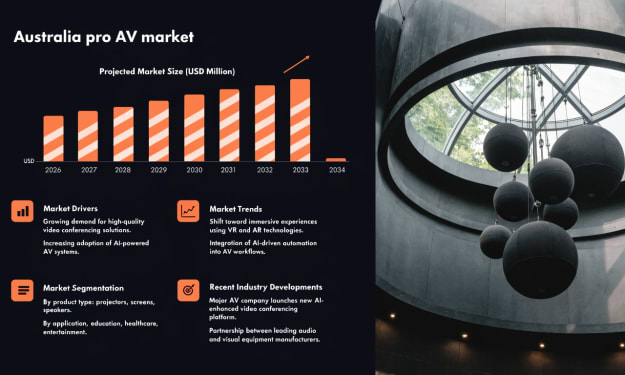
According to IMARC Group, the Australia pro AV market reached a value of USD 93.9 Million in 2025 and is projected to reach USD 133.6 Million by 2034, growing at a compound annual growth rate (CAGR) of 3.88% during 2026–2034. The market is expanding as organizations increasingly adopt advanced audiovisual solutions to support communication, collaboration and digital engagement. Hybrid work environments are encouraging businesses to invest in video conferencing systems, smart displays and integrated collaboration platforms that connect remote and in-office teams. At the same time, industries such as retail, hospitality and tourism are investing in digital signage to improve customer engagement and brand communication. As companies focus on creating interactive and technology-driven environments, professional AV solutions are becoming essential tools for modern workplaces, entertainment venues and commercial spaces across Australia.
By Kevin Cooperabout 9 hours ago in Futurism
Why Your TikTok DMs Aren't Private (And Why the Platform Says That's a Good Thing)
Introduction: The Privacy Paradox In the current landscape of digital communication, end-to-end encryption (E2EE) has moved from a niche privacy feature to a baseline consumer expectation. Silicon Valley giants are largely in a race to lock down user data, ensuring that not even the platforms themselves can peer into private conversations. Yet, TikTok—the world’s most scrutinized social media app—is pointedly marching in the opposite direction.
By Tech Horizons3 days ago in Futurism



Comments
There are no comments for this story
Be the first to respond and start the conversation.