
Alternative Fuels Market Insights: USD 688.2 Billion by 2034
Fueling the Future: A Professional Overview of the Global Alternative Fuels Market
Overview
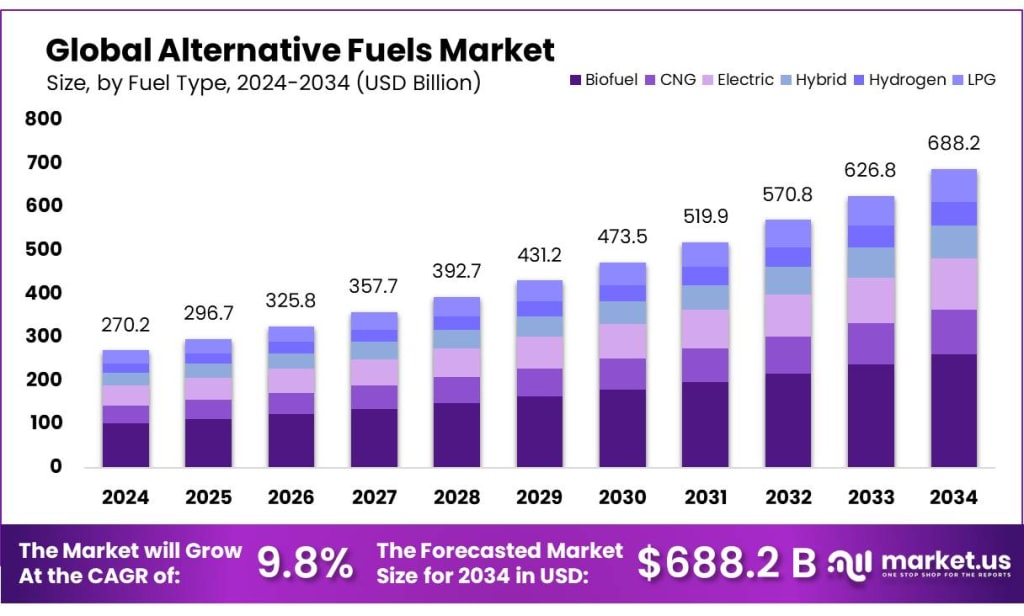
The Global Alternative Fuels Market is on a strong growth trajectory, projected to expand from USD 270.2 billion in 2024 to USD 688.2 billion by 2034, representing a compound annual growth rate of 9.8% over the forecast period. North America currently leads the market, accounting for a 43.2% share of global revenue in 2024.
Market Drivers
Government policy is the central force shaping this market. In the United States, the Renewable Fuel Standard under the Energy Independence and Security Act mandates 36 billion gallons of renewable fuel blending annually — including 16 billion gallons from cellulosic biofuels — displacing approximately 13.6 billion gallons of petroleum-based fuel, equivalent to roughly 7% of total transport fuel consumption. The economic case is equally compelling: the biofuels sector generated USD 13 billion in annual farm income by 2022, while carbon reduction credentials are well-established, with corn ethanol reducing lifecycle greenhouse gas emissions by approximately 21%, sugarcane ethanol by 61%, and cellulosic ethanol by up to 129% compared to fossil fuels.
India presents one of the most ambitious national programs in the sector. The Sustainable Alternative Towards Affordable Transportation initiative targets 5,000 compressed biogas plants with a combined annual production capacity of 15 million metric tonnes. The government's Ethanol Blended Petrol programme aims for 20% ethanol blending, projected to deliver USD 4 billion in annual savings through reduced fuel imports. Supporting this, a national investment of ₹5,000 crore has been allocated for seven second-generation bioethanol refineries, with a broader ₹10,000 crore plan for 12 facilities. At the state level, Gujarat has committed ₹3,300 crore through dairy cooperative-led investments to establish ethanol plants with 2,800 KLPD capacity, alongside 30 compressed biogas plants capable of powering 80,000 vehicles annually.
Segment Performance
Electricity dominates the fuel type landscape, commanding a 37.5% market share in 2024, driven by surging electric vehicle sales, rapid expansion of charging infrastructure, and tightening emission regulations across major economies. Passenger vehicles lead by vehicle type, holding a 57.1% share, as rising fuel costs and environmental awareness have accelerated consumer adoption of electric and hybrid models. Battery electric drive is the leading propulsion technology at 42.2%, supported by declining battery costs, improved driving range, and sustained government incentives. The transportation sector accounts for 68.9% of total end-use demand, encompassing vehicles, aviation, and rail — all of which are subject to intensifying decarbonisation mandates.
Regional Landscape
North America maintains its position as the leading regional market, underpinned by the U.S. Renewable Fuel Standard, the Inflation Reduction Act, and a national EV fleet exceeding 3.5 million vehicles supported by over 160,000 public charging stations. Annual ethanol production in the region surpasses 15 billion gallons. Canada reinforces the regional outlook through its Clean Fuel Regulation, which targets a 15% reduction in fuel carbon intensity by 2030.
Industry Developments
Major energy companies are repositioning their portfolios in response to these structural shifts. BP has moved aggressively into bioenergy through its acquisition of Archaea Energy, significantly scaling its renewable natural gas and sustainable aviation fuel capabilities. ExxonMobil has acquired Denbury Inc. to secure the largest CO₂ pipeline network in the United States, anchoring a carbon capture strategy that supports its low-carbon fuels ambitions. Sasol is advancing a flagship green hydrogen project at Boegoebaai in partnership with the South African government, targeting ammonia exports to Europe. GE Vernova is developing gas turbines capable of running on hydrogen blends, with a roadmap toward full hydrogen combustion, while GE Aerospace is testing engines on 100% sustainable aviation fuel. DuPont's advanced membrane technologies are enabling the proton exchange membrane electrolysis processes central to green hydrogen production.
Conclusion
The alternative fuels market is entering a period of sustained, policy-backed expansion. Diverse fuel pathways — electric, biofuel, hydrogen, and compressed natural gas — are finding established roles across transportation segments, from urban passenger vehicles to long-haul freight and commercial aviation. As infrastructure matures and costs continue to decline, alternative fuels are positioned to become the foundational energy source for low-carbon mobility over the next decade.
About the Creator
Hayden Kulas
I am blogger, digital marketing pro since 5 years and writes for Market.us. Computer Engineer by profession. I love to find new ideas that improve websites' SEO. He enjoys sharing knowledge and information about many topics.
Keep reading
More stories from Hayden Kulas and writers in Futurism and other communities.
Hybrid Solar Wind Systems Market to Reach USD 2.3 Billion by 2034
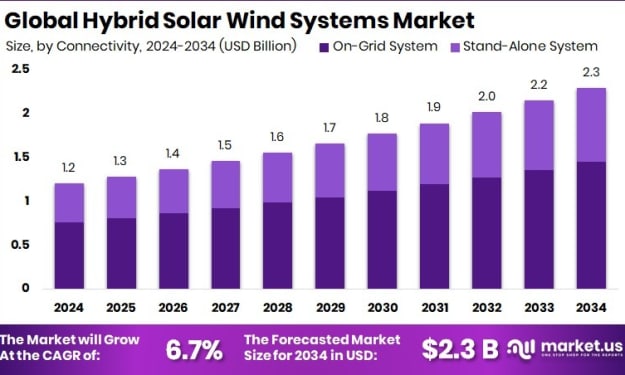
The Global Hybrid Solar Wind Systems Market, valued at USD 1.2 billion in 2024, is projected to reach USD 2.3 billion by 2034, growing at a CAGR of 6.7% from 2025 to 2034. The Asia Pacific region led the market in 2024, holding a 43.8% share worth approximately USD 0.5 billion.
By Hayden Kulas3 days ago in Futurism
Ship Fast, Not Perfect: What Building a Micro-SaaS In One Weekend Taught Me About Momentum
I pushed the deploy button on Sunday at 11:42 p.m., hands shaking, Stripe still in test mode, logo a little crooked, and a feature list that looked like it had been cut in half with a chainsaw.
By abualyaanartabout an hour ago in Futurism
Australia Pro AV Market: Hybrid Work Demand, Digital Signage & Smart AV Technologies
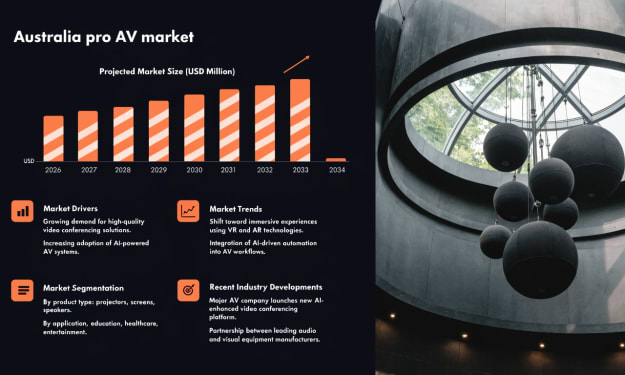
According to IMARC Group, the Australia pro AV market reached a value of USD 93.9 Million in 2025 and is projected to reach USD 133.6 Million by 2034, growing at a compound annual growth rate (CAGR) of 3.88% during 2026–2034. The market is expanding as organizations increasingly adopt advanced audiovisual solutions to support communication, collaboration and digital engagement. Hybrid work environments are encouraging businesses to invest in video conferencing systems, smart displays and integrated collaboration platforms that connect remote and in-office teams. At the same time, industries such as retail, hospitality and tourism are investing in digital signage to improve customer engagement and brand communication. As companies focus on creating interactive and technology-driven environments, professional AV solutions are becoming essential tools for modern workplaces, entertainment venues and commercial spaces across Australia.
By Kevin Cooperabout 12 hours ago in Futurism


Comments
There are no comments for this story
Be the first to respond and start the conversation.