
Gas Engine Market Trends: Distributed Power Demand, Low-Emission Technologies & Industry Forecast to 2033
How expanding natural gas infrastructure, distributed energy systems, and rising industrial power reliability needs are accelerating adoption of efficient gas engine technologies worldwide.

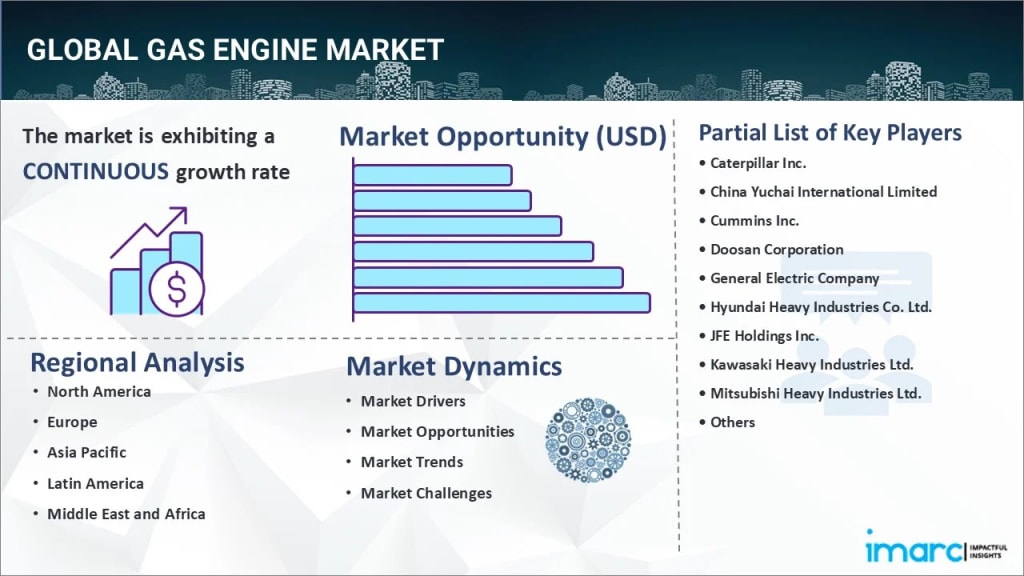
Accelerating industrialization, the global push for cleaner energy, and the rise of decentralized power systems are driving gas engine demand. These systems are supported by the expansion of natural gas infrastructure, government incentives for combined heat and power (CHP), and the integration of hydrogen-ready technologies. According to IMARC Group’s latest data, the global gas engine market size was valued at USD 5.01 Billion in 2025. Looking forward, IMARC Group estimates the market to reach USD 8.08 Billion by 2034, exhibiting a CAGR of 5.61% from 2026-2034. North America currently dominates the market, holding a market share of over 42.1% in 2025.
Gas engines now represent a critical component of the global energy infrastructure, with the market exceeding USD 5 billion and showing robust year-on-year growth. Demand is primarily fueled by the transition away from carbon-heavy coal and diesel toward cleaner-burning natural gas, especially in utility and industrial sectors. Innovation in fuel-flexible designs, such as engines capable of running on biogas or hydrogen blends, is further accelerating adoption. Key segments include the 1-2 MW power output range and natural gas-fueled units, with industries prioritizing electrical efficiency, grid stability, and the ability to utilize waste heat through cogeneration.
Gas Engine Market Growth Drivers:
- Global Transition Toward Lower-Carbon Energy Sources
Governments and industries are aggressively moving away from coal-fired power to meet decarbonization goals, positioning natural gas as a vital bridge fuel. Gas engines offer a significantly cleaner profile than diesel or coal, emitting roughly 25-30% less CO2 and far fewer nitrogen oxides. This shift is visible in utility-scale projects where aging coal plants are being replaced by high-efficiency gas reciprocating engines. As major economies pledge to reduce carbon footprints, the demand for these systems remains high, particularly for their ability to provide reliable, lower-emission baseload and peaking power.
- Rising Demand for Distributed and Decentralized Power
The push for grid resilience and the need to power remote industrial sites are driving the adoption of decentralized energy. Gas engines are ideal for on-site power generation in data centers, hospitals, and manufacturing plants, ensuring an uninterrupted supply during grid failures. In regions like Asia-Pacific, rapid urbanization is outpacing traditional grid expansion, making local gas-powered microgrids a necessity. With industrial sectors increasingly focusing on energy autonomy, the market sees a steady rise in the installation of smaller-scale, 0.5-2 MW units that offer flexible, "always-on" power closer to the point of consumption.
- Increased Adoption of Cogeneration (CHP) Systems
Industrial facilities are increasingly utilizing Combined Heat and Power (CHP) to maximize fuel efficiency, often reaching total system efficiencies of over 90%. By capturing waste heat from the engine to produce steam or hot water for industrial processes, companies significantly lower their operational costs. This economic advantage is a major driver in energy-intensive sectors like chemicals, paper, and food processing. For example, many European and North American manufacturing hubs are retrofitting facilities with gas engines to monetize heat that would otherwise be wasted, directly improving their bottom-line performance and environmental ratings.
Gas Engine Market Trends:
- Integration of Hydrogen-Ready and Fuel-Flexible Designs
A defining trend in 2026 is the development of "future-proof" engines capable of burning hydrogen blends or pure hydrogen. Manufacturers are launching upgrade kits and new platforms that allow operators to switch from natural gas to low-carbon fuels as they become available. Recent real-world applications include 1 MW units operating on 100% green hydrogen in pilot utility projects. This flexibility allows businesses to invest in gas infrastructure today while ensuring their assets remain compliant with future zero-emission mandates, effectively bridging the gap between current natural gas reliance and a future hydrogen economy.
- Digitalization and AI-Driven Predictive Maintenance
The industry is rapidly adopting digital twins and AI-enabled monitoring to reduce downtime and optimize engine performance. Modern gas engines are now equipped with sensors that track thousands of data points, allowing operators to predict component failures before they occur. This shift from reactive to proactive maintenance is particularly critical for data centers and hospitals where power reliability is non-negotiable. By leveraging real-time analytics, companies are extending the service life of their equipment by as much as 60% while simultaneously reducing the Total Cost of Ownership (TCO) through optimized fuel consumption and fewer emergency repairs.
- Expansion of Gas Distribution and LNG Infrastructure
Massive investments in gas pipelines and Liquefied Natural Gas (LNG) terminals, particularly in emerging markets like India and China, are making natural gas more accessible than ever. India's recent $67 billion investment to expand its gas pipeline network by over 9,000 miles is a prime example of how infrastructure drives engine adoption. As LNG becomes a global commodity, price-sensitive regions are gaining the fuel security needed to commit to large-scale gas engine projects. This trend is bolstered by the increasing availability of "virtual pipelines"—truck-delivered LNG or CNG for remote sites—expanding the market's reach beyond traditional grid-connected areas.
Recent News and Developments in Gas Engine Market
- January 2026: Siemens Energy announced a $1 billion investment in the United States to expand manufacturing capacity for grid-stabilizing technologies and high-efficiency gas engines, targeting the surging power demand from the data center sector.
- January 2026: Duke Energy Florida unveiled a pioneering system capable of producing, storing, and combusting 100% green hydrogen, utilizing specialized gas combustion technology to demonstrate the viability of carbon-free peaking power.
- February 2026: GE Vernova successfully commenced commercial operations of its first 9HA-class gas power project in Vietnam, significantly boosting the country's grid capacity and supporting its transition toward more efficient, gas-based generation.
Note: If you require specific details, data, or insights that are not currently included in the scope of this report, we are happy to accommodate your request. As part of our customization service, we will gather and provide the additional information you need, tailored to your specific requirements. Please let us know your exact needs, and we will ensure the report is updated accordingly to meet your expectations.
About the Creator
Andrew Sullivan
Hello, I’m Andrew Sullivan. I have over 9+ years of experience as a market research specialist.
Keep reading
More stories from Andrew Sullivan and writers in Futurism and other communities.
Adhesion Promoter Market Trends: Sustainable Coatings, High-Performance Materials & Industry Forecast to 2034
Optimizing bond strength and surface durability is becoming a central focus for industrial manufacturers as they transition toward advanced composites and high-performance coatings. According to IMARC Group’s latest data, the global adhesion promoter market size was valued at USD 4.44 Billion in 2025. Looking forward, IMARC Group estimates the market to reach USD 6.34 Billion by 2034, exhibiting a CAGR of 4.03% from 2026-2034. Asia Pacific currently dominates the market, holding a significant market share of over 45.3% in 2025.
By Andrew Sullivan6 days ago in Futurism
Cybersecurity Market: Rising Cyber Threats, Advanced Security Solutions & Industry Growth Outlook
According to IMARC Group's latest research publication, The global cybersecurity market size reached USD 326.2 Billion in 2025. Looking forward, IMARC Group expects the market to reach USD 676.3 Billion by 2034, exhibiting a growth rate (CAGR) of 8.40% during 2026-2034.
By sujeet. imarcgroup3 days ago in Futurism
Computed Tomography Market Outlook: Advanced Diagnostic Imaging and Healthcare Expansion Opportunities
According to IMARC Group's latest research publication, The global computed tomography market size was valued at USD 4.93 Billion in 2024. The market is projected to reach USD 7.83 Billion by 2033, exhibiting a CAGR of 5.01% from 2025-2033.
By James Whitman3 days ago in Futurism



Comments
There are no comments for this story
Be the first to respond and start the conversation.