
I Automated Too Much With AI
What Happened When My Side Project Didn’t Need Me

The surprising truth about what you lose when your “dream” side project runs on autopilot without you.
I didn’t realize I’d automated myself out of my own life until my side project stopped asking for my attention—and I kind of hated it.
I Automated Too Much With AI And Accidentally Fired Myself
The project started the way a lot of side projects do: late at night, browser tabs everywhere, a quiet panic that I was wasting my potential.
I wanted something small but real.
Something that made money while I slept.
Something I could point to and say, “I built that.”
So I built a little content-driven side project.
A niche site that answered specific questions in a space I understood: tools, workflows, tiny productivity hacks that people actually search for.
At first, it was just me.
I wrote every article, replied to every email, tracked every tiny analytics spike like it was a heartbeat.
Then I started wondering how much I could automate.
Not because I was lazy.
Because I was exhausted.
Full-time job, relationships, rent, dishes, all stacked on top of this thing that existed only in the margins of my day.
AI looked like an exit ramp from burnout.
So I automated:
AI-generated outlines for articles
AI-assisted drafts based on my notes
AI scheduling for social posts
AI summarizing user feedback into “actionable” bullets
AI chat widget for support
AI tools to track metrics and send me “insights”
It felt like power.
Like I’d discovered a cheat code.
The more I automated, the more the project grew.
Traffic went up, subscribers trickled in, affiliate sales started landing.
Then something strange happened.
My side project stopped needing me.
Not metaphorically.
Literally.
Days went by where there was nothing for me to do that the system wasn’t already doing better, faster, or more consistently.
And I didn’t feel free.
I felt irrelevant.
The Quiet, Uncomfortable Moment Nobody Talks About
The weirdest moment wasn’t the first payout.
It wasn’t the first time I saw a spike in search traffic while I was at the grocery store.
It was a Tuesday.
I logged in, ready to “work on the project,” and realized there was nothing urgent, nothing broken, nothing that couldn’t be handled by the workflows I had wired up.
New content?
The AI drafts were already queued based on keyword lists I’d fed into it weeks ago.
Email welcome sequence?
Running on autopilot, A/B tests cycling without me.
Social posts?
Scheduled.
Hashtags optimized.
Engagement replies pre-drafted.
Customer questions?
Handled by a chatbot fine-tuned on the content library and a chunk of my old emails.
The dashboard said everything was “green.”
Revenue was steady.
And I, the creator, sat there feeling like someone who showed up to a job they’d already been laid off from.
“Is this… it?”
That was the first thought.
The second thought hit harder:
“If this doesn’t need me… who does?”
Automating my side hustle was supposed to give me freedom.
Instead, it forced me to notice how much of my identity was built around being “needed,” even by a website.
Why Do People Over-Automate Their Side Projects?
The mistake wasn’t using AI.
The mistake was using it to erase myself from the process instead of amplify what only I could do.
When I talked to a few friends who were also building “AI-assisted” projects, I realized I wasn’t alone.
We automate too much with AI because:
We confuse friction with waste.
Not every slow moment is inefficiency.
Sometimes the friction is where we actually feel the work, process it, care about it.
We secretly hope to escape ourselves.
The part that doubts.
The part that procrastinates.
The part that feels insecure in front of a blinking cursor.
Automation looks like an upgrade, but sometimes it’s just avoidance dressed up as productivity.
We’ve swallowed the “passive income” fantasy whole.
We think the ideal side project is one that runs with zero involvement.
But when we get close to that, it can feel less like freedom and more like watching someone else raise our kid.
We mistake “system” for “soul.”
Systems are satisfying.
You can diagram them.
Measure them.
But they don’t love your ideas. They don’t wrestle with your values. They just execute.
The thing about automation is that it quietly removes small human moments.
Answering a weird email.
Tweaking a headline because something in your gut doesn’t like it.
Seeing a comment that changes how you think about your audience.
These don’t show up on dashboards.
But they’re the moments that make a project feel alive to you.
What Actually Broke When My Side Project Didn’t Need Me
From the outside, nothing was wrong.
If you looked at my metrics, you’d think I was winning the “AI side hustle” game.
Under the hood, a bunch of things started fraying.
None of them were obvious at first.
Here’s what actually broke:
The voice slowly drifted away from me.
AI wrote in a version of “my style” based on old content, but it froze me in time.
As I changed, the project didn’t.
New ideas I was wrestling with never made it in, because the system was recycling the past.
My curiosity went flat.
When the system is already generating topics based on search volume, you stop asking, “What do I actually want to explore?”
Curiosity became a column in a spreadsheet, not a feeling in my body.
I lost the feedback loop that made me better.
Writing, adjusting, being wrong, getting responses—this is how you sharpen your thinking.
Outsourcing that to AI meant I stopped bumping into the edges of my own ignorance.
I became scared to touch it.
The automations felt delicate, like a domino chain I didn’t want to disrupt.
Ironically, the thing that was supposed to give me control made me nervous to experiment.
The project stopped being a relationship and turned into a machine.
Before, my side project felt like a conversation with real people.
After the automation wave, it felt like a vending machine: input keywords, output content and clicks.
It reminded me of something people rarely say out loud about “productive routines” and “daily habits”:
You can optimize your life so much that you remove the parts that make it feel like your life.
Is It Bad To Automate Your Side Project With AI?
A question I kept circling was the one that shows up everywhere now:
“Is it bad to use AI to run a side project?”
The practical answer: no.
I’m not going to pretend it isn’t useful.
AI helped me:
Ship faster when I was tired
Brainstorm angles I hadn’t thought of
Turn messy notes into something readable
Handle repetitive questions without burning out
The deeper answer is more uncomfortable:
It depends what you think a side project is for.
If it’s only a passive income stream, then automation is beautiful.
Strip out the human.
Optimize.
Scale.
But if your side project is also:
A place to explore who you are when nobody’s grading you
A sandbox to test your ideas against the world
A way to connect with people who think like you (or don’t)
Then handing all of that to a machine is like outsourcing your personal growth.
AI is a great collaborator.
It’s a terrible stand-in for your actual presence.
So no, it’s not “bad” to automate.
What becomes bad—quietly, slowly—is when you automate away the parts that used to make you feel awake.
The Surprising Lesson: I Missed The Work I Was Trying To Escape
One night, I opened an old Google Doc from before I’d wired everything up.
The writing was clumsy in places, full of half-finished thoughts and little rants I’d never publish today.
But it felt alive.
You could see the moment I changed my mind mid-paragraph.
The sentence I clearly wrote too late at night.
The metaphor that didn’t quite land but you could feel the swing.
None of that shows up in AI-generated drafts.
They’re smoother.
Cleaner.
More “on brand.”
They’re also less me.
I realized I didn’t just miss the results.
I missed:
Wrestling with a paragraph until it finally said what I meant
Going down a research rabbit hole for one sentence
Getting an email from someone who could tell a real person wrote the piece
The work I thought I wanted to escape had quietly been part of what kept me sane.
It gave shape to my nights.
It gave me a place to put my questions.
I’d accidentally optimized away the part where I actually felt something.
How Do You Use AI Without Losing Yourself?
If you’re reading this and wondering whether you’re automating too much with AI in your own side projects, here’s what I wish I had done differently.
1. Decide what must stay human
Before you automate anything, ask:
What parts of this project feel like play, even when they’re hard?
Where do I feel most present?
What do I want to get better at by doing this?
For me, the answers were: voice, ideas, and how I respond to people.
Those shouldn’t have been offloaded.
2. Use AI as a power tool, not a replacement
AI works best when it:
Speeds up the parts you already know how to do
Helps you see blind spots
Gives you a rough first pass you refine
It works worst when you ask it to:
Decide what matters to you
Define your taste
Replace your willingness to sit with discomfort
If you’re no longer editing, questioning, or reworking what the model gives you, that’s a red flag.
3. Keep at least one “manual” channel
I brought back a small email newsletter I write completely by hand.
No AI drafting.
No polished sequences.
Just me, once a week, sending something a little raw.
It’s tiny.
It doesn’t scale.
But it keeps my voice alive.
Your version might be:
A weekly unscripted video
A messy notes doc where you think on the page
A small community you show up in without automation
Leave one corner of your project delightfully inefficient on purpose.
4. Rotate back into the machine
The other change I made was non-negotiable: I scheduled time to actively touch the system again.
Rewrite an automated email from scratch
Kill a workflow that didn’t feel right anymore
Replace a generic AI reply with something personal
Think of it like going into a garden that’s technically “self-watering” but still needs a human who notices which plant is dying in the corner.
The Part Nobody Can Automate For You
The hardest thing to admit was that automation hadn’t robbed me of meaning.
It had exposed that I’d been outsourcing my sense of meaning to being “busy” and “essential.”
When the project didn’t need me, I had to ask questions I’d been delaying with productivity:
If I’m not constantly hustling, who am I?
If money comes in while I’m not grinding, what do I do with my time?
If this project doesn’t reflect who I’m becoming, am I brave enough to change it?
AI can generate content, schedule posts, answer FAQs, and even simulate a version of your voice.
What it cannot do is live your life in a way that feels honest to you.
It can’t tell you what you care about.
It can’t sit with your fear of being irrelevant.
It can’t feel the satisfaction of finally saying something the way you meant to say it.
I still use AI.
I’m using it even now, as a mirror, a collaborator, a second brain.
But I’ve stopped trying to use it as a shield between me and my own work.
If you’re building something on the side—a business, a newsletter, a channel, a little weird corner of the internet—automation can absolutely help you.
Just remember the part no tool can do:
Choosing to show up anyway.
Not because the system needs you.
But because you need a place where your presence still matters.
That’s the one role you’ll never be able to automate away
About the Creator
abualyaanart
I write thoughtful, experience-driven stories about technology, digital life, and how modern tools quietly shape the way we think, work, and live.
I believe good technology should support life
Abualyaanart
Keep reading
More stories from abualyaanart and writers in Futurism and other communities.
I Let ChatGPT Build My Startup Prototype
How handing my idea to an AI in one weekend forced me to question what “building” a startup actually means A weekend experiment with "I let ChatGPT build my startup prototype" turned into an identity crisis about what a founder is for in the age of AI.
By abualyaanartabout 11 hours ago in Futurism
Digital Language Learning Market to Surpass USD 108.35 Billion by 2034: Accelerating AI-Powered Learning Platforms
The global digital language learning market is experiencing strong expansion as mobile applications, online education platforms, and artificial intelligence driven tutoring systems transform language education. The market is projected to grow from USD 22.16 billion in 2024 to approximately USD 108.35 billion by 2034, reflecting a strong 17.2% CAGR during the forecast period. Increasing globalization, international education mobility, and digital learning adoption have significantly accelerated demand for online language training solutions.
By Roberto Crum3 days ago in Futurism
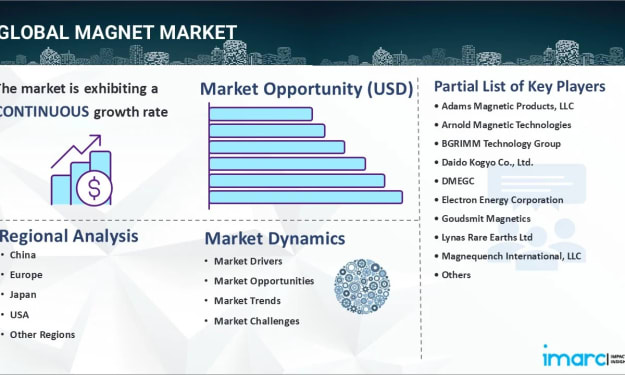
Magnet Market Outlook: Industrial Machinery Demand, Automation Growth & Industry Forecast to 2025
The global magnet industry is undergoing a significant transformation, evolving from a traditional component sector into a strategic pillar of the modern green economy. According to IMARC Group’s latest data, the global magnet market size reached USD 41.75 Billion in 2024. Looking forward, IMARC Group estimates the market to reach USD 58.7 Billion by 2033, exhibiting a CAGR of 3.82% during 2025-2033.
By Andrew Sullivan4 days ago in Futurism
Guard Your Battery
Why are some people so attractive just by standing there? It’s not because they are "likable," but because they don’t need everyone to like them. I realized later that truly charismatic people allow themselves to be criticized, but they never criticize themselves. They never try to please the world; instead, the world stops to watch them.
By Emily Chan - Life and love sharing3 days ago in Poets



Comments
There are no comments for this story
Be the first to respond and start the conversation.