
SCADA Market Trends: Smart Manufacturing Shift, Edge Computing Integration & Forecast to 2034
How industrial automation demand, smart grid investments, and real-time data monitoring are accelerating digital transformation across utilities and manufacturing sectors worldwide.

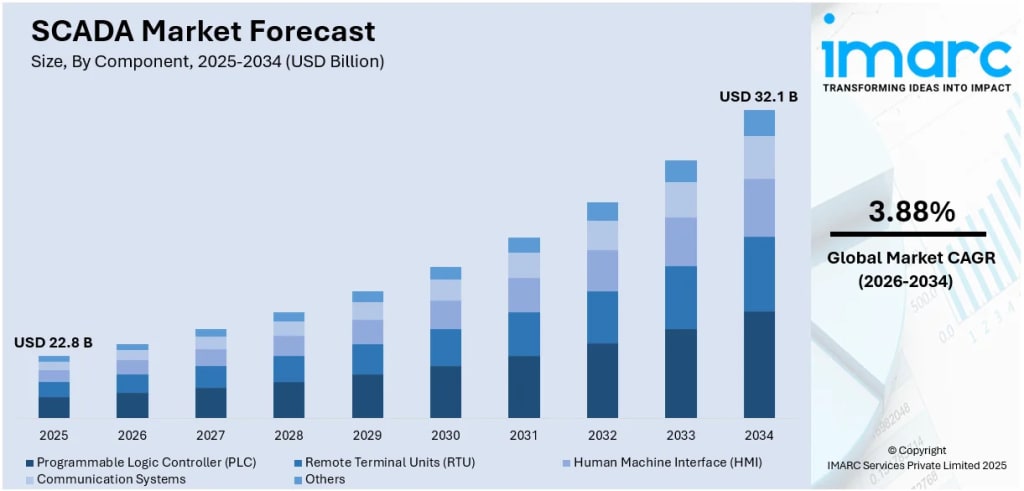
Rising demand for industrial automation, the rapid integration of the Industrial Internet of Things (IIoT), and the increasing need for real-time data monitoring across critical infrastructure are driving the SCADA market growth. These systems are becoming essential for optimizing operations in the oil and gas, power generation, and water management sectors, where reducing downtime and increasing efficiency are top priorities. According to IMARC Group’s latest data, the global SCADA market size was valued at USD 22.8 Billion in 2025. Looking forward, IMARC Group estimates the market to reach USD 32.1 Billion by 2034, exhibiting a CAGR of 3.88% from 2026-2034.
Supervisory Control and Data Acquisition (SCADA) has evolved into the central nervous system of modern industrial intelligence, now representing a global market exceeding USD 20 billion. Demand is fueled by the transition toward Industry 4.0, where companies prioritize seamless machine-to-machine communication and remote monitoring to maintain a competitive edge. Market uptake is further accelerated by the shift from legacy on-premise setups to scalable cloud-based architectures and the adoption of AI-driven predictive maintenance. Major segments include hardware components like PLCs and RTUs, alongside increasingly sophisticated software platforms that offer deep analytical insights into complex industrial workflows, particularly in geographically dispersed utility networks.
SCADA Market Growth Drivers:
- Accelerated Industrial Automation and Industry 4.0
Manufacturing and process industries are rapidly moving away from manual oversight toward fully automated environments to minimize human error and boost output. The integration of SCADA systems allows for high-precision control over assembly lines and chemical processes, which is vital as global robot installations recently hit record highs of over 500,000 units annually. By centralizing data from various sensors, operators can ensure consistent product quality while handling the increasing complexity of modern production. This push for "smart factories" makes SCADA indispensable for any facility aiming for peak operational performance.
- Rising Need for Grid Modernization and Renewable Integration
As nations shift toward green energy, the variability of solar and wind power requires sophisticated monitoring to maintain grid stability. SCADA systems provide the real-time telemetry needed to balance supply and demand across vast distances, facilitating the smooth transition to decentralized energy sources. With global primary energy demand projected to rise by 23% in the coming decades, utilities are investing heavily in smart grids. These systems enable load balancing and rapid fault detection, ensuring that power remains reliable even as the underlying infrastructure becomes more complex and distributed.
- Expansion of Critical Infrastructure in Emerging Economies
Rapid urbanization in regions like Asia-Pacific is driving massive investments in smart city projects, water treatment facilities, and transportation networks. Governments are increasingly mandating the use of automated monitoring to manage resources like water and electricity more efficiently. For instance, initiatives such as India's SAMARTH Udyog Bharat 4.0 are designed to modernize the manufacturing sector through digital transformation. These large-scale public and private investments create a sustained demand for SCADA solutions that can oversee everything from municipal wastewater pumping stations to high-speed rail signaling systems.
SCADA Market Trends:
- Transition to Cloud-Based and Hybrid Architectures
The industry is moving away from rigid, expensive on-premise hardware toward flexible cloud-based SCADA models that offer lower upfront costs and easier remote access. This shift allows engineers to monitor plant health from any location, which has become a priority as remote work capabilities expand. Cloud platforms also enable easier scaling for companies managing multiple sites, as they can centralize data without building a massive local IT infrastructure at every branch. Currently, nearly 40% of new implementations are opting for hybrid or pure SaaS deployment models to improve agility.
- Integration of Artificial Intelligence and Edge Analytics
Modern SCADA platforms are no longer just about data collection; they are becoming proactive tools through the integration of AI and machine learning. By analyzing historical data patterns, these systems can predict equipment failures before they happen, potentially saving millions in unplanned downtime. Edge computing plays a critical role here by processing data closer to the source, which reduces latency and allows for near-instantaneous automated responses. This trend is transforming SCADA from a reactive monitoring interface into an autonomous decision-support system that optimizes energy consumption and maintenance schedules.
- Heightened Focus on "Secure-by-Design" Cybersecurity
As industrial systems become more connected to the internet, they also become more vulnerable to sophisticated cyber threats. This has led to a major trend where security is integrated into the very architecture of the SCADA system rather than being an afterthought. New installations are prioritizing compliance with global standards like NERC CIP and IEC 62443, featuring advanced encryption and network segmentation. Brands are now differentiating themselves by offering robust access controls and continuous monitoring to protect critical infrastructure, such as power plants and water systems, from potential digital breaches.
Recent News and Developments in SCADA Market
- September 2024: The International Federation of Robotics reported a significant 10% rise in operational factory units worldwide, reaching over 4.2 million units, a milestone that underscores the growing reliance on SCADA for managing high-density automated environments.
- September 2025: Schneider Electric announced progress on its major manufacturing hub in India, set for 2026, aimed at producing advanced automation and SCADA components locally to support the region's rapidly growing smart infrastructure and industrial sectors.
- December 2025: Leading software providers introduced "unlimited tag" licensing models, a disruptive move in the SCADA market designed to allow organizations to expand their sensor networks without facing the traditionally high per-point licensing penalties.
Note: If you require specific details, data, or insights that are not currently included in the scope of this report, we are happy to accommodate your request. As part of our customization service, we will gather and provide the additional information you need, tailored to your specific requirements. Please let us know your exact needs, and we will ensure the report is updated accordingly to meet your expectations.
About the Creator
Andrew Sullivan
Hello, I’m Andrew Sullivan. I have over 9+ years of experience as a market research specialist.
Keep reading
More stories from Andrew Sullivan and writers in Futurism and other communities.
Cryptocurrency Market Trends: Central Bank Digital Currencies, Policy Reforms & Industry Forecast to 2034
Rising adoption of decentralized finance (DeFi) solutions, the proliferation of innovative blockchain platforms, and heightened interest from institutional investors are driving cryptocurrency market demand, supported by evolving regulatory frameworks, enhanced transaction transparency, and increased digitization of financial services. According to IMARC Group’s latest data, The global cryptocurrency market size was valued at USD 2,734.6 Billion in 2025. Looking forward, IMARC Group estimates the market to reach USD 6,394.1 Billion by 2034, exhibiting a CAGR of 9.60% from 2026-2034.
By Andrew Sullivan4 days ago in Futurism
“Sam Altman Is Losing His Grip on Humanity”: A Critique of AI’s Favorite Analogy
What Happened (Facts) This is an opinion essay by Matteo Wong (The Atlantic, dated Feb. 23, 2026), not a straight news report. Its central trigger is a remark OpenAI CEO Sam Altman made at an AI summit in India while responding to a question about the natural resources and energy required to train and run generative AI models.
By Behind the Tech7 days ago in Futurism
Privacy Focused Visual Search: Using AI to Understand Images Without Losing Control of Your Data
Visual search has changed how people interact with technology. Instead of typing long queries, users can now point a camera at an object, place, or document and instantly get information. While this convenience is powerful, it also raises an important concern: what happens to your images after the search?
By Maheep Makkar6 days ago in Futurism
Pearl
1980 something. we all hung out at Pearl and you and i were nothing special, or so i thought. i mean we all danced, drenched in our own sweat, our own saline solution of fear, too many beers, shots, laughter, tears, fucks in the bathroom and i don't know when we began to be afraid. do you?
By ROCK aka Andrea Polla (Simmons)5 days ago in Fiction



Comments
There are no comments for this story
Be the first to respond and start the conversation.