
Wind Energy Market Trends: Floating Wind Technology, Energy Transition & industry Outlook to 2034
How advancements in floating wind turbine platforms, offshore grid connectivity, and clean energy funding initiatives are driving innovation across the global wind energy market.

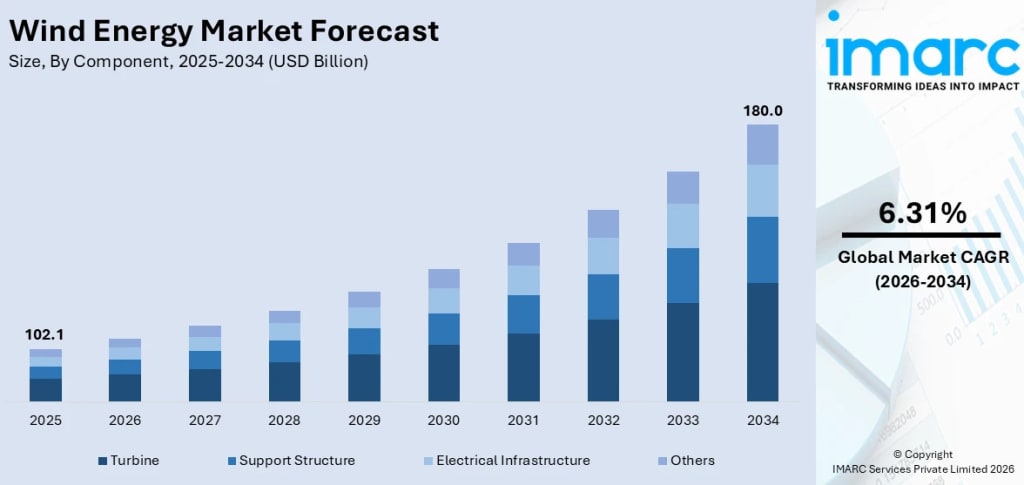
The global wind energy sector is undergoing a transformative shift as nations prioritize energy security and decarbonization. Governments are moving away from simple subsidies toward sophisticated industrial policies, such as India’s USD 890 million Viability Gap Funding for offshore wind and the Netherlands’ €3.9 billion IJmuiden Ver subsidy. This transition is further fueled by the integration of AI-driven grid management and the rapid scaling of 15 MW+ turbines, which can reduce installation costs by up to 20% per gigawatt. According to IMARC Group’s latest data, the global wind energy market size reached USD 102.1 Billion in 2025. Looking forward, IMARC Group estimates the market to reach USD 180.0 Billion by 2034, exhibiting a CAGR of 6.31% from 2026-2034.
Wind energy has evolved into a cornerstone of the modern power grid, with global installations reaching a record 143 GW in 2025 alone. The market is increasingly defined by the "utility-scale" segment, which accounts for approximately 88% of total capacity, as massive projects like the 704 MW Revolution Wind begin powering regional grids. Beyond traditional power generation, the market is expanding through corporate Power Purchase Agreements (PPAs) driven by data center operators and the development of green hydrogen offtake. With China aiming for 120 GW of new annual capacity and the U.S. racing to secure tax credits under updated fiscal frameworks, the industry is witnessing a shift toward high-capacity platforms and specialized offshore logistics.
Get Your Free Copy of the "Wind Energy Market" Sample Report
Wind Energy Market Growth Drivers:
- Accelerated Electrification and Rising Energy Demand
Global electricity consumption is surging, with 2024 seeing a 2.2% increase in demand—a rate significantly higher than historical averages. This spike is largely driven by the rapid expansion of data centers, industrial urbanization in emerging economies, and the electrification of transportation. Wind energy is being deployed as a primary solution to meet this demand sustainably. In 2025, the industry responded with a record-breaking 143 GW of new installations globally. As countries like Vietnam and the Philippines target high GDP growth, they are increasingly integrating wind power to ensure a reliable, low-carbon energy backbone.
- Technological Advancements in Turbine Capacity and Efficiency
The move toward larger, high-capacity turbines is drastically improving the economics of wind power. Modern units exceeding 6 MW now represent nearly half of the market capacity, while the introduction of 15 MW to 18 MW offshore turbines is setting new benchmarks for efficiency. These massive machines feature advanced composite blades and rotor diameters reaching 260 meters, allowing them to capture more energy even at lower wind speeds. By replacing older 1-2 MW models with these 5-6 MW variants, developers can triple power output on existing sites, significantly shortening project timelines and maximizing infrastructure use.
- Strategic Government Incentives and Industrial Policies
Governments are shifting from basic feed-in tariffs to comprehensive industrial frameworks that favor domestic manufacturing and energy security. For instance, India’s recent approval of an USD 890 million funding scheme for offshore wind projects in Gujarat and Tamil Nadu highlights this trend. Similarly, the UK’s latest auction rounds are expected to draw over £22 billion in private investment. These policies, coupled with carbon pricing and net-zero mandates, create a stable environment for long-term capital deployment. In 2025, clean energy investment reached a staggering USD 2.2 trillion, with wind remaining a top priority for public-private partnerships.
Wind Energy Market Trends:
- Rapid Expansion of Offshore and Floating Wind Projects
The focus is shifting toward deeper waters where wind speeds are higher and more consistent. Offshore installations are projected to see a massive step up in 2026, driven by project completions in the UK, France, and Vietnam. Floating wind technology is a particular standout, currently posting a 34.2% growth rate in component demand as it unlocks previously inaccessible deep-water sites. Major breakthroughs, such as the full operational status of the 700-plus MW Revolution Wind project, demonstrate the ability of offshore wind to provide "winter powerhouse" energy, reducing the risk of seasonal power outages by over 50%.
- Digitalization and Real-Time Energy Management
The integration of AI and digital automation is becoming essential for optimizing wind farm performance. Leading manufacturers are launching "smart" wind products that feature autonomous monitoring and real-time response to grid fluctuations. These systems allow for predictive maintenance, reducing downtime and extending the lifecycle of turbines. By utilizing digital twins and IoT sensors, operators can manage energy flow more effectively, ensuring that wind power integrates seamlessly into increasingly complex national grids. This trend toward "smart" infrastructure is critical for maintaining stability as the share of variable renewable energy in global generation nears 30%.
- Circular Economy and Sustainable Lifecycle Practices
Sustainability is moving beyond power generation to encompass the entire lifecycle of the equipment. There is a growing trend toward "green certifications" for wind farms, ensuring they meet rigorous environmental construction standards. Brands are prioritizing the development of recyclable rotor blades to address the long-term challenge of turbine decommissioning. In Europe, developers are increasingly pursuing certifications like LEED and BREEAM for their projects. This focus on the circular economy is supported by innovations in materials science, aiming to reduce the environmental footprint of steel and rare-earth components used in turbine manufacturing.
Recent News and Developments in Wind Energy Market:
- January 2026: The Global Wind Energy Council (GWEC) reported that 2025 was a record-breaking year, with global installations crossing 150 GW. The council projected that total global wind capacity will surpass 2 TW by 2030, with Asia-Pacific excluding China accounting for a major portion of this growth.
- March 2026: The 704 MW Revolution Wind offshore project, a joint venture between Ørsted and Skyborn Renewables, successfully delivered its first power to the New England grid. The facility is expected to serve over 350,000 homes once fully operational later this year.
- January 2026: GE Vernova announced a massive USD 59.3 billion order backlog, signaling robust future demand despite near-term supply chain pressures. The company is focusing on its "lean" manufacturing strategy to deliver high-capacity turbines for the 2026-2027 development cycle.
Note: If you require specific details, data, or insights that are not currently included in the scope of this report, we are happy to accommodate your request. As part of our customization service, we will gather and provide the additional information you need, tailored to your specific requirements. Please let us know your exact needs, and we will ensure the report is updated accordingly to meet your expectations.
About the Creator
Andrew Sullivan
Hello, I’m Andrew Sullivan. I have over 9+ years of experience as a market research specialist.
Keep reading
More stories from Andrew Sullivan and writers in Futurism and other communities.
Luxury Cosmetics Market Trends: Sustainable Luxury Beauty, Eco-Friendly Packaging & Industry Outlook to 2034
Increasing global disposable income, a growing emphasis on self-care, and the surging influence of social media trends are driving the demand for luxury cosmetics, supported by premium product innovations, clean-label formulations, and a shift toward personalized beauty experiences. According to IMARC Group’s latest data, the global luxury cosmetics market size was valued at USD 57.2 Billion in 2025. Looking forward, IMARC Group estimates the market to reach USD 80.8 Billion by 2034, exhibiting a CAGR of 3.92% from 2026-2034. Europe currently dominates the market, holding a market share of over 38.5% in 2025.
By Andrew Sullivanabout 3 hours ago in Futurism
When a Neuroscientist Turns Brain Signals Into Music
For decades, the idea that music could be created directly from the human brain has lived comfortably in the territory of science fiction — the kind of futuristic concept more commonly found in cyberpunk novels or speculative technology films. In those stories, humans connect directly to machines, thoughts become data, and creativity merges with technology in ways that feel both thrilling and unsettling.
By Navigating the World6 days ago in Futurism
Australia Bearings Market: Precision Engineering Demand, Industrial Automation Expansion & Renewable Energy Equipment Growth
According to IMARC Group, the Australia bearings market reached a value of USD 1.45 Billion in 2025 and is projected to reach USD 3.57 Billion by 2034, growing at a compound annual growth rate (CAGR) of 10.51% during 2026–2034. The market is experiencing robust growth as industries increasingly rely on high-performance mechanical components to support advanced machinery and equipment. Bearings play a critical role in reducing friction between moving parts and enabling efficient operation in mechanical systems used across automotive manufacturing, industrial machinery, energy production and transportation infrastructure. As Australia continues expanding its manufacturing capabilities and modernizing industrial operations, the demand for precision-engineered bearings is rising. Additionally, the rapid deployment of renewable energy infrastructure, including wind turbines and solar tracking systems, is increasing the need for specialized bearings capable of operating in demanding environmental conditions.
By Kevin Cooperabout 8 hours ago in Futurism
Pandora’s Burden
“My brother warned me to not accept gifts from the one who commissioned you,” said Epimetheus to the woman clad in silvery raiments standing at the entrance to the temple. Her silver tiara and the silver rings on her fingers and toes glinted in the firelight cast by torches set on either side of the doorway. Lingering in the shadows, beyond the reach of the flames as she was, he could not tell what she held in her hands. At first what appeared to be a box was perhaps a funerary urn, or maybe merely an apple.
By J. Otis Haas3 days ago in Fiction


Comments
There are no comments for this story
Be the first to respond and start the conversation.