
The Island of Dr Moreau by HG Wells
Why It's a Masterpiece (Week 107)


Background and Context:
You guys probably already know that 'The Island of Dr Moreau' is my favourite HG Wells novel and it has one of the most twisted storylines in Victorian Fiction. It takes the 'mad scientist' trope and turns it into something that blends it with a classic villain from the movies with a cult leader, drunk off his own sense of power. It's a really short book and really easy to read so please, if you haven't read it yet I would recommend getting stuck into it when you have some time. You definitely will not regret it. I've written multiple things about this book in my previous articles, praising it for its incredible themes and its fantastic blend of Sci-Fi and horror. Something that really characterises the era it was written in.
The Island of Dr Moreau by HG Wells
Published in 1896, The Island of Dr Moreau is one of H.G. Wells’ most unsettling novels. A blend of science-fiction and horror, it explores themes of evolution, ethics, and the limits of human ambition. Written during a period of scientific advancement, particularly in the fields of biology and vivisection, the novel reflects contemporary anxieties about the power and responsibility of scientific discovery.
Wells was influenced by Darwin’s On the Origin of Species (1859), which revolutionised understanding of evolution and natural selection. The novel raises troubling questions about what it means to be human, whether morality is innate or imposed, and the consequences of unchecked scientific experimentation.
Though initially received with a mixture of fascination and revulsion, The Island of Dr Moreau has since been recognised as a classic of speculative fiction. It has inspired numerous adaptations, from films to radio plays, and remains a powerful cautionary tale about the dangers of playing God.
Plot
The story is narrated by Edward Prendick, an Englishman who survives a shipwreck and is rescued by a passing vessel. The ship carries strange cargo (caged animals) and an eccentric man named Montgomery, who is accompanied by a grotesque, animalistic servant named M’ling. Montgomery tends to Prendick but warns him not to ask too many questions.
The ship arrives at a remote island, where Prendick meets Dr Moreau, a scientist infamous for his controversial experiments in vivisection. Initially, Moreau allows Prendick to stay but offers little explanation for the island’s strange atmosphere. Prendick soon becomes aware of eerie, humanoid creatures that roam the island, speaking in broken language and behaving in an unnatural way.
His horror deepens when he stumbles upon Moreau’s laboratory, where he witnesses the brutal reality of Moreau’s work: he has been transforming animals into semi-human hybrids through painful surgical and psychological conditioning. Moreau believes he is pushing the boundaries of science, attempting to accelerate evolution artificially. He enforces a strict “Law” upon his creations to maintain their human-like behaviour:
“Not to go on all-fours; that is the Law. Are we not Men?”
Despite the conditioning, the Beast Folk struggle to suppress their animal instincts. As the narrative unfolds, Prendick is trapped in a nightmarish struggle for survival. When Moreau is killed by one of his own creations, the island descends into chaos. Without his strict rule, the Beast Folk gradually revert to their primal nature, abandoning speech and walking on all fours again.
Prendick eventually escapes on a raft, returning to civilisation. However, he finds himself permanently changed by his experiences. The people of London now seem to him just as beast-like as Moreau’s creations, leading him to withdraw from society entirely.
Into the Book
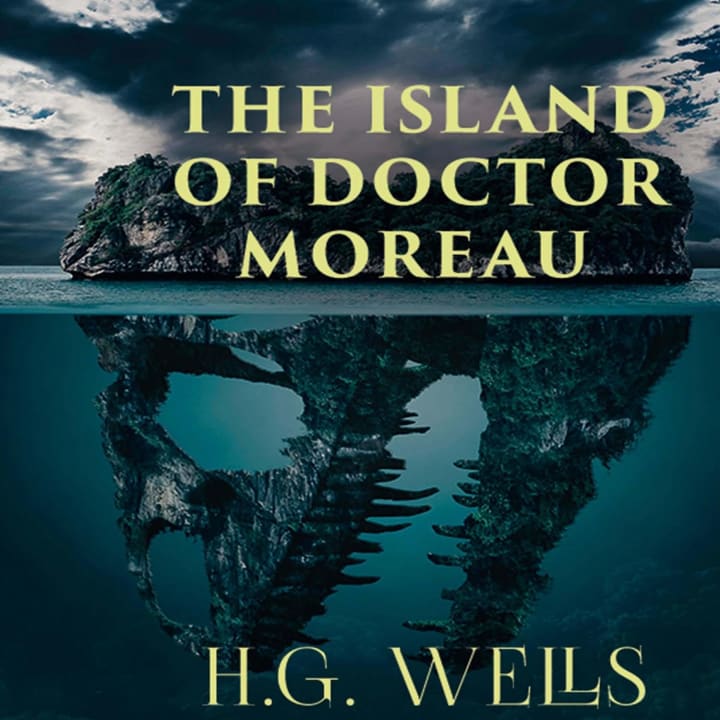
The Mad Scientist:
Moreau represents the archetype of the mad scientist, a man so obsessed with knowledge that he disregards all ethical boundaries. He justifies his horrific vivisections by claiming that pain is irrelevant and that his work will lead to great advancements.
Wells critiques the idea that scientific progress should be pursued without moral consideration. Moreau’s work, though driven by intellectual ambition, results only in suffering and chaos. The novel serves as a warning against the dehumanising effects of scientific arrogance and the dangers of treating living beings as just objects for experimentation.
“The study of Nature makes a man at last as remorseless as Nature.”
- The Island of Dr Moreau by HG Wells
Animals and Humans:
Prendick’s experiences on the island force him to confront the unsettling idea that humanity is not as far removed from animals as we like to believe. The Beast Folk, initially able to mimic human behaviour, slowly revert to their natural instincts once Moreau’s influence is removed. This suggests that civilisation is merely a thin veneer over our primal nature. When Prendick returns to England, he finds himself unable to view people as fully human.
Wells implies that the distinctions between human and beast are not as rigid as society assumes, and that under certain conditions, people might also regress to their most instinctive, brutal behaviours.
“The facial expressions of men and women seemed but a grotesque caricature of some animal mood.”
- The Island of Dr Moreau by HG Wells
The Desire to Control Nature:
Moreau’s experiments are an extreme example of humankind’s desire to control nature. By surgically reshaping animals and attempting to instil human characteristics in them, he assumes the role of a god-like figure. However, his failure demonstrates that nature cannot be easily controlled or reshaped to fit human desires. This is symbolised in the gradual breakdown of the Law. While Moreau is alive, the Beast Folk adhere to his imposed order.
But after his death, they instinctively revert to their animal states. Wells suggests that imposing civilisation or morality through force is ultimately futile: nature will always reclaim its own.
“His is the Hand that makes. His is the House of Pain.”
- The Island of Dr Moreau by HG Wells
Why It's a Masterpiece
This novel remains one of the most chilling and thought-provoking works of science fiction. Its exploration of scientific ethics, human identity, and the dangers of unchecked ambition continues to resonate, particularly in an age of genetic engineering and artificial intelligence.
The novel’s structure, a slow descent from mystery into horror, creates an atmosphere of dread that lingers long after the final pages. Moreau’s cold detachment, the eerie presence of the Beast Folk, and Prendick’s growing paranoia all contribute to an unsettling reading experience.
Also, The Island of Dr Moreau serves as a powerful allegory for colonialism and the imposition of order upon supposedly ‘lesser’ beings. Moreau’s attempts to shape and control the Beast Folk mirror the brutal ways in which colonial powers sought to civilise indigenous peoples, often with similarly disastrous consequences.
Conclusion
The Island of Dr Moreau is always understood as a haunting meditation on the ethics of scientific experimentation, the thin boundary between human and animal, and the dangers of unchecked ambition. It raises questions about the nature of civilisation and whether humanity is as evolved as it believes itself to be. This is a question we are currently asking too - no wonder this book is coming back into fashion. (If it isn't by the time this piece is released then I sure hope it will be)
By crafting a novel that is both a thrilling horror story and a profound philosophical work, Wells seals his name as one of the great authors of speculative fiction. His vision of an island where the laws of nature are bent and broken still is seen today, ensuring that The Island of Dr Moreau remains as dark and twisted as when it was first published.
Other Masterpieces:
- The Strange Case of Dr Jekyll and Mr Hyde
- Frankenstein by Mary Shelley
- The Invisible Man by HG Wells
Next Week: The Face of Another by Kōbō Abe
About the Creator
Annie Kapur
I am:
🙋🏽♀️ Annie
📚 Avid Reader
📝 Reviewer and Commentator
🎓 Post-Grad Millennial (M.A)
***
I have:
📖 300K+ reads on Vocal
🫶🏼 Love for reading & research
🦋/X @AnnieWithBooks
***
🏡 UK
Keep reading
More stories from Annie Kapur and writers in Geeks and other communities.
Book Review: "The Palace"by Gareth Russell (Pt. 5)
This review covers chapter 18 to the end of the book *** Chapter 18 covers the reign of Queen Anne, the final queen of the Stuart household and mostly seems to look at the idea that she could barely marry, she had lots of miscarriages and in the end the only child she had lived to eleven years' old and so, she had no heir. There were many questions of Queen Anne's marriage, from her husband participating in homosexual affairs to the ideas put forward in the film The Favourite in which it is Queen Anne who is homosexual and promiscuous. Whatever it was, I definitely feel sorry for Queen Anne - everything must have hurt by the end of her reign, too many pregnancies and miscarriages meant her health was declining quickly towards the end. It's quite sad.
By Annie Kapurabout 15 hours ago in Geeks
The Female Characters Who Taught a Gay Boy How to Be Strong
International Women’s Day usually centers on real history — scientists, activists, artists, leaders. Women who changed laws, built movements, and refused to accept the limits placed on them, but stories shape us too.
By Tamas Csokas6 days ago in Geeks




Comments (2)
I have not read this one, but you have, once again, added to the TBR pile. 📚
I appreciate how this piece highlights why the novel still matters today. With modern conversations about genetic engineering and AI, the questions Wells raised feel surprisingly current. It makes the story feel less like old fiction and more like a warning that never really stopped being relevant.