
Ali Khamenei Leadership, Legacy, and the Influence of His Family
Understanding the Role of Iran’s Supreme Leader and the Public Profile of the Khamenei Family

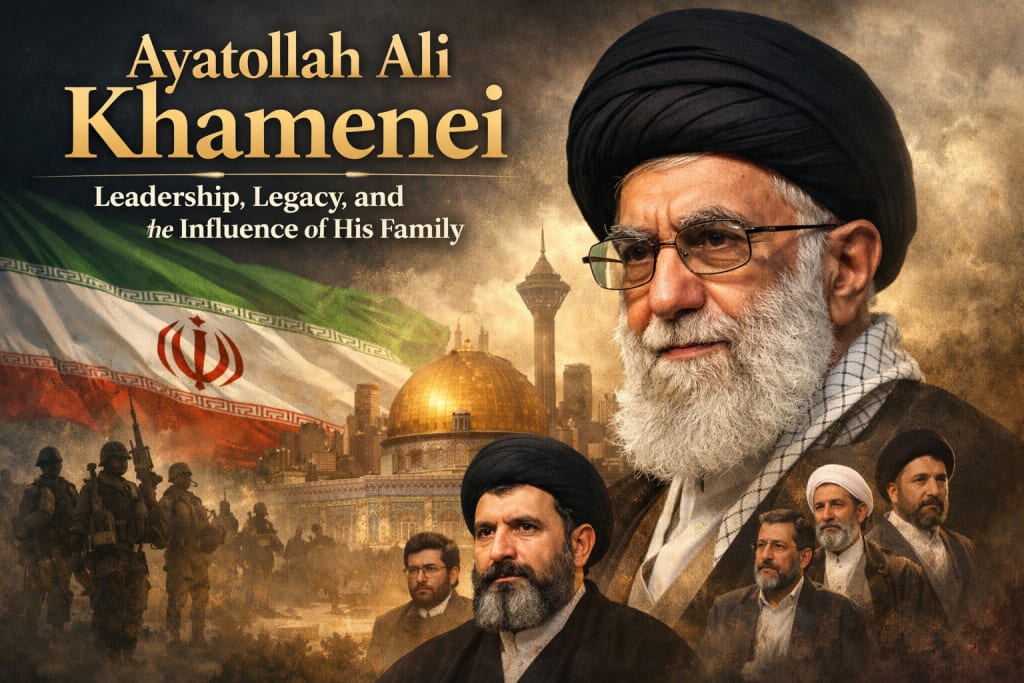
Ali Khamenei is one of the most influential political and religious figures in the contemporary Middle East. As the Supreme Leader of Iran since 1989, he has played a central role in shaping the country’s domestic governance, foreign policy, and ideological direction for more than three decades. His leadership position gives him authority over major state institutions, including the armed forces, the judiciary, and state media, making him the highest-ranking official in the Islamic Republic.
Born in 1939 in the city of Mashhad, Ali Khamenei grew up in a religious family. His father was a cleric, and Khamenei pursued Islamic studies from a young age. He studied in religious seminaries in Mashhad and later in Qom, a major center of Shia scholarship. During the 1960s and 1970s, he became involved in opposition activities against the rule of Mohammad Reza Pahlavi, the Shah of Iran. His political activism led to several arrests and periods of imprisonment before the 1979 Islamic Revolution.
The revolution, led by Ruhollah Khomeini, resulted in the establishment of the Islamic Republic. Following the revolution, Khamenei quickly rose within the new political system. He served in various key positions, including as a member of parliament and later as President of Iran from 1981 to 1989. After the death of Ayatollah Khomeini in 1989, Khamenei was selected by the Assembly of Experts to become the Supreme Leader, a position that combines religious authority with ultimate political oversight.
As Supreme Leader, Khamenei has overseen critical periods in Iran’s modern history. These include the Iran-Iraq War’s aftermath, tensions with Western countries, the development of Iran’s nuclear program, and shifting regional alliances in the Middle East. His leadership style is often described as cautious but firm, emphasizing resistance to foreign influence and the preservation of the Islamic Republic’s ideological foundations.
### The Structure of Power in Iran
To understand Khamenei’s influence, it is important to recognize the unique political structure of Iran. While the country has elected institutions, such as the presidency and parliament, the Supreme Leader holds ultimate authority. He appoints the heads of the judiciary, the commanders of the armed forces, and key members of powerful oversight bodies. This constitutional framework ensures that the Supreme Leader’s decisions significantly shape national policy.
Over the years, Khamenei has maintained close relationships with influential political and security institutions, including the Islamic Revolutionary Guard Corps (IRGC). His authority extends beyond political administration into religious guidance, making him both a political strategist and a spiritual figure for many of his supporters.
### The Khamenei Family: Influence and Public Perception
The question of how influential the Khamenei family is often arises in discussions about Iranian politics. Compared to some political dynasties in other parts of the world, the Khamenei family maintains a relatively low public profile. Khamenei has several children, including sons who are involved in religious and academic circles. One of his sons, Mojtaba Khamenei, is sometimes mentioned in media discussions about potential future leadership, although there has been no official confirmation of succession plans.
Unlike hereditary monarchies, the position of Supreme Leader in Iran is not legally passed down through family lines. Instead, the Assembly of Experts is responsible for selecting the next leader. While family connections may contribute to influence within political networks, the system does not formally recognize dynastic succession.
Public discussions about the family’s wealth or power are often influenced by political perspectives, both inside and outside Iran. Supporters argue that the family lives modestly and focuses on religious scholarship and public service. Critics, on the other hand, question the transparency of financial and institutional networks connected to powerful figures in the country. As with many political families worldwide, perceptions can vary significantly depending on the source.
### Legacy and Continuing Impact
Ali Khamenei’s long tenure has made him one of the most enduring political leaders in the region. His influence has shaped Iran’s regional policies, particularly in its relationships with neighboring countries and global powers. Under his leadership, Iran has pursued strategic alliances and maintained a strong stance on issues of national sovereignty and defense.
Whether viewed as a stabilizing force or a controversial figure, Khamenei’s role in Iran’s political system is undeniable. His family, while not officially part of a ruling dynasty, remains connected to influential religious and political circles due to his position.
In summary, Ali Khamenei is a central figure in Iran’s post-revolutionary history. His leadership combines religious authority with political power, and his family’s influence is closely tied to his position rather than to a formal hereditary system. Understanding his role provides valuable insight into the structure and direction of modern Iran.
About the Creator
Irshad Abbasi
Ali ibn Abi Talib (RA) said 📚
“Knowledge is better than wealth, because knowledge protects you, while you have to protect wealth.
Keep reading
More stories from Irshad Abbasi and writers in History and other communities.
The Next-Generation Conversational and Walking Sex Doll in Robotics
In the rapidly evolving field of robotics and artificial intelligence, innovations are no longer limited to industrial applications or personal assistants. One of the most talked-about developments in recent years is the emergence of advanced humanoid sex robots that combine lifelike aesthetics with interactive intelligence. Among these, a creation known as Harmony — or “Hum Aahang” in Urdu, meaning “harmony” — has gained significant attention for its unique capabilities. Harmony represents a new frontier where technology, companionship, and sexual wellness intersect.
By Irshad Abbasi 3 days ago in History
Trump and Netanyahu Are Breaking the Bond Between American Jews and Israel
Israeli Elections & The public's demand: Even though Israel gained as many seats as its biggest significant adversary, the results of the April 9 election have been seen as a win for the status quo. Meanwhile, Prime Minister Benjamin Netanyahu is best positioned to form a new administration alongside the Likud party that he leads. Most certainly, Netanyahu will be able to maintain his position of authority. The public's demand for familiarity and regularity is the reason behind this.
By Laura Hooverabout 16 hours ago in History
This Is What I Do When People Throw Rocks At Me
Rocks have been thrown at me for a greater part of my life. Some have been small and missed hitting me. When people don't get a reaction from me, they throw bigger rocks with a better aim. Many have been hurled at me with precision over the years. For a long time, I thought my only options were to dodge them or be crushed by them.
By Margaret Minnicks5 days ago in Confessions



Comments
There are no comments for this story
Be the first to respond and start the conversation.