
Ancient Voices from Stone: 44,000-Year-Old Cave Painting Discovered in Indonesia
A prehistoric masterpiece hidden for millennia reveals early human creativity, storytelling, and spiritual imagination.

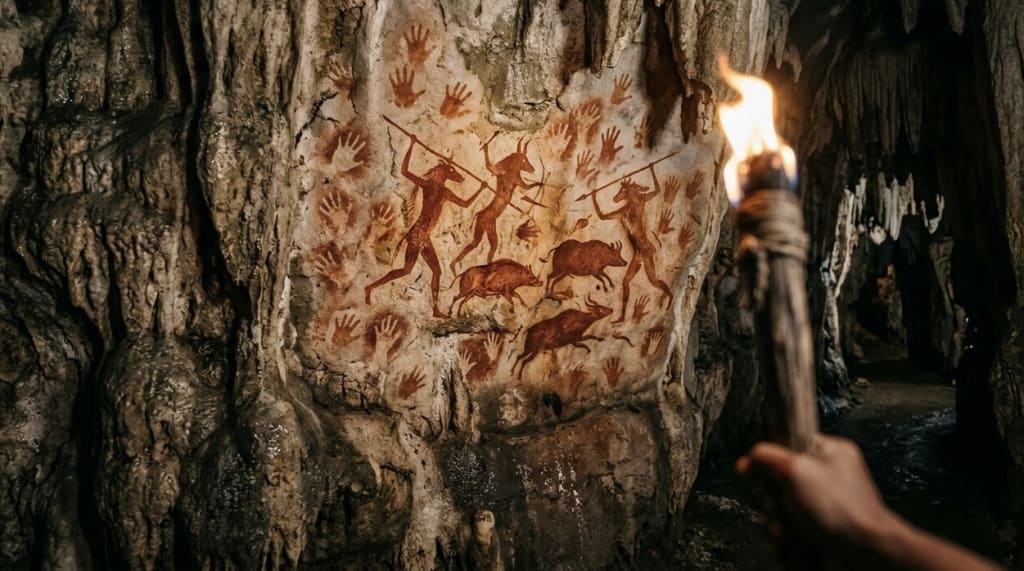
A remarkable archaeological discovery in Indonesia has reshaped our understanding of early human creativity and storytelling. Deep inside a limestone cave on the island of Sulawesi, researchers uncovered a prehistoric painting estimated to be around 44,000 years old, making it one of the oldest known narrative artworks in the world. This extraordinary find offers a rare glimpse into the symbolic thinking, beliefs, and imagination of early humans.
The painting was discovered in a cave known as Leang Tedongnge, a remote and difficult-to-access location surrounded by steep limestone cliffs and dense jungle. The artwork depicts several animal figures—believed to be wild pigs or buffalo-like creatures—along with humanoid forms that appear to be hunting them. These human-like figures have animal features, suggesting they may represent mythological beings, spirits, or symbolic characters rather than ordinary humans.
What makes this discovery truly special is not just its age, but its narrative nature. Unlike simple handprints or single-animal drawings found in many prehistoric caves, this painting appears to tell a story. It shows interaction, movement, and intention—evidence that humans at this time were already capable of complex imagination and symbolic communication. This challenges older theories that early humans only created simple or decorative art and lacked advanced abstract thinking.
Scientists used a technique called uranium-series dating to determine the age of the painting. This method measures the decay of uranium in mineral deposits that formed over the artwork. The results showed that the painting is at least 44,000 years old, possibly even older. This places it among the earliest known examples of figurative and narrative art in human history.
The discovery has major implications for how we understand the evolution of human intelligence and culture. It suggests that early humans in Southeast Asia were developing complex belief systems, storytelling traditions, and symbolic expression at the same time—or even earlier—than their counterparts in Europe. For a long time, Europe was considered the birthplace of advanced prehistoric art because of famous cave paintings in France and Spain. However, this Indonesian discovery shows that early artistic and intellectual development was happening across different regions of the world simultaneously.
Experts believe these paintings were not just decoration. They likely had spiritual or ritual significance. The animal-human hybrid figures, often called “therianthropes,” may represent ancient myths, religious beliefs, or early forms of spiritual symbolism. This suggests that humans 44,000 years ago were not only hunters and survivors, but also thinkers, storytellers, and believers.
The environment in which the painting was found also adds to its importance. The cave remained hidden and protected for thousands of years, preserving the artwork in remarkable condition. However, modern threats such as climate change, tourism, pollution, and environmental erosion now pose serious risks to these fragile prehistoric sites. Researchers stress the importance of protecting such locations to preserve humanity’s shared heritage.
This discovery also changes the way historians and scientists view the timeline of human civilization. It proves that long before cities, writing, and formal religion, humans were already expressing identity, belief, fear, hope, and imagination through art. The cave painting becomes a silent voice from the past, telling us that creativity is not a modern invention—it is a fundamental part of what it means to be human.
In a world dominated by technology and modern media, this 44,000-year-old artwork stands as a powerful reminder: storytelling began not with books or screens, but with stone walls, natural pigments, and human imagination. The people who created this painting had no written language, yet they left behind a message that still speaks today—about life, survival, belief, and the human need to express meaning.
The ancient cave painting of Indonesia is more than an archaeological discovery. It is a bridge between past and present, connecting modern humanity with its earliest ancestors. It proves that the roots of art, culture, and storytelling go back tens of thousands of years, reminding us that creativity is one of the oldest and most powerful human traits.
About the Creator
Irshad Abbasi
Ali ibn Abi Talib (RA) said 📚
“Knowledge is better than wealth, because knowledge protects you, while you have to protect wealth.
Keep reading
More stories from Irshad Abbasi and writers in History and other communities.
Echoes of a Forgotten War: The Discovery of a Japanese POW’s Remains in the United States
The discovery of the remains of a Japanese prisoner of war (POW) from World War II on American soil has reopened a quiet chapter of history that many people never knew existed. More than seventy years after the end of the war, this unexpected finding has sparked renewed interest in the stories of Japanese soldiers who were captured, transported across the Pacific, and held in detention camps across the United States.
By Irshad Abbasi 2 days ago in History
The Seven Last Words of Jesus on the Cross
The seven last words of Jesus on the cross are popular during the season leading up to Easter/Resurrection Sunday. When churches were filled with children they would have plays, where each child would be given one of the sayings to quote.
By Cheryl E Preston5 days ago in History
I wanted to title this something different, but worried that my chosen title might cause problems entering the United States in the future so this is the new title. It's the greatest title. No one has ever written a title better than this. (All titles unrelated to content).
Let me be honest. I am finding this difficult. Now, I like a challenge, a stretch, a bit of an obstacle course. “Write about the decline of the British Empire in the form of a narrative poem in which your protagonist is an artichoke” I read, and flex my fingers. “Write a haiku to evoke the sensation of sibilance using only the first half of the alphabet.” “Well”, I think to myself, “this should be fun.” But “write about a system that isn’t working”? A system that isn’t working? Now? In 2026? ONE system? My favourite system that isn’t working? The sexiest system that isn’t working? The one giving me the most angst day to day? The one giving me the most existential dread? I am, as I say, finding this difficult. I will own that I have contemplated writing a thousand words on why the steady “all on” setting on my fairy lights is the EIGHTH of seven options which must be sequentially activated to get there, because that is a system that some fool came up with and it definitely doesn’t work, and now who is paying the price, eh? But how can I write about my fairy lights when…. When…. When….
By Hannah Moore5 days ago in Humans



Comments
There are no comments for this story
Be the first to respond and start the conversation.