
Empire of Fangs: The Unlikely Conquest Won by War Dogs
How massive, battle-trained hounds terrified armies and helped carve an empire without the thunder of cannons

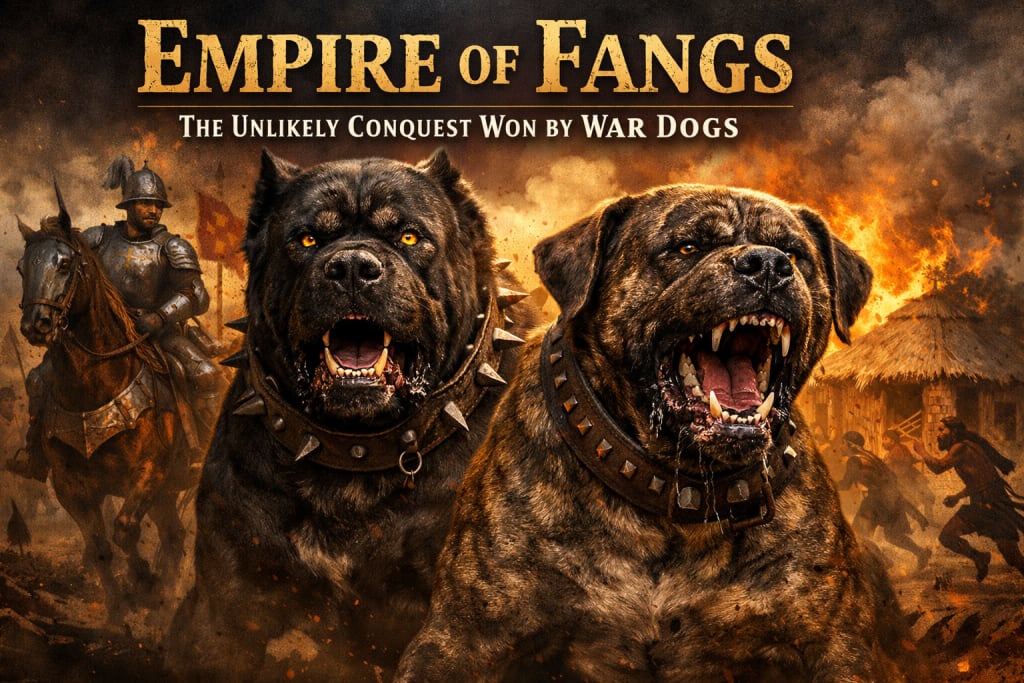
*How massive, battle-trained hounds terrified armies and helped carve an empire without the thunder of cannons*
---
History often celebrates empires built by glittering swords, roaring cannons, and ironclad ships. Yet there are lesser-known chapters where conquest did not begin with artillery fire, but with the growl of powerful dogs. In one remarkable episode of imperial expansion, a campaign was shaped not by the flash of steel, but by the shadow of enormous war hounds—animals so large and fierce that witnesses claimed they looked like lions.
During the age of exploration and conquest in the 15th and 16th centuries, European powers expanded aggressively into new territories. Among the most notorious campaigns were those led by Spanish conquistadors in the Americas. While figures like Hernán Cortés and Francisco Pizarro are remembered for their military tactics and political cunning, fewer people know about the silent weapons that accompanied them: war dogs bred specifically for combat.
These were not ordinary hunting companions. The conquistadors brought massive mastiff-type breeds, including the fearsome Alaunt and early forms of what would later become known as the Spanish Mastiff. Trained to attack on command, these dogs were armored, disciplined, and conditioned to charge into crowds without hesitation. Their size alone—sometimes weighing over 100 pounds—made them terrifying. With broad chests, muscular builds, and powerful jaws, they could easily overpower a grown man.
For many Indigenous communities encountering European invaders for the first time, the sight of mounted soldiers was already bewildering. Horses were unknown in much of the Americas before European arrival, and the image of a rider fused with his mount created an almost mythical figure. Now imagine, alongside these horsemen, enormous snarling dogs unleashed into villages. The psychological effect was devastating.
Contemporary accounts describe moments when entire groups scattered in panic at the mere release of these animals. In some narratives, locals believed they were facing supernatural beasts. The dogs were often deliberately starved before battle to make them more aggressive. Once unleashed, they would chase fleeing civilians, attack defenders, and create chaos that allowed soldiers to strike with minimal resistance.
One of the most infamous war dogs was named Becerrillo, owned by Spanish forces in the Caribbean. According to chronicles, Becerrillo was treated almost like a soldier, rewarded for successful attacks and even given a share of spoils. Stories claim he could distinguish between friendly Indigenous allies and enemies, though such tales likely reflect the exaggerated storytelling common in conquest narratives. Still, his legend underscores how central these animals became to the Spanish war machine.
The use of dogs in warfare was not entirely new. Ancient civilizations, including the Romans, had employed canines in battle. But what made the Spanish campaigns distinctive was the strategic use of dogs as instruments of terror. They were not merely companions guarding camps—they were frontline shock troops.
In psychological warfare, fear can be more powerful than force. The conquerors understood this well. When rumors spread that monstrous beasts accompanied the invaders, resistance sometimes weakened before a fight even began. Entire settlements reportedly surrendered rather than risk facing the dogs. In this way, conquest was achieved not only through physical domination but through carefully cultivated dread.
Of course, the historical record must be read critically. Much of what we know comes from Spanish chroniclers who may have exaggerated both their own heroism and the ferocity of their animals. At the same time, Indigenous oral histories recount deep trauma linked to these attacks. Between myth and memory lies a stark truth: animals were weaponized to break human resistance.
The moral questions raised by this history are complex. Dogs, creatures known for loyalty and companionship, were transformed into tools of violence. Their training demanded brutality, and their deployment often targeted civilians rather than organized armies. In the broader sweep of colonial history, their role symbolizes how conquest blurred the line between human strategy and animal instinct.
Today, military dogs still serve in armies worldwide, trained to detect explosives, track suspects, and protect soldiers. However, modern standards emphasize discipline, welfare, and targeted use rather than indiscriminate terror. The brutal spectacles of conquest-era war dogs stand in stark contrast to contemporary practices.
The story of empire built with the help of dogs reminds us that power is not always projected through cannons or cavalry charges. Sometimes it moves on four legs, driven by teeth and fear. The image of massive hounds racing ahead of armored men—so large that onlookers thought they were lions—captures a haunting dimension of history. It reveals that conquest can be as much about psychological domination as battlefield strength.
In the end, the empire forged with the aid of fangs was not sustained by dogs alone. Political alliances, disease, superior weaponry, and internal divisions all played decisive roles. Yet the legend of the lion-like hounds endures as a chilling testament to how even humanity’s closest animal companion can be reshaped into an instrument of empire.
About the Creator
Irshad Abbasi
Ali ibn Abi Talib (RA) said 📚
“Knowledge is better than wealth, because knowledge protects you, while you have to protect wealth.
Keep reading
More stories from Irshad Abbasi and writers in History and other communities.
The Secret Return of a Former President’s Body from Nigeria to Somalia
In a story that sounds more like a political thriller than a real-life event, the body of a former Somali president was secretly transported from Nigeria to Somalia in an operation that involved only two pilots, a coffin, and a journey of thousands of kilometers. The quiet and discreet mission reflected not only the sensitivity surrounding the former leader’s death but also the complex political realities of the region.
By Irshad Abbasi 2 days ago in History
I found the history of Death that produced the AI that I have found
If someone you love died tomorrow, would you want to continue communicating with them? Not through memories or stored messages, but through artificial intelligence — a chatbot that uses their texts, emails, and voice notes to respond in their own tone and style.
By Jejak Kabar Dunia2 days ago in History
Flower Bloom 369
FLOWER Bloom 2/25/26 Wednesday By Mariann Carroll Karen had been with Tony for 7 years. Tony started acting strangely after her surgery. He would mow the lawn in the rain and be on his cellphone. He started pushing Karen away. Tony came clean about seeing someone. Karen moved out two months later. Karen moved in with a friend. She felt betrayed.
By Mariann Carroll5 days ago in Fiction



Comments
There are no comments for this story
Be the first to respond and start the conversation.