
Harut and Marut The Story of the Angels Sent Down to Babylon
A Comparative Study in the Qur’an, the Bible, and Jewish Traditions

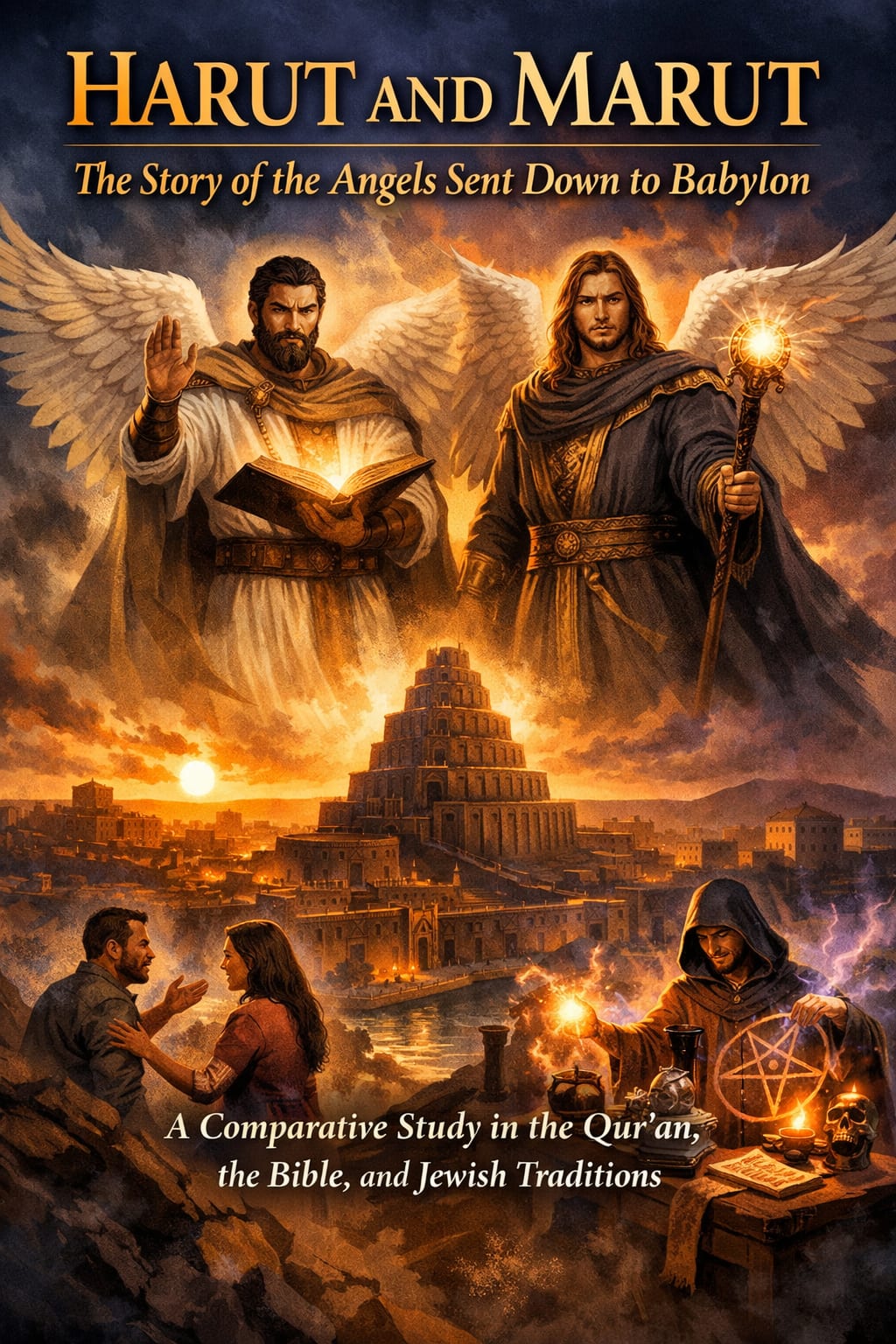
The story of Harut and Marut is one of the most intriguing and debated narratives in Islamic tradition. Mentioned briefly in the Qur’an, elaborated upon in later Islamic exegesis, and paralleled by certain themes in Jewish and biblical traditions, the account of these angels sent to Babylon explores themes of temptation, free will, magic, and divine testing. While the Qur’an provides a concise reference, Jewish apocryphal literature and later interpretations offer additional context that has shaped understanding across centuries.
---
## **Harut and Marut in the Qur’an**
The primary source of the story in Islam is found in Surah Al-Baqarah (2:102) of the Qur’an. The verse refers to two angels, Harut and Marut, who were sent down to Babylon as a trial for people. According to the verse, these angels taught magic, but not without warning those who sought knowledge from them: “We are only a trial, so do not disbelieve.”
The Qur’anic narrative situates the story within a broader discussion about magic and false accusations against Prophet Solomon (Sulayman). The Qur’an firmly denies that Solomon practiced magic and instead attributes the spread of sorcery to devils. Harut and Marut, in contrast, were sent as a divine test. They did not promote disbelief but warned those who came to learn from them. Despite the warning, some people misused the knowledge to create discord, including causing separation between husband and wife.
The city mentioned is Babylon, a historically significant center of ancient civilization and often associated in biblical and Near Eastern traditions with corruption and moral decline. In Islamic interpretation, Babylon becomes the setting for a moral trial, emphasizing that knowledge itself is neutral; it is the human use of it that determines moral responsibility.
---
## **Interpretations in Islamic Tradition**
While the Qur’an gives only a brief account, later Islamic scholars and storytellers expanded upon the narrative. Some traditions describe Harut and Marut as angels who questioned why humans were prone to sin. In response, God granted them human-like desires and sent them to earth as a test. According to certain narrations, they succumbed to temptation, thereby demonstrating the difficulty of resisting worldly desires.
However, many classical Muslim theologians rejected the idea that angels could sin, emphasizing the Qur’anic doctrine that angels are obedient servants of God. Scholars such as Ibn Kathir discussed various narrations but often treated the more dramatic elements with caution, noting that some reports resembled stories from earlier Jewish traditions (Isra’iliyyat).
Thus, within Islam, the dominant theological view maintains that Harut and Marut did not commit sin but were instruments of divine testing.
---
## **Parallels in the Bible**
The canonical Bible does not mention Harut and Marut by name. However, there are thematic parallels in certain passages, particularly regarding fallen angels and forbidden knowledge. The Book of Genesis (6:1–4) briefly refers to the “sons of God” who descended to earth and interacted with human women. Though the text is ambiguous, later interpretations associated these beings with angels who transgressed divine boundaries.
Another important reference is the symbolic role of Babylon in the Bible. In books such as Jeremiah and Revelation, Babylon represents moral corruption, arrogance, and rebellion against God. The association of Babylon with spiritual decline may have influenced later Islamic narratives that situate Harut and Marut there.
---
## **Jewish Apocryphal Traditions**
More detailed parallels to the Harut and Marut story are found in Jewish apocryphal texts, especially the Book of Enoch. In this work, a group of angels known as the Watchers descend to earth and teach humans forbidden knowledge, including sorcery and other secret arts. They also engage in sinful behavior, leading to divine punishment.
The similarities are striking: heavenly beings descending, imparting knowledge that leads to corruption, and being subjected to divine judgment. However, the theological framing differs. In the Book of Enoch, the angels act in rebellion, whereas in the Qur’an, Harut and Marut function as part of God’s plan and explicitly warn people not to misuse what they teach.
Many Muslim scholars acknowledged these parallels but argued that Islamic revelation corrects earlier distortions, presenting a purified account consistent with the principle that angels do not rebel against God.
---
## **Theological Themes and Moral Lessons**
Across these traditions, the story highlights key theological themes:
1. **Free Will and Temptation:** Humans possess the ability to choose between right and wrong. Even when warned, people may misuse knowledge.
2. **Knowledge as a Test:** Sacred texts consistently portray knowledge as powerful and morally neutral; its ethical value depends on human intention.
3. **Divine Justice:** Whether in Islamic or Jewish tradition, divine response follows moral corruption.
In Islam, the emphasis is particularly strong on personal accountability. Harut and Marut did not compel anyone to sin; rather, they clarified that learning magic could lead to disbelief. The responsibility lay with those who chose to proceed.
---
## **Conclusion**
The story of Harut and Marut bridges multiple religious traditions while maintaining distinctive theological boundaries. In the Qur’an, they are agents of divine testing in Babylon, not fallen rebels. In Jewish apocryphal literature like the Book of Enoch, similar figures embody angelic transgression. The Bible itself offers symbolic and thematic parallels, particularly concerning Babylon and heavenly beings interacting with humanity.
Ultimately, the narrative serves as a profound reflection on temptation, the misuse of knowledge, and the enduring challenge of moral choice. Through comparative study, the story reveals how different traditions wrestle with similar existential questions while preserving their unique doctrinal perspectives.
About the Creator
Irshad Abbasi
Ali ibn Abi Talib (RA) said 📚
“Knowledge is better than wealth, because knowledge protects you, while you have to protect wealth.
Keep reading
More stories from Irshad Abbasi and writers in History and other communities.
The End of Ayatollah Khamenei’s Long Iron Grip
For more than three decades, **Ali Khamenei** stood at the center of Iran’s political and ideological system, shaping the country’s domestic trajectory and foreign policy with a firm and often uncompromising hand. As the second Supreme Leader of the **Iran**, Khamenei inherited a revolutionary state and transformed it into a tightly controlled political order anchored by hardline clerics and the formidable **Islamic Revolutionary Guard Corps** (IRGC). His authority was neither accidental nor purely spiritual; it was built on institutional alliances, security structures, and a careful balancing of rival factions.
By Irshad Abbasi 2 days ago in History
I found the history of Death that produced the AI that I have found
If someone you love died tomorrow, would you want to continue communicating with them? Not through memories or stored messages, but through artificial intelligence — a chatbot that uses their texts, emails, and voice notes to respond in their own tone and style.
By Jejak Kabar Duniaa day ago in History
I was in a Toxic Relationship, with my Workplace
“You got that?” My ex yelled. His hands were balled into fists at his side. At six foot three, he towered over me. A normal person would have been afraid, but I looked up a video of George Lopez repeatedly saying, “I got this,” and showed it to him. I had grown used to this treatment, so much so that I didn’t blink when he ripped the phone from my hand and threw it across the room.
By Jade M.4 days ago in Confessions



Comments
There are no comments for this story
Be the first to respond and start the conversation.