
The Cornish Pastie: A History, A Craft, and the Law That Guards Its Name

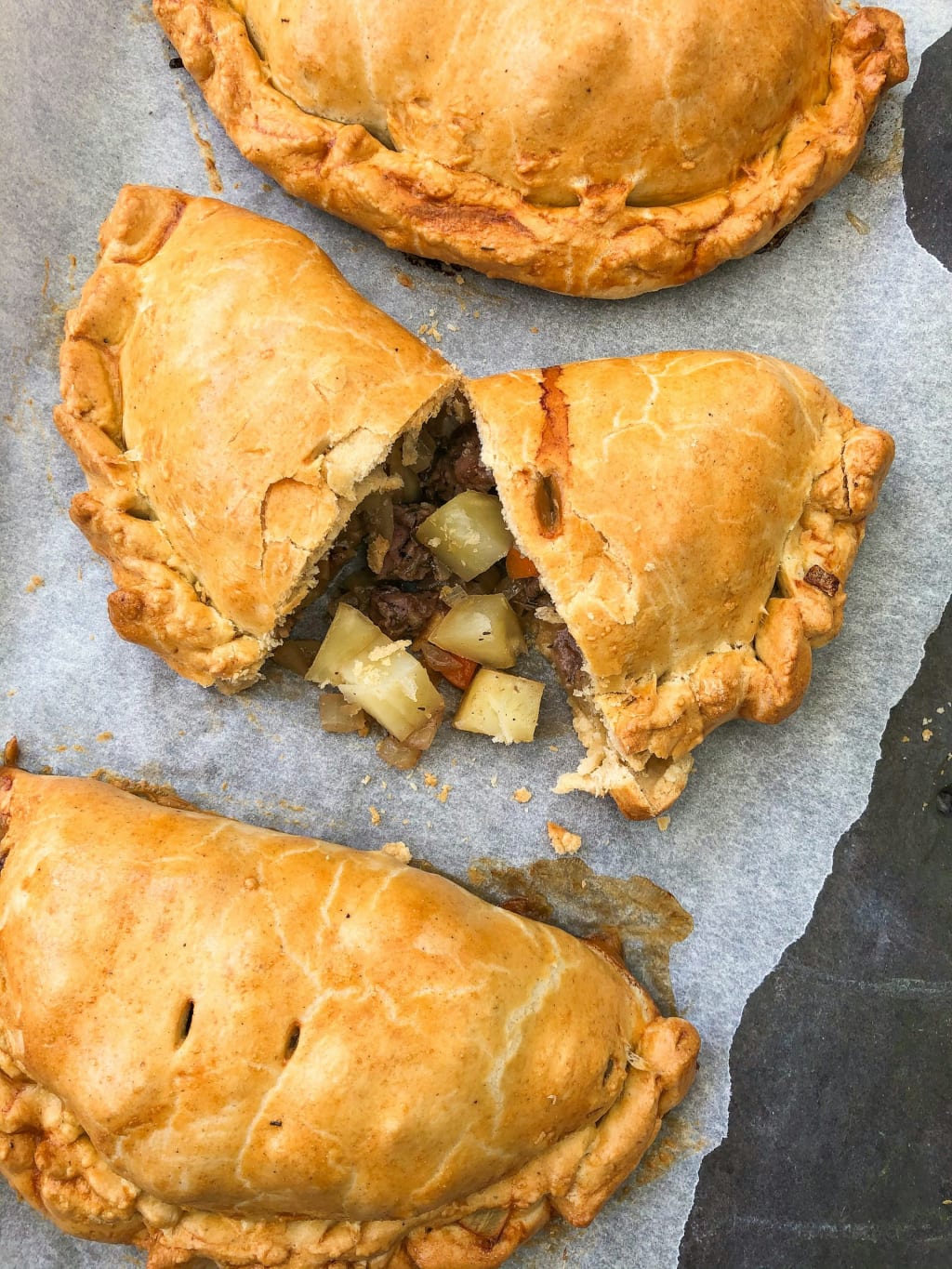
Cornwall rises from the sea with a kind of ancient certainty, its cliffs carved by wind and salt, its moors stretching into a quiet, haunted distance. Life here has always been shaped by endurance. The land is beautiful, but it is not gentle. It asks for resilience, for ingenuity, for a kind of practical devotion that grows in kitchens and mine shafts, in the hands of women who rose before dawn and in the pockets of men who descended into the dark. Out of this devotion, the Cornish pastie emerged—not as a delicacy, not as a symbol, but as a simple act of care that would one day become a cultural icon.
The earliest written references to pasties appear in the thirteenth century, though those medieval versions bore little resemblance to the working‑class staple that would define Cornwall. The wealthy filled their pastries with venison, game, and spices, while the poor relied on whatever the land could offer. Over time, the pastie shifted from aristocratic tables to the hearths of miners’ cottages, where necessity shaped it into something sturdy, portable, and sustaining. By the eighteenth and nineteenth centuries, the pastie had become inseparable from the mining life. It was designed to survive a morning in a pocket, an afternoon in a lunch tin, and the rough handling of hands coated in dust.
The thick crimped edge served as a handle, allowing miners to hold the pastie without contaminating the edible portion with arsenic‑laden fingers. Many discarded the crust, leaving it for the knockers—the spirits said to haunt the mines. Folklore tells us that these spirits could be mischievous or protective depending on how they were treated, and leaving the crust was a small gesture of respect. A miner’s lunch was never just a meal; it was a thread of connection between the world above and the world below, between the living and the unseen.
The pastie carried more than sustenance. It carried the presence of home. Women marked the crust with initials so that every miner knew which pastie was his. Some families tucked sweet fillings into one end and savory into the other, creating a two‑course meal in a single pastry. Others stretched ingredients as far as they could, turning humble vegetables into something comforting and complete. A pastie was a message of love sent into danger, a reminder that someone waited for the miner’s return.
Cornwall’s mining industry eventually declined, but the pastie traveled with the Cornish diaspora. Miners carried their craft to Michigan’s Upper Peninsula, to South Africa, to Australia, and to the silver mines of Real del Monte in Mexico. In each place, the pastie adapted to local ingredients and tastes, yet it never lost its essence. It remained a food of workers, families, and communities. It remained a symbol of endurance.
Yet the heart of the pastie still belongs to Cornwall. In 2011, the European Commission granted the Cornish pasty Protected Geographical Indication (PGI) status, a legal protection now upheld by the UK government. This protection means that a pasty cannot legally be sold as a Cornish pasty unless it is made in Cornwall and follows the traditional recipe and method. The law is explicit: the pasty must be D‑shaped, crimped on the side, filled with raw beef, potato, onion, and swede, and baked so that the ingredients cook together inside the pastry. It must be robust enough to hold its shape yet tender enough to break with a satisfying flake. Anything else—no matter how delicious—cannot bear the name.
The Cornish Pasty Association states it plainly: “Only pasties made in Cornwall from a traditional recipe can be called ‘Cornish’ pasties.” This legal protection places the pastie alongside Champagne, Roquefort, and Parma ham—foods whose identity is inseparable from their place of origin. It is not a matter of snobbery. It is a matter of heritage. The pastie is not merely a recipe; it is a story carried through generations, shaped by the land and the labor of a people who endured hardship with quiet strength.
The irony, of course, is that the law codifies a version of the pastie that many miners could not afford. A modern historian notes that “the law insists on beef, yet 1862 wage logs prove the miner could not afford it.” Most working families relied heavily on vegetables, with meat appearing only when wages allowed. The PGI protects a tradition that is both authentic and aspirational, a reminder that food heritage often reflects the ideal rather than the lived reality. Yet the spirit of the pastie remains intact: simple ingredients transformed through care, shaped by hand, and baked into something greater than the sum of its parts.
The making of a pastie is a ritual that carries the weight of history. The dough must be strong enough to hold the filling yet supple enough to fold without cracking. This is not the fragile pastry of French patisserie. It is a working pastry, a practical pastry, a pastry that understands the task ahead. Flour, fat, water, and salt come together with a kind of quiet determination. Some cooks use lard for authenticity; others blend butter for flavor. The dough rests not for refinement but for resilience. It needs time to gather itself, to become something that can be shaped without resistance.
The filling is simple, but simplicity is deceptive. The vegetables must be cut into small, even pieces so they cook at the same rate. The beef must be diced, not minced, so that it retains its texture and juices. The seasoning must be confident but restrained. A pastie does not rely on herbs or spices to make its point. It relies on the alchemy of ingredients cooking together inside a sealed world. As the pastie bakes, the vegetables release their moisture, the beef releases its fat, and the pastry absorbs just enough of both to become tender and flavorful. Nothing is wasted. Nothing is separate. Everything becomes part of everything else.
Shaping the pastie is where craft becomes art. The circle of dough receives its filling like a cupped hand receiving something precious. The cook folds the pastry over, creating a half‑moon, and then begins the crimping. This is the signature of the pastie, the gesture that distinguishes it from every other hand pie in the world. The crimp is not merely decorative. It is structural. It seals the pastie, strengthens the edge, and gives it the resilience it needs. Each crimp is a small act of devotion, a repetition of a movement performed by countless hands across centuries. The rhythm of it feels ancient, almost meditative. The pastie takes shape not through precision but through familiarity, through the memory of hands that have done this work before.
When the pastie enters the oven, it carries the promise of transformation. The raw ingredients, humble and unassuming, become something greater than the sum of their parts. The pastry browns, the filling softens, and the scent fills the kitchen with a warmth that feels both comforting and ancestral. A pastie does not demand attention. It does not require ceremony. It simply becomes itself, quietly and completely.
Eating a pastie is an experience shaped by place. In Cornwall, it is often eaten outdoors, where the wind carries the scent of the sea and the landscape feels like part of the meal. The pastie fits naturally into the hand, its shape designed for portability long before modern convenience foods existed. The first bite reveals the tenderness of the filling, the richness of the beef, the sweetness of the vegetables, and the satisfying contrast of the pastry. It is a food that nourishes without pretense, a food that feels honest. It is also a food that carries memory, because every pastie is shaped by a lineage of hands that learned the craft from someone who learned it before them.
Cornish humor has always surrounded the pastie. One of the most beloved sayings claims that “the devil himself wouldn’t dare cross the Tamar, for fear he’d be baked in a pasty.” The line is delivered with a wink, but it reveals something true about the place the pastie holds in Cornish identity. It is not merely a dish. It is a symbol of belonging. It is a reminder that Cornwall has always been a land apart, shaped by its own rhythms, its own hardships, its own quiet pride.
Another anecdote tells of a traveler who bought a so‑called Cornish pasty in London’s East End only to discover it was filled with baked beans. The story circulates in countless variations, each one a gentle reminder that imitation is rarely the same as authenticity. These stories endure because they speak to a truth: the pastie belongs to Cornwall, and Cornwall belongs to the pastie.
The legal protection that guards its name is not a barrier but a blessing. It ensures that the pastie remains rooted in the land and the people who shaped it. It honors the generations who made pasties not for fame or commerce but for love. It preserves a tradition that might otherwise be diluted into meaninglessness. In a world that often values novelty over heritage, the PGI stands as a quiet refusal. It refuses to forget where the pastie came from. It refuses to let its identity be borrowed without understanding. It refuses to let a food born of hardship and devotion become a generic commodity.
The pastie also carries the story of Cornwall itself. A land shaped by hardship and beauty, by industry and myth, by the resilience of a people who have always lived at the edge of things. The pastie reflects this landscape. It is sturdy yet tender, simple yet profound, practical yet filled with meaning. It is a food that understands survival, but it is also a food that understands joy.
Making a pastie today is an act of remembrance. It is a way of honoring the generations who came before, of keeping their stories alive, of participating in a tradition that has endured because it was never about perfection. It was about care. It was about nourishment. It was about love expressed through the simplest of ingredients.
The Cornish pastie is more than a recipe. It is a world. It is a history. It is a testament to the power of humble things. And when you hold one warm in your hands, you hold not only food but the echo of countless lives, countless kitchens, countless stories woven into the fabric of a single, perfect fold of pastry.
References
Cornish Pasty Association – Protected Status
UK Government – Protected Food Name Scheme: Cornish Pasty (PGI)
European Commission – Regulation (EU) No 1151/2012
Real del Monte Mining Archives, Mexico
Michigan Upper Peninsula Historical Society – Mining and Pasty Migration Records
Cornish oral folklore and traditional sayings
About the Creator
Julie O'Hara - Author, Poet and Spiritual Warrior
Thank you for reading my work. Feel free to contact me with your thoughts or if you want to chat. [email protected]
Keep reading
More stories from Julie O'Hara - Author, Poet and Spiritual Warrior and writers in History and other communities.
The Trump Family History: The Life and Legacy of Friedrich Trump
I am writing this article from a clearly objective point of view. Draw your own conclusions. Introduction The Trump family stands as one of the most prominent dynasties in contemporary American history. Frequently associated with business, real estate, and political influence, the roots of the family stretch across the Atlantic, beginning with Friedrich Trump, grandfather to Donald J. Trump, the 45th President of the United States. This article offers a comprehensive exploration of Friedrich Trump’s life ... from his German origins and emigration to America, to his entrepreneurial ventures in the Pacific Northwest, including his controversial involvement in brothel operations. By examining the details of Friedrich’s journey, we gain insight into how his choices shaped the trajectory of the Trump family and contributed to their legacy.
By Julie O'Hara - Author, Poet and Spiritual Warrior5 months ago in History



Comments
There are no comments for this story
Be the first to respond and start the conversation.