
The Search for the Distant World
The Discovery of Pluto

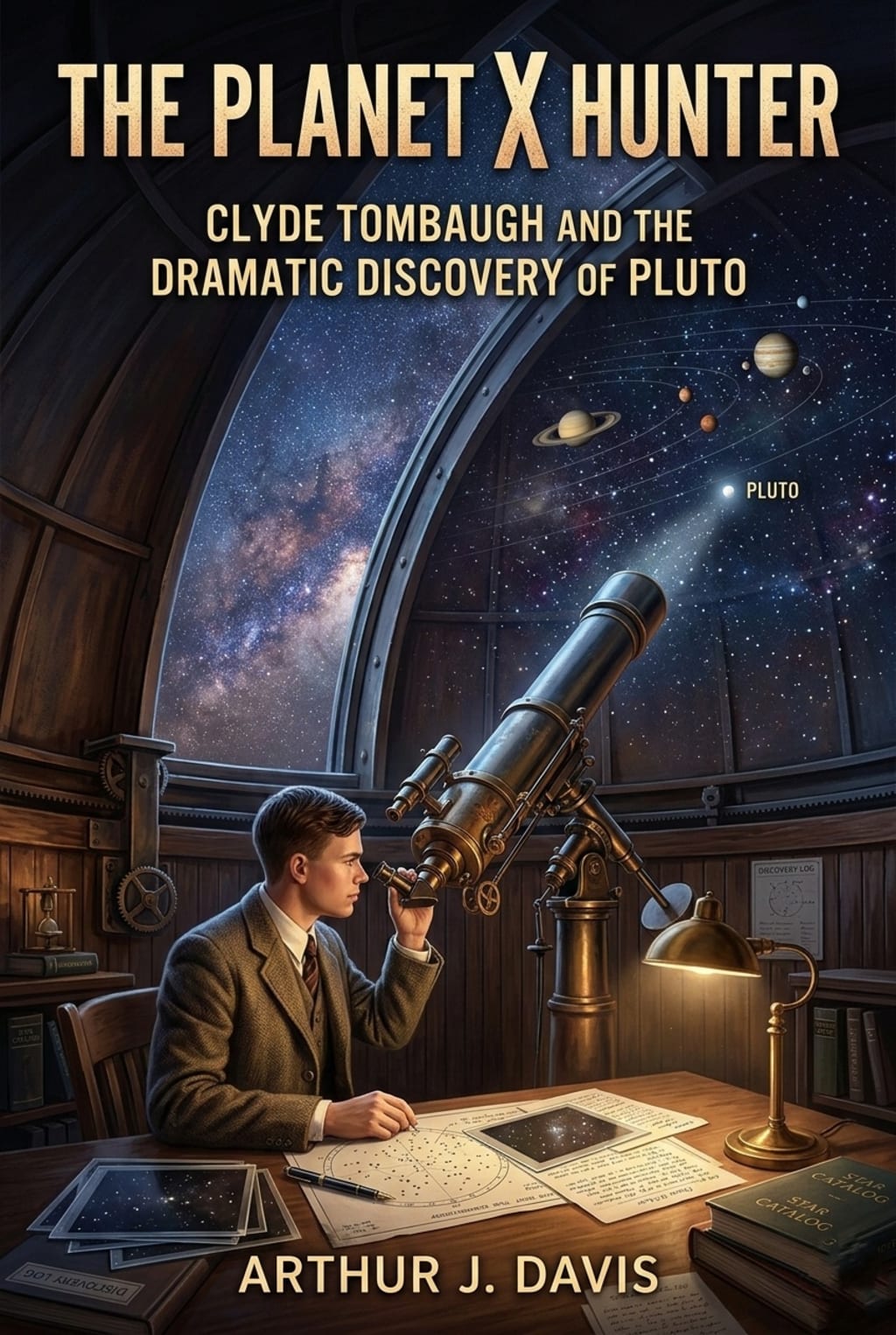
Long before powerful telescopes and modern space missions, astronomers spent countless nights studying the sky. They watched the stars carefully and recorded the movements of the planets. Each discovery helped scientists understand the vast universe a little better. Among the most fascinating discoveries in astronomy was the discovery of Pluto, a tiny and distant world at the edge of our Solar System.
The story of Pluto’s discovery is not just about a planet. It is a story of curiosity, patience, and the determination of scientists who spent years searching for something that no one had ever seen before.
The Mystery of Planet X
In the early 1900s, astronomers believed there might be another planet beyond Neptune. They noticed that the orbits of Uranus and Neptune did not behave exactly as expected. Some scientists thought that the gravity of an unknown planet might be affecting their motion.
One astronomer who became very interested in this mystery was Percival Lowell. Lowell believed strongly that a hidden planet existed far beyond Neptune. He called this mysterious world “Planet X.”
To find it, Lowell built an observatory in Arizona known as the Lowell Observatory. From there, he and his team carefully studied photographs of the night sky. They searched for a small object that slowly moved among the stars.
Unfortunately, Lowell died in 1916 before he could find the planet he was looking for. But the search did not end.
A Young Man with a Dream
Years later, a young farm boy named Clyde Tombaugh became interested in astronomy. Tombaugh lived in Kansas and did not have expensive scientific equipment. However, he loved building telescopes and observing the planets from his backyard.
Tombaugh carefully drew detailed pictures of Mars and Jupiter using a homemade telescope. He sent these drawings to Lowell Observatory, hoping that professional astronomers might notice his work.
The scientists at Lowell Observatory were impressed by his careful observations. In 1929, they invited Tombaugh to work at the observatory and continue the search for the mysterious Planet X.
For Tombaugh, it was the opportunity of a lifetime.
The Difficult Search
The search for Planet X was extremely challenging. The distant planet would appear very small and faint in photographs of the sky. It would look almost exactly like a star.
To find it, Tombaugh used a special machine called a blink comparator. This device allowed him to compare two photographs of the same part of the sky taken several days apart.
When he looked through the machine, the images switched back and forth quickly. Most stars stayed in the same place. But if an object moved slightly between the two photographs, it would appear to jump back and forth.
That movement could reveal a planet.
Night after night, Tombaugh studied thousands of star images. The work required incredible patience and concentration. Sometimes he spent hours searching through photographs without finding anything unusual.
But he never gave up.
The Moment of Discovery
On February 18, 1930, Tombaugh was examining photographs taken in January of that year. While comparing two images, he noticed a tiny dot that moved slightly from one position to another.
At first, he looked again carefully to make sure it was not a mistake or a flaw in the photograph.
But the tiny object had definitely moved.
This meant it was not a star—it was something within our Solar System.
After additional observations confirmed the movement, the scientists at Lowell Observatory realized that Tombaugh had discovered the long-sought Planet X.
The discovery was officially announced on March 13, 1930.
Astronomers around the world celebrated the discovery of a new planet beyond Neptune. It was one of the most exciting astronomical discoveries of the 20th century.
Naming the New World
After the discovery was announced, people from many countries suggested names for the new planet.
The final name came from an 11-year-old girl in England named Venetia Burney. She suggested the name Pluto, after the Roman god of the underworld. The name seemed perfect because the planet was dark, distant, and hidden in the far reaches of the Solar System.
Astronomers liked the name for another reason. The first two letters, P and L, were also the initials of Percival Lowell, the astronomer who had first searched for Planet X.
Soon, the International Astronomical Union officially approved the name Pluto.
A Planet That Changed Our Understanding
For many decades, Pluto was known as the ninth planet of the Solar System. It became a symbol of exploration and curiosity about the outer regions of space.
However, as technology improved, astronomers discovered many other icy objects beyond Neptune in a region called the Kuiper Belt. Scientists realized that Pluto was part of this large population of distant objects.
Because of this, in 2006 the International Astronomical Union reclassified Pluto as a dwarf planet instead of a full planet.
Although this decision surprised many people, Pluto remains one of the most fascinating worlds in our Solar System.
Exploring Pluto
In 2015, the spacecraft New Horizons flew past Pluto and sent back the first close-up images of the distant world.
Scientists were amazed by what they saw. Pluto has mountains made of ice, vast frozen plains, and a giant heart-shaped region on its surface.
These discoveries showed that even small worlds far away from the Sun can be complex and beautiful.
The Legacy of the Discovery
The discovery of Pluto proved that patience and curiosity can lead to incredible discoveries. Clyde Tombaugh’s careful work and dedication allowed humanity to find a new world billions of kilometers away.
Today, Pluto continues to inspire scientists and students to explore the mysteries of space.
Even though it is small and distant, Pluto reminds us that the universe is full of surprises waiting to be discovered. 🌌
About the Creator
Keep reading
More stories from Sahir E Shafqat and writers in History and other communities.
The Man Who Lit the World
In a small village called Smiljan, in what is now modern-day Croatia, a boy was born on a stormy night in July 1856. Lightning flashed across the sky again and again, and thunder roared loudly. The midwife looked at the baby and said, “This child will be a child of darkness.” But his mother smiled and replied, “No, he will be a child of light.” That child was Nikola Tesla, one of the greatest inventors the world has ever known. Early Curiosity From a very young age, Tesla showed signs that he was different from other children. He had an incredible memory and a powerful imagination. He could picture machines in his mind and test how they would work without even building them. His father, Milutin Tesla, wanted him to become a priest, but Tesla was fascinated by science and electricity. Tesla’s mother, Đuka Tesla, was very intelligent and skilled at creating tools for household work. Although she had never received formal education, she inspired Tesla’s creativity and love for invention. Tesla often said that his ability to invent came from his mother. As a boy, Tesla loved reading books about science and mathematics. He studied hard and later attended the Graz University of Technology in Austria. There he became deeply interested in electricity, which was still a new and mysterious force at the time. The Dream of Alternating Current In the late 1800s, electricity was beginning to power cities. However, the system used at that time, called direct current (DC), could only travel short distances. This made it difficult to supply electricity to large areas. Tesla believed there was a better way. One day, while walking in a park and reciting poetry from Johann Wolfgang von Goethe, an idea suddenly appeared in his mind. He imagined a system called alternating current (AC) that could send electricity over long distances efficiently. Tesla was so excited that he drew the design of the motor right there in the sand. Journey to America In 1884, Tesla decided to travel to the United States with almost no money in his pocket. He carried only a few belongings and a letter of recommendation for the famous inventor Thomas Edison. When Tesla arrived in New York City, he began working for Edison. At first, Tesla improved some of Edison’s electrical machines. However, the two inventors had very different ideas about electricity. Edison strongly supported direct current (DC), while Tesla believed alternating current (AC) was the future. Their disagreement became part of what history calls the “War of Currents.” A Powerful Partnership After leaving Edison’s company, Tesla struggled for some time. He even worked digging ditches to survive. But he never gave up on his dream. Soon, Tesla met a businessman named George Westinghouse. Westinghouse believed in Tesla’s AC system and decided to support him. Together they developed electrical systems that could power entire cities. Their success became clear during the World's Columbian Exposition in Chicago. Tesla’s alternating current system lit up the entire exhibition with bright electric lights. Millions of visitors saw the power of AC electricity for the first time. Soon after, Tesla’s system was used to build a massive power plant at the Niagara Falls. The plant generated electricity from the waterfall and sent it to nearby cities. It was one of the greatest engineering achievements of its time. The Brilliant but Lonely Inventor Tesla invented many amazing technologies. He created the Tesla coil, improved radio communication, and worked on wireless transmission of electricity. Many scientists believe his ideas helped shape modern technologies such as radio, robotics, and wireless communication. However, Tesla’s life was not always easy. He cared more about ideas than about money or business. Because of this, other inventors sometimes became richer and more famous than him. Tesla spent much of his later life working alone in laboratories and hotels. Even though he made hundreds of inventions, Tesla died in 1943 with little money and few possessions. Yet the world slowly began to realize how important his work had been. A Legacy That Powers the World Today, Tesla’s ideas are everywhere. The electricity that powers homes, schools, and cities around the world mostly uses alternating current, the system Tesla believed in more than a century ago. His name is honored by the innovative technology company Tesla, Inc., which produces electric cars and advanced energy systems. Scientists and engineers now recognize Tesla as one of the most brilliant inventors in history. The Lesson from Tesla’s Life The story of Nikola Tesla teaches us an important lesson: great ideas often come from imagination, persistence, and courage. Tesla faced many failures, disagreements, and financial problems. But he never stopped believing in his vision of a brighter world powered by electricity. Just as his mother predicted on that stormy night, Tesla truly became a “child of light.” And today, every time a city lights up after sunset, a small part of Tesla’s dream shines with it. ⚡
By Sahir E Shafqatabout 22 hours ago in History
The 1969 Libyan Coup: How Muammar Gaddafi Overthrew the King
On September 1, 1969, Libya experienced a dramatic political transformation when a group of young military officers staged a coup that overthrew the country’s monarchy. The revolution ended the rule of King Idris I of Libya and brought a 27-year-old army officer, Muammar Gaddafi, to power. What made this event remarkable was not only its success but also the fact that it was almost entirely bloodless. Within hours, the monarchy that had ruled Libya since independence collapsed, and a new revolutionary government emerged.
By Irshad Abbasi 2 days ago in History
Guard Your Battery
Why are some people so attractive just by standing there? It’s not because they are "likable," but because they don’t need everyone to like them. I realized later that truly charismatic people allow themselves to be criticized, but they never criticize themselves. They never try to please the world; instead, the world stops to watch them.
By Emily Chan - Life and love sharing3 days ago in Poets



Comments
There are no comments for this story
Be the first to respond and start the conversation.