
Architecture of the Scythe
The Burden of the Static

The Glass King
I was a man of cold lines and hard angles. I was Silas Thorne, the "Architect of the New Century," a title bestowed upon me by critics who mistook my arrogance for vision. My face looked back at me from the gloss of Architectural Digest; my hands had drafted the shimmering glass spires that defined this city’s skyline. I didn't just build offices; I built altars to human ego. I believed in structural integrity, in the unshakeable laws of physics, and, most fervently, in my own untouchable prestige.
I lived in a penthouse that was essentially a glass birdcage suspended 60 stories above the pavement. From that height, the people below weren't even ants; they were just data points. I thought I had mastered the world because I had learned how to cage the sky.
Then came the inauguration of the Blackwood Bridge. My masterpiece. A suspension marvel that was supposed to knit the two halves of this fractured city together forever.
I was standing at the center of the span during the ribbon-cutting, flanked by the Mayor and the Governor. The air was electric—literally. I felt the first vibration not as a psychic premonition, but as a catastrophic failure of steel. I heard the primary bolt snap—a sound like a gunshot echoing in a cathedral. Then, the sky opened up. A freak meteorological event, the experts called it later. A "Hand of God."
The lightning didn't just strike the bridge; it used the carbon-fiber suspension cables as a nervous system, I was the primary conductor. I remember the searing heat, a taste of molten pennies in my mouth, the horrifying sight of my legacy buckling like wet cardboard. Then, the plunge into the icy, churning throat of the river.
The Social Execution
I woke up six months later in a sterile room that smelled of bleach and lost hope. I was a patchwork quilt of scar tissue and shattered reputations. But the physical pain was secondary to the surgical precision with which the city removed me from its memory.
The investigation was a masterclass in scapegoating. "Structural oversight," the reports claimed. They said I had prioritized aesthetic over safety, that my "glass king" ambitions had led to the deaths of twelve people on that bridge. The lawsuits didn't just take my money; they took my identity.
I remember the day I was summoned to Thorne & Associates—the firm I founded. My former partners wouldn't even look me in the eye. They sat behind a mahogany table I had designed, in a room overlooking a park I had landscaped.
"We’re removing the name, Silas," my protégé, Marcus, had said, his voice as cold as a morgue slab. "Thorne is a word associated with gravity. With falling. We’re rebranding. It’s better for the firm if you’re... forgotten."
They handed me a severance check and escorted me out through the service elevator. By the time I hit the sidewalk, the workers were already on scaffolding, prying the bronze letters of my name off the building’s facade.
The Frequency of the Doomed
But the loss of my career was nothing compared to the loss of my silence.
A severe lightning storm had remapped my brain. My synapses were no longer firing in the typical standard patterns; now a radio tuned to a frequency I doubted any human was meant to hear. I don't see the world in blueprints anymore; I see it in The Static.
It’s a persistent, low-grade hum—a visual shudder like television snow that clings. At first, I thought I was losing my mind. I spent a year in a basement apartment in the District of Rust—a place where the buildings are too tired to stand and the people are too broken to leave. I tried to drown the Static with cheap gin, where I used to be able to drown my stress in fancier ethanol, but the alcohol only turned the gray snow into a blizzard.
I became a ghost in my own city. To the public, I was a cautionary tale of hubris. To the police, I was a "vagrant with a history of delusions" who haunted the scenes of accidents I claimed to "see" before they happened.
The First Harvest: Elena Vane
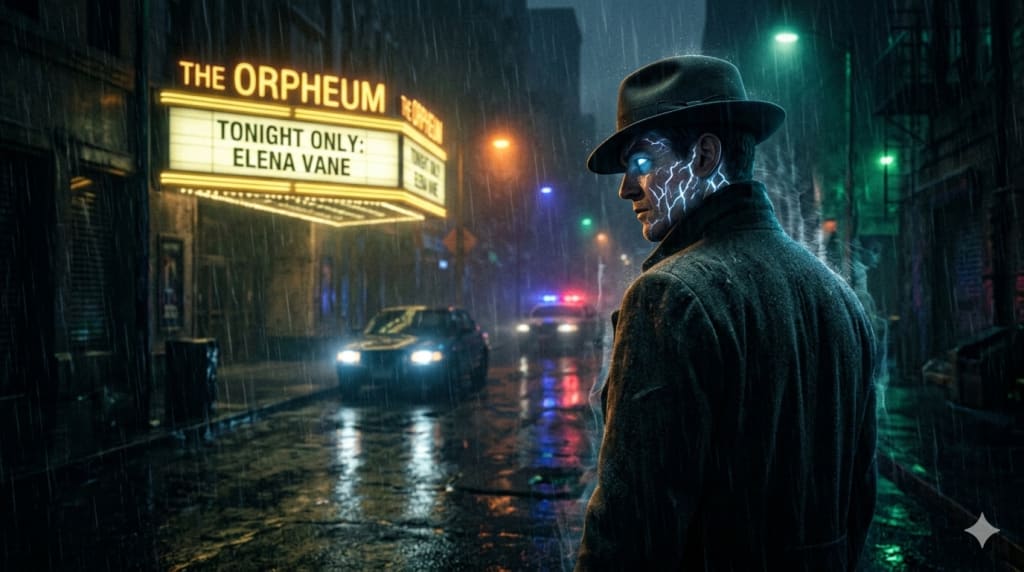
I was at the Orpheum the night Elena Vane took the stage because I had reached a level of desperation that required a crowd. I thought that if I surrounded myself with enough life, enough screaming fans and pounding music, the Static would be drowned out by sheer volume.
Elena was a mirror of my own ruin. A Diva whose sequins were losing their luster, singing for a world that had already moved on to younger, louder voices, different beats. But as she stood in that blinding white spotlight for her final encore, the Static didn't just hum. It screamed.
I didn't see the glamour. I saw the Water.
It was a phantom tide, rising invisibly from the floorboards, pooling around her ankles while she hit that impossible, heartbreaking high C. It was thick, gray, and suffocating. She wasn't singing a ballad; she was gasping out a requiem in a room that had already become a tomb. The crowd cheered, but to my eyes, they cheered at a funeral.
I looked around the front row, desperate for a witness, and that’s when I saw Detective Miller.
He wasn't watching the singer. He was watching the clock.
He sat in the VIP box, his badge glinting like a predator’s eye. He looked at Elena not with admiration, but with the cold, clinical patience of a farmer awaiting harvest. He wasn't surprised by the "Static" around her; he invited it.
I lunged for the stage door, desperate to scream a warning. Miller was already there. He didn't arrest me. He didn't even look surprised to see a scarred, half-mad architect in his path.
"Some structures aren't meant to stand, Silas," he whispered. His grip on my arm was like a vise, and for a moment, the Static around him turned a deep, bruised purple. "Some are built specifically to fall. 'Planned Obsolescence.' Don't fight the current. You've already drowned once. Don't make us do it again."
Two nights later, Elena Vane was found dead in a luxury bathtub. The world called it a tragedy. The police called it a closed case. But as I sat in my basement, watching the news through the flickering snow of my own vision, I saw Miller behind the yellow tape. He was pocketing a small gold record from Elena’s mantel. It wasn't evidence. It was a tithe for the Order.
The Architect was dead. The Prophet was awake. And the harvest had only just begun.
About the Creator
Nathan McAllister
I create content in the written form and musically as well. I like topics ranging from philosophy, music, cooking and travel. I hope to incorporate some of my music compositions into my writing compositions in this venue.
Cheers,
Nathan
Keep reading
More stories from Nathan McAllister and writers in Horror and other communities.
Architecture of the Scythe Pt. 4/5
The Geometry of a Fugitive Rain in the District of Rust doesn't wash things clean; it just turns the soot into permanent, oily stain. The kind of rain that feels like it’s trying to dissolve pavement, a slow-motion acid bath for a city that has already lost its soul.
By Nathan McAllisterabout 9 hours ago in Horror
"Scream 7" (2026): Running out of Fresh Screams
This is the seventh time we’ve had a Ghostface crisis. Scream 7 is the latest edition of the Scream franchise. Sydney Prescott and her family are under attack by another anonymous killer dressed in a Ghostface costume. While having issues with her daughter, Tatum, they run from the bloody murders, trying to determine who is behind it all.
By Marielle Sabbag6 days ago in Horror


Comments
There are no comments for this story
Be the first to respond and start the conversation.