
The Station That Wasn't There: A Japanese Liminal Space Horror Story
I missed my last stop on the Yurikamome Line. Now, I’m standing on a platform that hasn't existed since 1994, and the vending machines only sell memories.
There is a phenomenon in Japan called Satoru-kun, a legend about a ghost who knows everything. But there is a much quieter, more terrifying reality that commuters rarely discuss: the "Ghost Stations." These are the liminal spaces—the cracks between the A and B points of our daily lives—where the world hasn't finished rendering.
If you are a fan of Japanese Gothic horror and the "Backrooms" aesthetic, this story will stay with you next time you’re standing on a train platform after midnight.
The Wrong Turn at Shiodome
It was 12:42 AM. I was exhausted, my head leaning against the cool glass of the train window as the lights of Tokyo blurred into long, neon ribbons. I should have been home in Toyosu by 1:00 AM.
I woke up to a chime that wasn't right. It was a three-note melody, low and dissonant, like a distorted music box. I stepped off the train before the doors hissed shut, my brain still clouded by sleep.
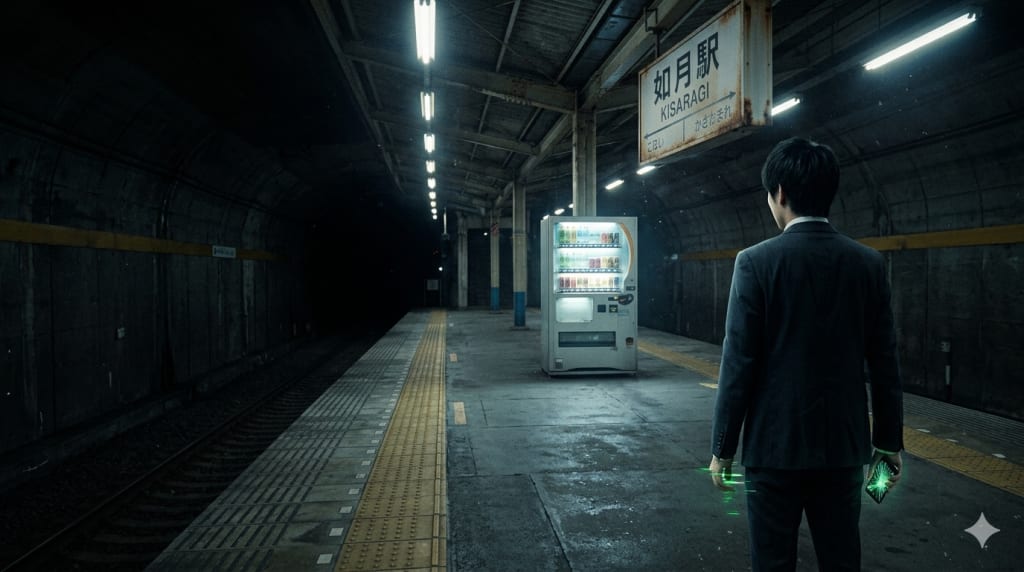
The station sign didn't say Shiodome. It was written in an archaic form of Kanji that I could barely decipher. Kisaragi Station.
I looked back, but the train was already gone. Not pulling away—just gone. The tunnel was a throat of absolute, light-swallowing blackness.
The Low-Competition Terror: Liminality
The station was a masterpiece of architectural dread. The fluorescent lights overhead hummed at a frequency that made my teeth ache. The floor was made of high-polish linoleum that didn't show my reflection.
This is what experts call a Liminal Space—a place of transition that has become a destination. It felt like a video game map where the developers forgot to add the NPCs.
I walked toward the exit, my footsteps echoing with a three-second delay. Step. (One, two, three). Thud. I stopped. The echo didn't.
Thud. Thud. Thud. Something was walking on the ceiling, or perhaps in a dimension just an inch away from mine. I reached the vending machines. In Tokyo, these are beacons of comfort. Here, the glowing glass displayed cans with no labels—just dates.
August 12, 1985. June 4, 1994. March 11, 2011. Every date corresponded to a national tragedy. My hand hovered over the button for 1994, the year of my birth. I pulled my hand back. I wasn't thirsty enough to drink a catastrophe.
The Figure on the Tracks
"Sumimasen?" I called out. My voice didn't echo. It felt flat, as if the air itself was made of cotton.
From the edge of the platform, a figure emerged from the darkness of the tunnel. It was a station attendant, dressed in a crisp, midnight-blue uniform from the Showa era. He wore white gloves and a hat pulled low over his eyes.
He didn't walk; he glided, his body perfectly stiff.
"The last train has departed," he said. His voice sounded like it was being played through a broken radio. "You shouldn't have brought your phone, Kenji."
My blood turned to ice. He knew my name. I hadn't told anyone my name.
"How do I get out of here?" I asked, backing toward the ticket gates.
"You don't," he replied, finally tilting his head up. Where his face should have been, there was only a flickering static—the kind you see on an old television when the signal is lost. "You are part of the Archive now. You are a glitch in the commute."
The Psychological Breakdown
I ran for the stairs. I climbed until my lungs burned, but every flight of stairs led back to the same platform. I passed the same vending machines. I passed the same "Kisaragi" sign.
I checked my phone. The clock was stuck at 12:42 AM. No signal. No Wi-Fi. But then, a notification popped up.
AirDrop: "The Station Attendant" wants to share a photo.
I shouldn't have looked. I knew I shouldn't have looked. But I tapped 'Accept.'
The photo was a high-resolution shot of me, taken from behind. I was sitting on the train, my head against the glass. But in the reflection of the window, I wasn't sleeping. In the reflection, my skin was already turning into the same grey static as the attendant's face.
The "me" in the photo was looking directly at the camera with a wide, toothless grin.
The Japanese Gothic Twist
In Japanese folklore, spirits often tether themselves to objects. In the 21st century, they tether themselves to the signal.
I heard the dissonant chime again. A train was approaching. But it wasn't a modern automated car. It was an old, rusted steam engine, its metal skin hissing and bubbling like it was made of living flesh.
The doors didn't slide open; they split like a wound.
The station attendant stood beside the door, gesturing for me to enter. "Your seat is reserved, Kenji. You've been scrolling for so long, you forgot to live. Now, you can just... exist."
How to Escape a Liminal Trap
If you ever find yourself at a station that feels too quiet, or if the "Next Station" sign displays a language you don't recognize: Do not look at your phone. The blue light is the tether. The algorithm is the trap.
I didn't board the train. I jumped. Not into the train, but off the platform, down into the grease-slicked gravel of the tracks. I ran into the darkness of the tunnel, away from the hum of the lights.
I ran until my heart felt like it would burst, until the smell of ozone replaced the smell of old paper.
I woke up on the floor of the Shiodome public restroom. My phone was shattered in my hand.
The Aftermath
I’m back in the "real" world now. But every time I take the train, I feel the "Glitch." Sometimes, for just a split second, the person sitting across from me has a face made of static.
And every night at exactly 12:42 AM, my broken phone—the one that shouldn't even turn on—vibrates in my drawer.
It’s an AirDrop request. And the sender is always the same: The Station Attendant.
About the Creator
The Glitch Archive
The Glitch Archive Where modern tech meets ancient dread. Documenting AI glitches, urban legends, and the uncanny valley. Explore the dark side of the digital age through viral horror stories and psychological thrillers. 📂🌑
Keep reading
More stories from The Glitch Archive and writers in Horror and other communities.
The Sourdough Secret: A Trad Wife Horror Story of Domestic Survival
I traded my corporate tech career for a farmhouse, a floral apron, and a vintage starter kit. But the "Mother" in my kitchen isn't just fermented flour—it’s hungry, and it wants more than water.
By The Glitch Archiveabout 11 hours ago in Horror



Comments
There are no comments for this story
Be the first to respond and start the conversation.