
Dining with Death: From Poetry to Science and What Happens When Life Slowly Departs
"Death asked me to join him for dinner so I slipped into my favorite black dress that I had been saving for a special occasion and let him walk me to our candlelit tryst."

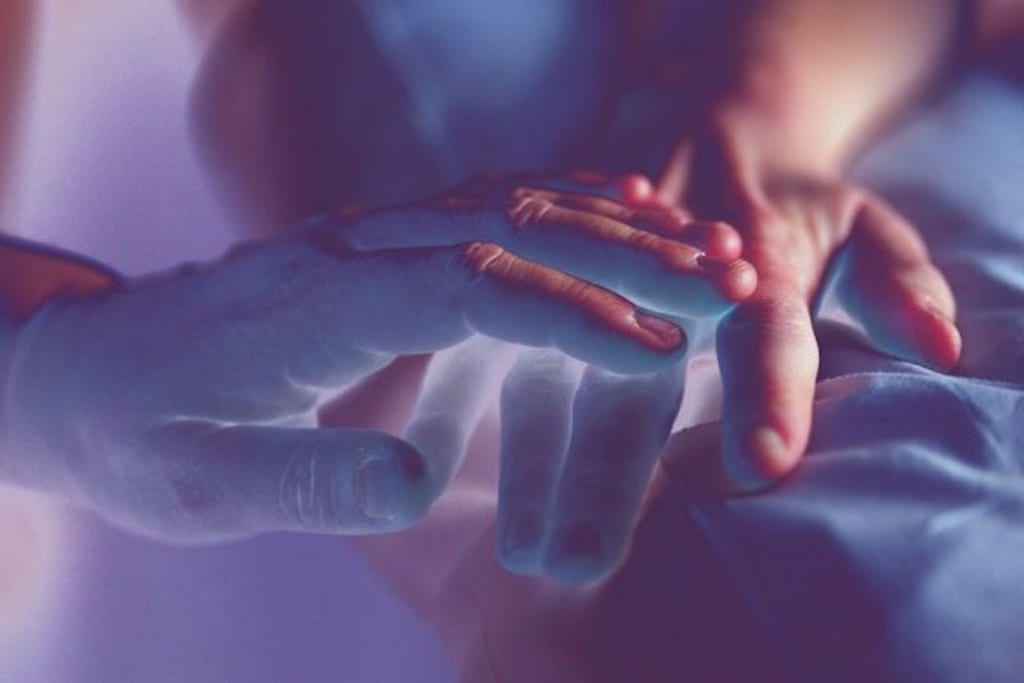
These words open the poem Oh, Death by the writer and poet Gina Puorro - a playful, intimate celebration of death as a lover, not a bogeyman.
Thanatology - the science of dying and death - today shows us that this metaphorical dinner is not merely a poetic image. It is also a description of what happens when life slowly recedes. Death is not a sharp cut, but a long, multilayered process, a feast at which the body, brain, and soul gradually take their leave and prepare for transformation.
Death is not a moment, it is a slow dance in the brain
Modern neurology tells us that the boundary between life and death has no clearly defined line. After cardiac arrest, the brain can remain active for tens of minutes or even hours, especially during resuscitation.
“When I swirled the wine in my glass, I pondered. She looked at me with the endless night sky in her eyes and asked…”
In 2023, a team led by Jimo Borjigin, associate professor in the Department of Molecular and Integrative Physiology and Neurology at the University of Michigan, published a study offering deeper insight into how the brain of a dying person functions. In several patients declared dead and disconnected from life support, a sudden, sharp surge of gamma waves - the fastest brain activity linked to consciousness, memory, and emotions, was recorded at a certain moment. Areas of the brain that had been nearly silent shortly before briefly reactivated, as if lighting up in one final concentrated flash.
People who have stood on the threshold of death (near-death experiences) often describe this moment in similar ways: as peace, light, a sense of returning home, and a sudden reevaluation of life. This is not proof of an afterlife, but a hint that dying need not be mere extinguishment. Rather, it resembles a transitional state—a moment when consciousness organizes itself one last time before dissolving into a larger whole. Endorphins, dopamine, and serotonin are released as the body’s final gift. The brain returns to its strongest memories, as if death were saying: “Look once more at what truly mattered.” And we realize that life was not about grand things, but about the small ones: laughter, touches or red wine in the middle of the night. It is precisely in this quiet space that poetry and neuroscience unexpectedly touch.
The cycle of the earth: decomposition as a natural return
The biology of decomposition is a fascinating symphony of return. Not chaos, but a process with rhythm and order. First comes autolysis - the silent self-devouring of cells, which, after death, begin to break down through their own enzymes. What sustained us throughout life becomes the first instrument of transformation.
Next, the bacteria of our own microbiome awaken. They are not invaders, but old cohabitants. Those who shared the everyday life of the body with us begin their final work. Decomposition is not an attack from outside; it is cooperation from within. The body gradually turns into soil, releasing nitrogen, phosphorus, and carbon back into the cycle from which they once came.
Forensic entomology reveals another layer of this choreography. Worms, flies, beetles, and fungi do not arrive randomly—they follow a precisely ordered sequence, like guests at a feast we no longer see. Each species has its time, its role, its function. Here, death is an event for which the ecosystem is prepared.
Western society has long resisted this process. Cremation, concrete tombs, embalming, digital archives—an endless effort to halt decomposition, delay departure, preserve form and meaning. As if we feared admitting that the end of the body’s functioning is not a failure, but the continuation of a story written in another language.
Yet Puorro invites us to a different stance: “Let me not be wasted; let me be returned.” Today we are rediscovering ways to allow death to be fruitful. So-called human composting, now legal in several U.S. states, transforms the body into fertile soil. “Green burials” permit decomposition without chemicals or concrete, so our remains become a tree or a meadow, roots of future life.
Death then ceases to be pure loss. It becomes a gift to the ecosystem and a quiet contribution to the world’s breath. We do not depart entirely—we merely change form. We remain part of something larger that breaks down, reassembles, and breathes on.
Why do we fear death?
Evolutionary psychology has given a name to this resistance: Terror Management Theory.
Humans are likely the only creatures who grasp death as an abstract concept and the inevitable end of their own life, leading to existential reflection and fear—and at the same time serving as the source of deep, ever-present anxiety. To bear it, we create cultural shields: stories of meaning, morality, success, and the continuation of family lines. We work, build, have children, inscribe ourselves into history and the cloud. Simply put, we seek meaning and ways to transcend our own finitude. While biology leads us toward decomposition and return, culture teaches defiance—the effort to persist, preserve form, leave a trace. Perhaps this is where the tension arises between what we are as organisms and what we strive to be as humans.
This manifests most powerfully in hospices and palliative care. People who accept death often die more peacefully and with less pain. Studies show that spiritual and existential acceptance reduces anxiety and improves the quality of the final days.
The final kiss
At the end of the poem, Death says: “…My darling, it’s time.”
The narrator slips her hand into his and lets herself be led “home.”
In a context where medicine can prolong life but cannot stop its finality, Gina Puorro’s poetry acts as a corrective to our resistance to death. It reminds us that dying need not be failure or defeat. It is a return—a process in which the body gives itself away and the earth receives. A feast where flesh, plants, soil, and love meet.
Awareness of impermanence need not lead to anxiety, but to conscious attention. Each day can become more intense—not because it is the last, but because it could be. Puorro does not invite us to death, but to a life that does not avoid it. She calls us to slowness, to experience, to savoring the moment. And ultimately to the willingness to look into the darkness—not as a threat, but as the space to which we belong.
(The poem “Oh, Death” © Gina Puorro, 2024. Original text published with the kind permission of the author).
Death asked me to join him for dinner
so I slipped into my favorite black dress
that I had been saving for a special occasion
and let him walk me to our candlelit tryst.
He ordered a ribeye, extra rare
I ordered two desserts and red wine
and then I sipped
and wondered
why he looked so familiar
and smelled like earth and memory.
He felt like a place both faraway
and deep within my body
A place that whispers to me
on the crisp autumn breeze
along the liminal edges of dusk and dawn
somewhere between dancing
and stillness.
He looked at me
with the endless night sky in his eyes
and asked
‘Did you live your life, my love?’
As I swirled my wine in its glass
I wondered If I understood the thread I wove into the greater fabric
If I loved in a way that was deep and freeing
If I let pain and grief carve me into something more grateful
If I made enough space to be in awe that flowers exist
and take the time to watch the honeybees
drink their sweet nectar
I wondered what the riddles of regret and longing
had taught me
and if I realized just how
beautiful and insignificant and monstrous and small we are
for the brief moment that we are here
before we all melt back down
into ancestors of the land.
Death watched me lick buttercream from my fingers
As he leaned in close and said
‚My darling, it’s time.‘
So I slipped my hand into his
as he slowly walked me home.
I took a deep breath as he leaned in close
for the long kiss goodnight
and I felt a soft laugh leave my lips
as his mouth met mine
because I never could resist a man
with the lust for my soul in his eyes
and a kiss that makes my heart stop.
About the Creator
Keep reading
More stories from Elvira Diggory and writers in Humans and other communities.
Xenophobia: Why We Fear Strangers – and Why It’s Worse in the East Europe Than in the West
It’s not just some complicated term from books—it’s a common human feeling with deep roots inside us. In this article, we’ll look at where this fear comes from and why, in the countries of the former Eastern Bloc—including the Czech Republic—xenophobia is stronger than in Western Europe.
By Elvira Diggory29 days ago in Humans
A Historic Declaration
We the People of the Husbands of the United States of America, in Order to form a more perfect Union, and I mean you...with me...establish Justice, insure domestic Tranquility, provide for the common defence, promote the general Welfare, and secure the Blessings of Liberty to ourselves, after Puberty, do ordain and establish this Declaration of Co-Dependence.
By Gerard DiLeo5 days ago in Humans
Lying On a Prayer
Deepak Chopra is one of the most acclaimed spiritual gurus of our generation. While I have never followed or studied his teachings, many people, upon hearing about my psychological issues or my interest in yoga and meditation, have asked me to check out his teachings.
By Avocado Nunzella BSc (Psych) -- M.A.P 6 days ago in Humans



Comments
There are no comments for this story
Be the first to respond and start the conversation.