
To Become Undivided
The deepest wisdom may be learning how to let truth, love, and the way we live finally belong to one another.

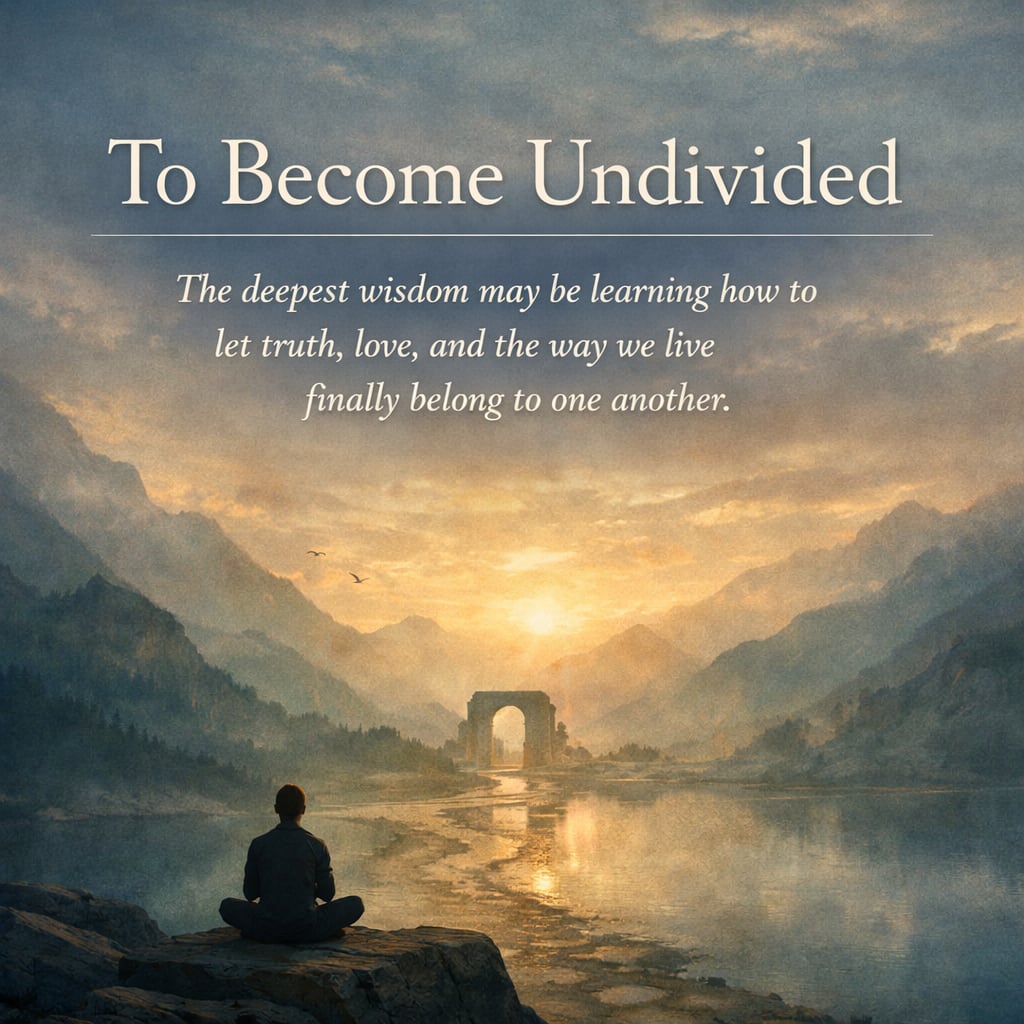
A reflective philosophical essay on the deepest kind of wisdom: learning to live in truth, accept reality, and become inwardly undivided.
There comes a point in life when intelligence no longer feels like enough.
You can know a great deal and still be ruled by fear. You can speak beautifully and still avoid the truth. You can call yourself loving and still live divided against your own conscience. Sooner or later, a deeper question begins to rise: not What do I know? but What is the deepest wisdom a human being can actually live by?
I keep coming back to this:
The deepest wisdom may be learning how to live without demanding that reality become something other than it is.
Not as resignation. Not as passivity. Not as giving up on beauty, hope, or transformation. But as a kind of intimacy with truth. A willingness to stop arguing with the structure of existence long enough to really see it.
So much of human suffering comes not only from pain itself, but from our resistance to what is true. We want certainty in an uncertain world. We want love without vulnerability. We want growth without discomfort. We want peace without self-examination. We want to keep our preferred self-image while also becoming whole.
But wisdom does not flatter us that way.
Wisdom asks us to look again.
Not at the version of reality that protects the ego.
Not at the story that makes us feel the most innocent.
Not at the illusion that lets us postpone responsibility.
Just at what is there.
That kind of seeing is not easy. In fact, it may be one of the hardest things a person ever learns to do. Because clear seeing threatens all the little arrangements we make with ourselves to stay comfortable. It exposes where we are pretending, where we are projecting, where we are clinging, where we are asking life to spare us from being changed.
And yet, clear seeing is also merciful.
Because what we do not face does not disappear. It simply goes underground. It begins shaping our reactions, our relationships, our choices, our identity. Unattended pain becomes distortion. Unquestioned desire becomes rule. Fear becomes philosophy. Ego becomes narrator. We think we are choosing freely when in truth we are often being driven by forces within us we have not had the courage to name.
This is why I do not believe wisdom is merely the accumulation of ideas. Wisdom is inner ordering.
It is the slow work of becoming a person whose inner life is no longer governed primarily by appetite, image, reaction, denial, or emotional weather. It is the discipline of learning that not every feeling is a compass, not every thought is truth, not every desire is sacred, and not every wound should be handed authority over the rest of your life.
That is not coldness. That is not repression. That is maturity.
The wise person is not numb. The wise person feels deeply, but does not worship every passing inner storm. They learn discernment. They learn proportion. They learn to pause. They learn that freedom is not doing whatever one wants, but being shaped into someone who is no longer enslaved by every impulse.
That kind of wisdom changes how we understand nearly everything.
It changes how we understand suffering. Pain, while never automatically meaningful, can deepen a person if it is faced honestly. But it can also deform a person if it is turned into identity, weapon, or permanent lens. Suffering does not guarantee wisdom. What matters is what we do with it.
It changes how we understand love. Love without truth becomes illusion. Truth without love becomes cruelty. The deepest form of love is not indulgence, and it is not possession. It is the courageous act of remaining real. To love well is to refuse both sentimentality and hardness. It is to care enough to stay honest.
It changes how we understand the self. We are not fixed beings. We are formed creatures. Habit forms us. Repetition shapes us. What we practice, we become. Character is not built in theory. It is built in what we return to, day after day, especially when no one is watching.
It changes how we understand peace. Peace is not the absence of complexity. It is not the removal of all tension. Real peace comes when there is less civil war within the self. When what we know, what we say, what we love, and how we live begin to move toward one another instead of away from each other.
Maybe that is the deepest wisdom after all:
To become undivided.
To become someone who no longer needs illusion in order to function. Someone who can bear truth without collapsing into shame. Someone who can admit limitation without giving up dignity. Someone who can be softened by love without becoming naïve, and sobered by reality without becoming bitter.
That kind of person is rare.
Rare not because wisdom is hidden, but because it costs so much. It asks for humility. It asks for self-confrontation. It asks for restraint. It asks for patience. It asks us to surrender our favorite disguises. It asks us to stop performing certainty and start practicing honesty. It asks us to stop using our wounds as permanent proof of who we are. It asks us to stop confusing intensity with depth.
But in exchange, it gives something almost nothing else can give:
An inhabitable life.
A life where the soul is not constantly splitting itself in half. A life where truth is no longer the enemy. A life where reality can be met instead of manipulated. A life where love is not blind, and clarity is not cruel.
I think many of us spend years trying to master life, only to discover that the deeper invitation is not mastery, but right relationship.
Right relationship with time, because everything changes.
Right relationship with desire, because appetite is a powerful servant and a dangerous ruler.
Right relationship with suffering, because pain can either open or harden us.
Right relationship with truth, because what we refuse to face eventually speaks through us anyway.
Right relationship with love, because without love wisdom becomes sterile, and without wisdom love becomes blind.
So when I ask myself what the deepest thought or principle of wisdom is, I no longer think it is brilliance. I do not think it is being right all the time. I do not think it is detachment from the world or superiority over others.
I think it is this:
A good life is built when a person becomes inwardly ordered enough to live in reality with honesty, courage, and grace.
That is wisdom to me.
Not perfection.
Not performance.
Not a spotless life.
But a life becoming whole.
A life no longer at war with what is true.
A life where thought ripens into character.
A life where the soul learns, slowly and painfully and beautifully, how to become undivided.
Author note: I’m drawn to the place where philosophy stops being abstract and starts becoming lived. This reflection is for anyone trying to bring truth, love, and inner alignment into the same room and call that wisdom.
—Flower InBloom
About the Creator
Flower InBloom
Writer and creator publishing original essays, poetry, and reflective digital content rooted in lived truth, healing, and grounded spirituality. This profile is my public creative space under the name Flower InBloom.
Keep reading
More stories from Flower InBloom and writers in Humans and other communities.
How To Navigate Mixed Signals And Avoid Confusing Dating Situations
One of the most frustrating moments in the contemporary dating is mixed signals. They arise when words and actions of a person are not in unison thus making a person confused about their intentions. An illustration is that an individual can be interested by sending messages but avoid face-to-face interaction and be enthusiastic today and withdraw the following day. Such discrepancies tend to confuse the singles regarding their position with regard to the relationship.
By Robert Smith3 days ago in Humans



Comments
There are no comments for this story
Be the first to respond and start the conversation.