
Investing in the Europe Home Decor Market: A Guide for Global Brands and Retailers
IKEA leads the Europe Home Decor Market through scale, affordability, and tech innovation. Zara Home and Maisons du Monde compete on trend speed and curation.

Executive Summary
The Europe home decor market is entering a period of steady, structural growth. Valued at USD 204.0 billion in 2024, the market is projected to reach USD 283 billion by 2033, growing at a CAGR of 3.59%. But behind these topline figures, the landscape is shifting fast. Geopolitical tensions, tighter sustainability regulations, AI-powered retail tools, and changing consumer profiles are all rewriting the rules. B2B stakeholders who understand these five forces will be best positioned to capture new growth.
What Is Driving Growth in the Europe Home Decor Market?
The Europe home decor market is expanding because of rising demand for personalized, eco-friendly living spaces, growing e-commerce adoption, and hybrid work models that turn homes into multi-use environments. Government incentives for sustainable upgrades and higher disposable incomes across the EU further fuel the momentum.
Let's break that down.
Consumer demand for personalization and sustainability in products is the main growth engine. Increasing disposable incomes, growing interest in interior design, and widespread adoption of eco-friendly materials also drive expansion.
The transformation of the home into a primary space for work, wellness, and social interaction is also a major catalyst. According to the European Foundation for the Improvement of Living and Working Conditions, 42% of employed Europeans now follow hybrid work models. This has boosted demand for home office furniture, mood-enhancing lighting, and acoustic solutions.
Urbanization and smaller living spaces are another significant factor, increasing demand for multifunctional and space-saving furniture.
How Are Geopolitical Tensions Affecting Home Decor Supply Chains?
The Russia-Ukraine conflict, Red Sea shipping disruptions, and rising raw material costs have forced European home decor businesses to rethink sourcing. Companies now prioritize supply chain diversity, nearshoring, and buffer inventory over pure cost efficiency.
The Russia-Ukraine conflict has led to long-lasting changes in trade routes and fuel prices. European countries have reduced their dependence on Russian energy, and energy prices have fluctuated significantly since the conflict began.
For home decor specifically, this means higher production costs for manufacturers who rely on energy-intensive processes like glass, ceramics, and textiles. Rising costs and supply constraints for wood, metal, textiles, and other materials can affect product pricing and availability. Geopolitical instability, logistics disruptions, and inflation are impacting inventory planning and delivery timelines.
The Red Sea crisis of early 2024 represented a significant geopolitical risk. Attacks on merchant shipping prompted major carriers like Maersk to reduce operations, and ships rerouted around the Cape of Good Hope, increasing transit times by approximately 30%.
What should B2B players do?
• Diversify supplier networks across at least two regions
• Build "just-in-case" inventory buffers for key product lines
• Invest in local production and sustainable practices to reduce reliance on imports, as companies in Germany and Japan are already doing
What Do European Home Decor Buyers Actually Want?
Today's European buyer blends practicality with values. They want eco-friendly materials, personalized aesthetics, and products that tell a story. Millennials and Gen Z now dominate purchasing decisions, and they expect brands to be socially and environmentally responsible.
Millennials and Gen Z are quickly becoming Europe's main consumers and professional buyers. For them, an important buying motive is how products can improve their mental and physical wellness.
In Europe, 86% of shoppers consider environmental impact essential, prompting brands to adopt recycled materials and circular design programs.
But there's a trust problem. According to the European Commission's 2025 sweep of green claims, 52% of home decor products labeled "eco-friendly" lacked sufficient evidence. A Eurobarometer survey found that 61% of consumers doubt the authenticity of sustainability claims in home goods.
Key pain points for B2B buyers:
• Finding suppliers with verified (not just claimed) sustainability credentials
• Balancing affordable pricing with premium eco-friendly materials
• Keeping up with fast-changing design trends across regional markets
Who Are the Top Competitors and What Sets Them Apart?
IKEA leads the Europe Home Decor Market through scale, affordability, and tech innovation. Zara Home and Maisons du Monde compete on trend speed and curation. Premium players like Roche Bobois focus on craftsmanship. New DTC brands and circular marketplaces are disrupting from below.
The presence of designer home decor brands including IKEA, H&M Home, Zara Home, and Roche Bobois, which launch fresh products regularly, helps the regional market maintain its relevance.
Inter IKEA Systems, Home Depot Product Authority, Wayfair, Ashley Global Retail, and MillerKnoll leverage scale, logistics sophistication, and brand equity to remain top of mind with consumers.
Here's how their strategies differ:
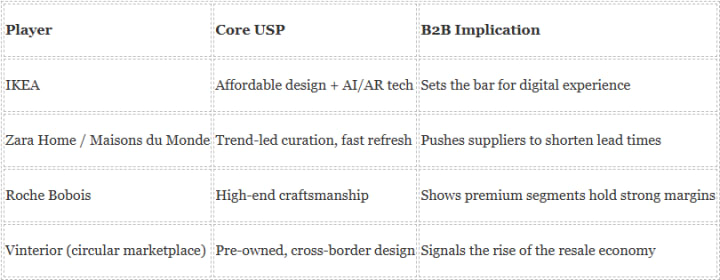
Online platforms enable access to niche designers and circular marketplaces like Vinterior, which saw 42% growth in cross-border sales. This is a trend B2B suppliers can't ignore.
How Are AI and Sustainability Regulations Changing the Game?
AI-powered design tools and tighter EU sustainability rules are the two most disruptive forces reshaping the Europe Home Decor Market. Companies that embrace both will gain a measurable edge in customer conversion and regulatory compliance.
AI and Augmented Reality
Ingka Group, the largest IKEA retailer, launched its AI-driven digital design experience, IKEA Kreativ. It offers customers a lifelike, fully integrated way to design and visualize their own living spaces. IKEA Kreativ combines decades of life-at-home expertise with spatial computing, machine learning, and 3D mixed reality technologies.
Zalando Living and Wayfair report 89% user satisfaction with their AR integrations in 2024. Meanwhile, TikTok Shop and Instagram Checkout generated 38% year-on-year growth in home decor sales across Southern Europe in 2024.
For B2B suppliers, this means product catalogs need 3D models. Static photography is no longer enough.
EU Sustainability Regulation
A wave of new EU rules will hit the home decor sector starting in 2026:
• The EU ESPR introduces a ban on destroying unsold apparel and footwear from July 2026, along with a Digital Product Passport (DPP) registry. Furniture is among the first priority product groups.
• The EU Empowering Consumers for the Green Transition Directive applies from September 2026, restricting generic environmental claims and uncertified labels.
• The ESPR's first working plan prioritizes 11 product groups, including textiles and furniture, as part of the European Green Deal's sustainable products initiative.
These rules raise the compliance bar. Small designers struggle to afford third-party verification, placing them at a disadvantage against larger firms that can absorb certification costs.
What Is the Fastest Growing Sales Channel?
Online retail is the fastest growing distribution channel in the Europe Home Decor Market, driven by AR tools, same-day delivery, and social commerce. But offline still matters for high-value purchases.
The online stores segment is expected to grow at the fastest CAGR of 11.7% throughout the forecast period, with enhanced digital shopping tools, expanded logistics networks, and shifting consumer expectations.
Rising disposable incomes and the influence of digital platforms, including social media and e-commerce sites, are major contributors. In 2023, more than 59% of the EU population actively participated on social media.
Although e-selling is rising, offline channels remain relevant for high-value categories where physical inspection is preferred. The overall trend, however, shows online channels are driving growth in Europe's middle-to-premium home decor market.
Strategic Recommendations
Based on the research, here are five actionable steps for B2B stakeholders in the Europe Home Decor Market:
1. Prepare for the ESPR now. Furniture and textiles are priority product groups. Invest in third-party sustainability certification (OEKO-TEX, FSC, Cradle to Cradle) before the 2026 deadlines hit.
2. Invest in 3D product assets. AR-powered shopping is becoming standard. Ensure your product catalog is compatible with platforms like IKEA Kreativ and Wayfair's AR tools.
3. Diversify your supply chain. Businesses are increasingly shifting production closer to home or to friendly geopolitical allies. This trend reduces reliance on long, complex supply chains that are vulnerable to geopolitical disruptions.
4. Target the hybrid worker segment. The shift to hybrid work has spurred demand for curated decor such as acoustic wall panels, ergonomic desk accessories, and mood-enhancing lighting. Design product lines that blend function with aesthetics.
5. Back up every sustainability claim. The European Commission found that over half of environmental claims assessed in the EU were vague, and 40% lacked supporting evidence. The new Directive aims to protect consumers against greenwashing and unreliable sustainability labels. Vague "eco-friendly" labels will become a legal liability, not a marketing asset.
About the Creator
Joey Moore
I'm Joey Moore, a seasoned Research Analyst with 5+ years of experience in market research. Expert in data analysis, strategic planning, and industry insights. Proven track record in delivering actionable reports.
Keep reading
More stories from Joey Moore and writers in Journal and other communities.
Hyperscale Expansions by Microsoft AWS and Google Fuel Brazil's 9.50% CAGR Data Center Growth to USD 9 Billion
Recently analyzed of the global cloud infrastructure landscape shows the one massive trend that stood out immediately. The hyperscale expansions by Microsoft, AWS and Google fuel Brazil's 9.50% CAGR data center growth to USD 9 billion. Consequently, South America's largest economy is rapidly transforming into a global digital powerhouse. In my analysis of the recent market data, I found that this explosive growth is reshaping how we view cloud computing in the Global South. Let's dive into exactly how and why this is happening.
By Joey Moore5 days ago in Journal
Author’s Advice
If you would’ve asked me 20 years ago did I know I’d become a writer and an author, I would’ve said “nope, ain’t happening”. As fate would have it I did become an author and I can honestly say I’m loving it so far. It really does feel good to be a writer. I’ve learned a lot on this journey and I feel like with even me being as new to this world as I am, there’s some wisdom I need to share with every other aspiring author.
By Joe Patterson5 days ago in Journal




Comments
There are no comments for this story
Be the first to respond and start the conversation.