
How to Make Your Work Visible Without Bragging
Silence makes you invisible.

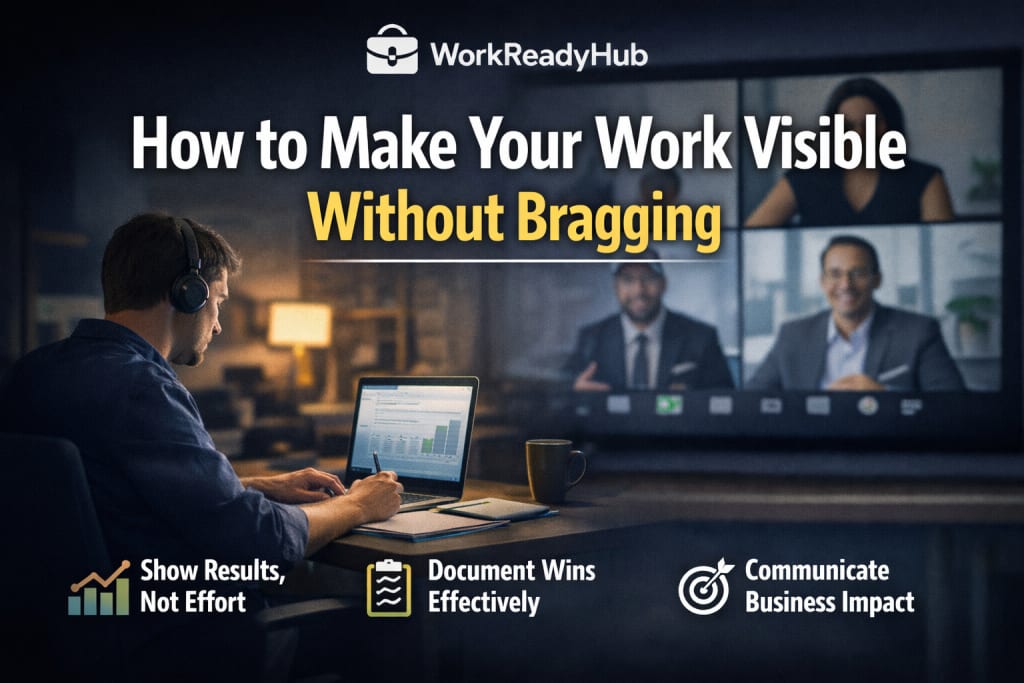
One of the biggest challenges remote professionals face is not doing great work — it’s making sure the right people actually know about it.
In traditional office environments, visibility happens naturally. Managers walk past your desk. Colleagues overhear discussions. Executives see you presenting ideas in meetings.
Remote work removes those natural visibility signals.
And when that happens, something dangerous occurs: great work becomes invisible work.
Many professionals respond to this problem the wrong way. They either stay completely silent about their achievements, assuming their work will speak for itself. Or they swing to the opposite extreme and start promoting themselves constantly.
Neither approach works.
Silence makes you invisible.
Constant self-promotion makes you look insecure.
The real skill is something much more strategic: intentional visibility.
Intentional visibility means ensuring that your work, results, and contributions are clearly understood — without turning every update into self-praise.
The difference comes down to how you communicate impact.
Shift From Effort to Results
One of the most common mistakes remote workers make is talking about effort instead of outcomes.
You’ll often hear updates like this:
“I worked really hard on the project this week.”
“I spent a lot of time improving the process.”
“I’ve been busy with the new campaign.”
None of these statements tell decision-makers what actually changed.
Managers do not promote effort.
They promote impact.
Instead of describing activity, describe results.
For example:
Instead of saying:
“I worked on optimizing the sales workflow.”
Say:
“The updated workflow reduced onboarding time for new leads by 25%.”
The second statement does something powerful. It translates work into business value.
When leaders understand the impact of your work, visibility happens naturally — without you needing to brag.
Document Your Wins Strategically
Another major advantage remote professionals can develop is documentation.
In physical offices, recognition often comes from observation. In remote environments, recognition comes from records.
Strategic professionals keep a simple system for tracking achievements.
This does not have to be complicated.
A simple document can include:
Projects completed
Problems solved
Revenue influenced
Processes improved
Positive feedback from clients or managers
This habit turns scattered accomplishments into clear professional evidence.
And when the time comes for performance reviews, promotions, or internal opportunities, you are not trying to remember what you did months ago.
You already have the proof.
This approach shifts your communication from vague claims to documented contributions.
Communicate Progress, Not Praise
The next principle is subtle but powerful.
Instead of announcing your achievements as personal victories, communicate them as project updates.
For example, compare these two approaches.
Approach one sounds like bragging:
“I successfully fixed the onboarding system and improved the customer experience.”
Approach two sounds professional and strategic:
“The onboarding update we implemented reduced customer setup time from two days to six hours.”
Notice the difference.
The second example focuses on the result, not the individual.
Yet the person responsible still receives recognition.
This is the essence of professional visibility: let the outcomes speak louder than the ego.
Share Insights, Not Just Accomplishments
Another powerful visibility strategy is sharing what you learn, not just what you achieve.
Leaders value professionals who think strategically.
Instead of only reporting finished work, occasionally share insights like:
A pattern you noticed in customer behavior
An improvement idea for a process
A lesson learned from a completed project
For example:
“After reviewing the last three campaigns, I noticed that customer response increases significantly when we include onboarding tutorials early in the process. It might be worth standardizing that approach.”
Statements like this demonstrate something deeper than productivity.
They demonstrate thinking ability.
And thinking ability is one of the clearest signals of leadership potential.
Build a Visibility Rhythm
One of the most overlooked professional skills in remote work is communication consistency.
You don’t need to announce every small task.
But you should develop a rhythm for sharing meaningful updates.
Many high-performing professionals follow a simple structure:
Weekly updates summarizing key progress
Monthly reflections highlighting measurable outcomes
Occasional insights that improve team decisions
This rhythm ensures that your contributions are visible without becoming overwhelming.
You are not chasing attention.
You are providing clarity.
The Strategic Truth About Visibility
The uncomfortable reality of modern work is this:
Doing great work is not enough.
Leaders cannot reward contributions they cannot clearly see.
Visibility is not about ego.
It is about alignment.
Your manager must understand how your work contributes to team success, organizational goals, and measurable results.
When you communicate impact clearly, recognition becomes easier.
Promotions become easier.
Opportunities become easier.
And most importantly, your professional value becomes undeniable.
Final Thought
In remote careers, the professionals who advance the fastest are not always the ones who work the hardest.
They are the ones who make their impact understandable.
They translate effort into outcomes.
They document their progress.
They communicate strategically.
And they do it without bragging.
Because true professional credibility doesn’t come from saying you are valuable.
It comes from making the value impossible to ignore.
About the Creator
Bahati Mulishi
Practical advice on remote work, IT careers, and professional skills to help you stay work-ready anywhere in the world.
Keep reading
More stories from Bahati Mulishi and writers in Lifehack and other communities.
The Top Five Things You Should Consider When Looking For A Homestead
A homestead is more than its parts. However, those parts need to work well together, and that’s why you need to know what you’re looking for. Any homestead can work, if you put enough work into it, but that doesn’t mean that you should settle for a parcel with more banes than boons. You should be looking for something that at least gives you a fighting chance, and so therefore there are some things you should be looking for. With that in mind, here are some things that every good homestead should have.
By Jamais Jochimabout 5 hours ago in Lifehack
Why Oral Health Matters More Than You Think
Your mouth is one of the main gateways to your body. Everything you eat and drink passes through it first. When hygiene is neglected, harmful bacteria can grow quickly, forming plaque and irritating soft tissues. Over time, this can lead to inflammation, sensitivity, and infections that may even affect other parts of the body.
By Nenci Gajera 2 days ago in Lifehack



Comments
There are no comments for this story
Be the first to respond and start the conversation.