
The Quarterly OKR Review: Getting the Most from Your Retrospectives
Quarterly OKR Review
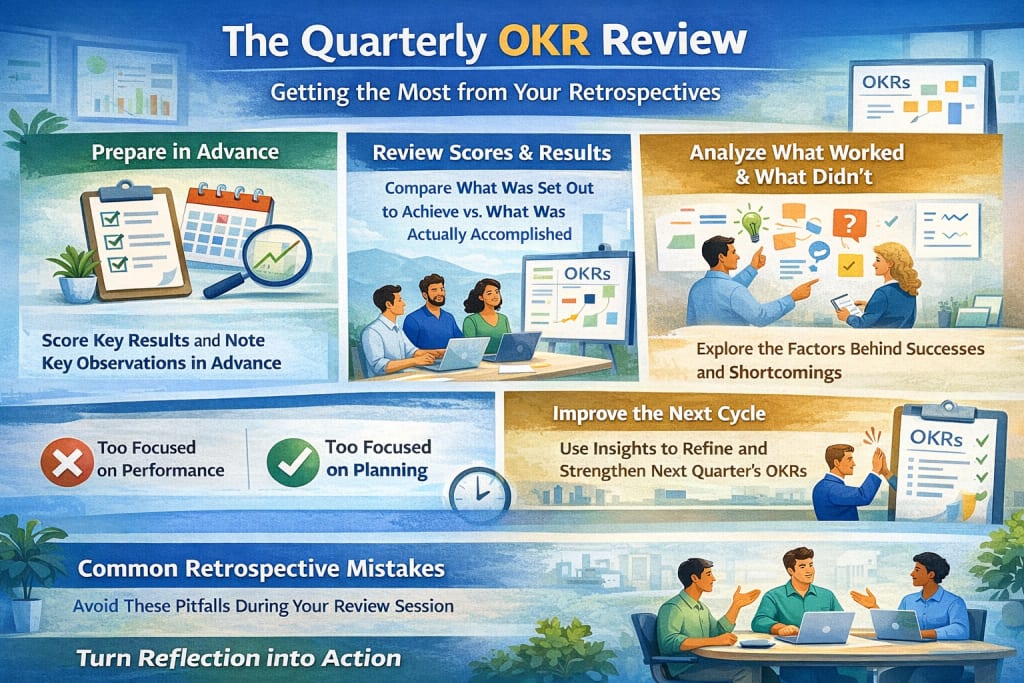
The end of an OKR cycle is not simply an administrative milestone where scores are recorded and new objectives are set. It is, or should be, the most valuable learning opportunity in the entire process. Yet many organisations rush through their quarterly reviews, treating them as a box-ticking exercise rather than the strategic conversation they deserve.
A well-structured OKR retrospective helps teams understand not just what happened, but why it happened and what should change going forward. It is the mechanism through which organisations convert experience into improved performance.
Preparing for the Review
Effective retrospectives require preparation. At least three to five days before the review session, every team member should score their key results and prepare brief notes explaining the outcome. Were targets met, exceeded, or missed? What factors contributed to the result? Were there external circumstances that affected progress?
This preparation serves two purposes. First, it ensures that the review session itself focuses on discussion and learning rather than data gathering. Second, the act of reflecting individually before the group conversation produces more honest and thoughtful assessments than putting people on the spot in a meeting room.
Structuring the Conversation
The most productive OKR reviews follow a consistent structure. Begin with a factual review of the scores. What did we set out to accomplish, and what did we actually achieve? Keep this section brief and resist the urge to explain or justify results at this stage.
Next, move into analysis. For key results that scored well, explore what contributed to the success. Was it a matter of strong execution, favourable market conditions, or a combination? Understanding why things went right is just as important as diagnosing failures, because it helps the team replicate successful approaches.
For key results that fell short, the analysis should focus on causes rather than blame. Were the targets unrealistic? Did the team lack necessary resources? Were there dependencies on other teams that were not delivered? The tone should be curious and constructive rather than defensive.
Distinguishing Between Objective Quality and Execution Quality
One of the most important distinctions in an OKR retrospective is between the quality of the objectives themselves and the quality of execution against them. A low score does not necessarily indicate poor performance. It might indicate that the objective was poorly written, the key results were not genuinely measurable, or the targets were set without sufficient information.
Similarly, a high score does not automatically mean the team performed well. If every key result scores near 1.0, the team may have set unambitious targets. The retrospective is the right forum to ask honest questions about whether the OKRs themselves were fit for purpose.
Feeding Insights into the Next Cycle
The ultimate purpose of the retrospective is to improve the next quarter. Insights from the review should directly inform how the team writes its upcoming OKRs. If a key result was unmeasurable, the team knows to be more specific next time. If an objective turned out to be less important than anticipated, that learning shapes the next round of prioritisation.
Teams that use structured OKR management platforms like Profit.co benefit from having historical data readily accessible during retrospectives. Being able to compare scores across multiple quarters reveals trends that single-quarter reviews cannot surface: improving execution capability, shifting organisational priorities, or recurring obstacles that require systemic solutions.
Common Retrospective Mistakes
The most destructive mistake is turning the retrospective into a performance evaluation. The moment people fear that honest reflection will be used against them, candour disappears. Leaders must actively model vulnerability by openly discussing their own objectives that fell short and what they learned.
Another frequent error is allowing the retrospective to consume the entire planning session. The review of the previous quarter and the setting of new OKRs should be separate conversations, ideally held on different days. Trying to do both in a single session invariably means one or the other gets shortchanged.
Making It a Habit
The organisations that extract the most value from OKRs are those that treat retrospectives with the same seriousness as planning sessions. Block the time in advance, prepare thoroughly, and create an environment where honest conversation is welcomed. Over successive quarters, the quality of both the OKRs and the retrospectives improves, creating a virtuous cycle of learning and execution that compounds over time.
It is worth remembering that the OKR framework is not a set-and-forget tool. It is a practice that improves with repetition. Each retrospective is an opportunity to refine the practice itself, and teams that embrace this mindset consistently outperform those that treat OKRs as a static process.
About the Creator
Keep reading
More stories from Jane Smithh and writers in Lifehack and other communities.
A Complete Guide on Who Can Benefit Most from Microsoft Office Professional Plus
When it comes to productivity software, Microsoft Office has long been the gold standard. But among its many versions, Microsoft Office Professional Plus stands out for its comprehensive tools, advanced features, and powerful integrations. Whether you're a business owner, student, or corporate professional, this edition offers a wide range of capabilities that go beyond the basics.
By Jane Smithh9 days ago in Lifehack
The Hidden Plumbing Problems Perth Homes Face (And How to Prevent Them)
Maintaining a home in Perth comes with a unique set of challenges. From the coastal salt air to the intense summer heat, our local infrastructure is constantly under pressure. While most homeowners focus on visible maintenance like gardening or painting, the most significant threats often lie beneath the surface. Hidden plumbing issues are the "silent saboteurs" of Perth properties, often remaining undetected until they have caused thousands of dollars in structural damage.
By Muhammad Owais SEO6 days ago in Lifehack
When the Shelter Closes
Across the street from my house, a man slept under a tree, his dog by his side. My first, naive thought: he must be traveling through. But he kept coming back, often sleeping there during the day. Then it hit me—that person might not have a home.
By Bride of Sound5 days ago in Humans


Comments
There are no comments for this story
Be the first to respond and start the conversation.