
Twiddling Your Thumbs: A Simple Habit That Offers Surprising Mental Health Benefits
Thumb twiddling is great for relaxation,calming the mind and more.

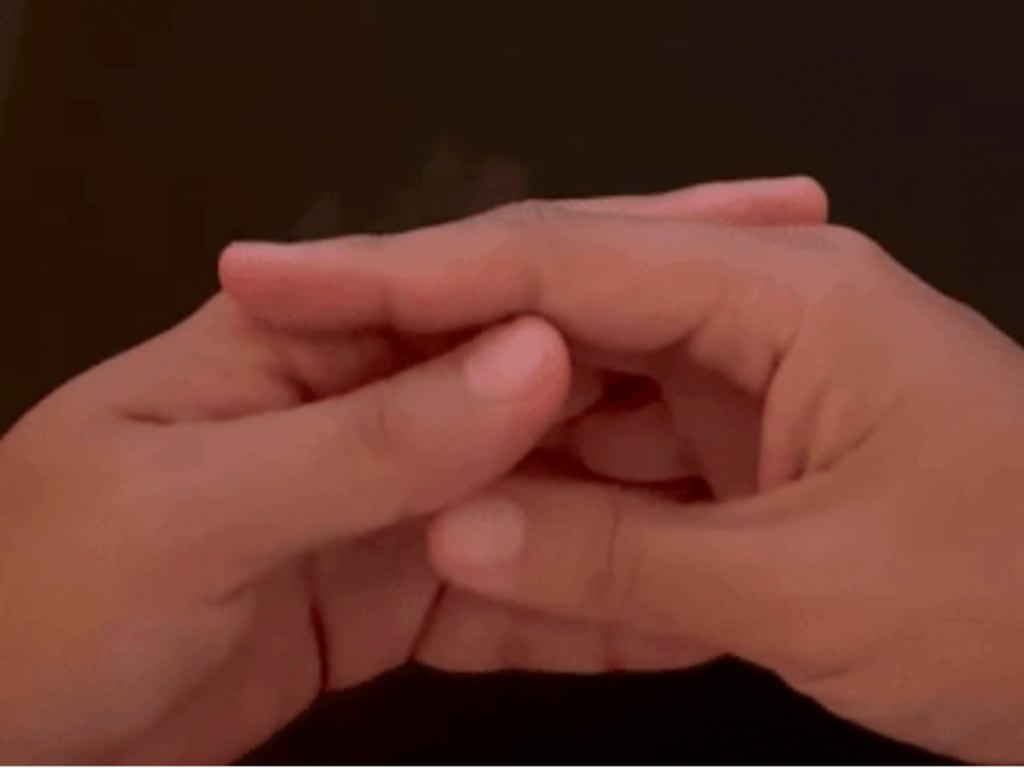
Thumb twiddling has emotional benefits
“Twiddling your thumbs” is an expression that means someone is doing nothing while passing the time away, or they are feeling bored or waiting. The phrase suggests wasting time or idleness but this simple repetitive motion of interlocking fingers and moving the thumbs together in a circular pattern is a self-soothing behavior that psychologists recognize as potentially beneficial for mental health well-being.
Thumb twiddling involves small,repetitive movements with the fingers and thumb similar to doodling, tapping fingers, toe tapping, spinning an object in the hands or leg boouncing.
People often engage in small repetitive motions when they are anxious, nervous, or need to concentrate. This repetitive motor behavior, is classified by psychologists as selff-stimulation via fidgeting and considered to be a form of mindfulness and meditation.
Medical science weighs in
Psychologists reveal that repetitive motions can help manage anxiety by providing a sense of grounding and control in the present moment. This is similar to mindfulness techniques that focus on breathing or simple body movements.
This activity may remind older adults of a finger game children once played. Fingers are intertwined as they point dowward and you say "Here is the church." Pointer fingers are raised and touch while you say "This is the steeple." Hands are opened with fingers still locked together and you say "Open the door." Fingers and thumbs wiggle as you exclaim "See allthe people."
Although twiddling the tumbs is usually associated with impatience or boredom research shows the repetitive movement can reduce mild stress and improve focus by providing the brain with a steady, predictable sensory experience which assists in regulating emotional states.
Calm and relaxation may be achieved
Thumb twiddling and similar actions can activate calming responses in the nervous system. By focusing on a simple, rhythmic motion, a calming response is triggered because the brain may temporarily disengage from stressors and intrusive thoughts. This same effect has been achieved by hamdling fidget tools, stress balls or knitting.
Research has also suggested that small movements can improve alertness, cognitive functioning and attention. Minor motor activity can increase stimulation in the brain and prevent mental fatigue for those who have trouble remaining alert. AARP, however, issues the following warning.
“While there are no easy hacks to prevent dementia, there’s increasing evidence that people who engage in a variety of cognitive as well as physical activities [see the six pillars of brain health] are more likely to slow down cognitive decline over time,” says Dr. Joe Verghese, professor and chair of neurology at Renaissance School of Medicine at Stony Brook University.
Benefits of repetitive movemets
Repetitive movements may influence the autonomic nervous system, which controls the body’s stress responses. This is great news especially for seniors. Rhythmic motions can promote relaxation by slowing breathing, calming the mind and reducing physiological tension.
Twiddling your thumbs is considered as a form of micro-mindfulness—a brief moment of mental pause. While you are waiting in line, sitting in a meeting, waiting on a ride or pausing between tasks, repetitive hand movements may give your brain a short break from constant cognitive demands.
Mild fidgeting such as thumb-twiddling is normal and harmless for most people. Be mindful that it does not take over your day and interupt other necessary activities.
Temporarily pausing to twiddle your thumbs may support emotional health in today's fast paced society by allowing brief moments of mental recovery and preventing overstimulation. So twiddle away!
If you are under a doctor's care for any emotional disorder do ot stop seeing your healthcare provider or discontiue medications for a life hack or home remedy. Please check with your provider before making such changes.
About the Creator
Cheryl E Preston
Cheryl is currently pursuing a Bachelor of Science in Psychology. She enjoys writing about current events, history and baby boomer nostalgia. Tips are greatly appreciated.
Keep reading
More stories from Cheryl E Preston and writers in Lifehack and other communities.
Baton Twirling has mental and physical health benefits for seniors
Baton twirling offers many benefits I had not thought about twirling a baton in many years until today. This morning, I was walking in my backyard when I noticed a small black metal pole. I had walked past this item for many days, but this time, I picked it up.
By Cheryl E Preston5 days ago in Lifehack
I Tried to Become the Perfect Person — It Destroyed Me
I Tried to Become the Perfect Person — It Destroyed Me For most of my life, I believed that if I could just become perfect, everything would finally fall into place. People would admire me. Opportunities would appear. I would feel proud of who I was. And most importantly, I thought I would finally feel enough. That belief quietly shaped almost every decision I made. It started small, the way these things usually do. As a child, I learned very quickly that praise came when I did things right. Good grades meant smiles from teachers. Being polite meant approval from adults. Staying quiet and responsible meant I was called “mature for my age.” At first, it felt good. Being the “good one” made life easier. But over time, something changed. I stopped doing things because I enjoyed them. I started doing them because they made me look good. I studied harder than everyone else, not because I loved learning, but because failure felt unbearable. I carefully chose my words in conversations so I wouldn’t sound foolish. I avoided risks because mistakes were embarrassing, and embarrassment felt like proof that I wasn’t good enough. Slowly, my life became less about living and more about maintaining an image. The image of the perfect person. From the outside, things looked fine. Maybe even impressive. I was responsible. Organized. Reliable. The person people trusted. The person teachers praised. The person friends came to for advice. But inside, something felt wrong. Every success came with relief rather than happiness. I wasn’t proud of my achievements. I was simply relieved that I hadn’t failed. And every mistake felt enormous. A small error could ruin my entire day. A bad grade, a misunderstanding, a moment where I said the wrong thing — these moments stayed in my mind for weeks. I replayed them endlessly, wondering how a “perfect” person could have messed up. The strange thing about perfection is that the closer you try to get to it, the more impossible it becomes. Because perfection doesn’t have a finish line. There is always another flaw to fix. Another skill to master. Another expectation to meet. I kept raising the standard for myself. If I succeeded once, the next time had to be even better. If someone praised me, I had to prove they were right. If someone doubted me, I had to prove them wrong. There was never a moment where I could simply exist and feel satisfied. Eventually, the pressure started to crack something inside me. I became exhausted in a way sleep couldn’t fix. Not physical exhaustion — emotional exhaustion. The kind that makes even simple tasks feel heavy. I remember one night sitting alone, staring at my desk, surrounded by unfinished work. My mind was full of thoughts about everything I hadn’t done perfectly. And suddenly, I realized something terrifying. I didn’t know who I was anymore. I knew the version of myself that performed well. The version that impressed people. The version that avoided mistakes. But the real person underneath all of that? I had no idea. For years, I had been building a person that looked perfect on the outside, while quietly ignoring what I actually felt, wanted, or needed. The realization hit me like a quiet collapse. I had spent so much energy trying to become the ideal version of myself that I had forgotten how to be human. And humans are not perfect. We make mistakes. We change our minds. We fail. We learn slowly. Sometimes we disappoint people. Sometimes we disappoint ourselves. For a long time, I thought those things were weaknesses. Now I understand they are simply part of being alive. The day I stopped trying to be perfect wasn’t dramatic. There was no sudden transformation, no inspirational moment where everything changed. It was smaller than that. I allowed myself to fail at something and didn’t punish myself for it. I spoke honestly even when I worried someone might disagree. I rested without feeling like I had to earn it. At first, it felt uncomfortable — almost wrong. Perfection had been my identity for so long that letting go of it felt like losing control. But slowly, something unexpected happened. Life became lighter. I laughed more easily. I felt less afraid of trying new things. Conversations became more genuine because I wasn’t constantly editing myself. I also started noticing something surprising about other people. No one was actually expecting perfection. Most people were just trying to figure things out, just like I was. The pressure I had lived under for years wasn’t coming from the world as much as it was coming from inside my own mind. That realization changed everything. I’m still learning how to live without chasing perfection. Some days the old habits return. I still feel the urge to prove myself, to control every outcome, to avoid every possible mistake. But now I recognize those thoughts for what they are — echoes of an old belief. A belief that said my worth depended on how flawless I could appear. It took me years to understand that perfection isn’t strength. In many ways, it’s fear disguised as ambition. The fear of rejection. The fear of failure. The fear of not being enough. Ironically, the moment I stopped trying to be perfect was the moment I started becoming more real. And for the first time in a long time, that felt like enough.Start writing...
By Faizan Malik3 days ago in Lifehack




Comments
There are no comments for this story
Be the first to respond and start the conversation.