
30 Days in a Shelter
What Stress Does to a Dog

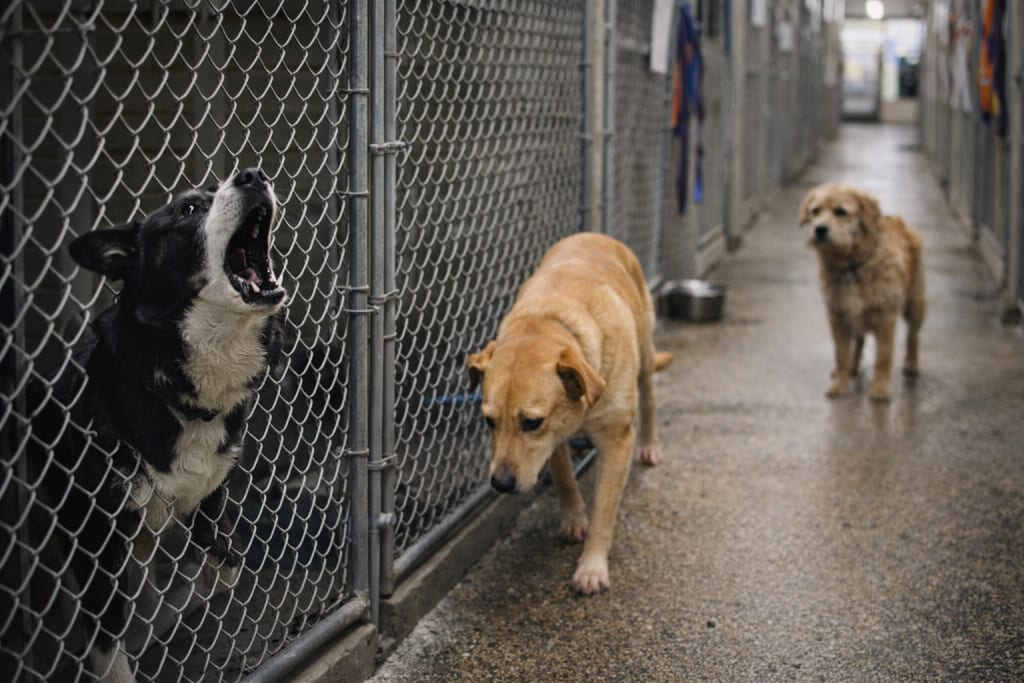
By day 3, the barking changes.
The first 48 hours are chaos. Intake processing. New smells. Metallic doors slamming. By day 3, some dogs bark constantly. Others stop almost entirely. One paces the kennel line until the pads on his feet redden. Another stands motionless, eyes half-lidded, ignoring visitors.
Nothing about this environment is neutral.
A shelter is a chronic stress setting. Even well-run facilities carry noise levels that routinely exceed 80 to 100 decibels. Dogs are housed in tight proximity to unfamiliar animals. Routines shift. Human contact is inconsistent. Sleep is interrupted.
Stress is not an emotion. It is a physiological state.
When a dog enters a shelter, the hypothalamic-pituitary-adrenal axis activates. Cortisol rises. Heart rate increases. Vigilance increases. This is adaptive in short bursts. It is not adaptive when sustained.
Research measuring salivary cortisol in shelter dogs shows significant elevation during intake and the early days of confinement. For some dogs, levels decline after a period of adjustment. For others, especially those with prior instability, cortisol remains elevated for extended periods.
Thirty days is not a small window in a dog’s life.
Here is what that sustained stress can produce.
• Hyperarousal
Some dogs escalate. Barking intensifies. Jumping increases. Barrier frustration appears. These behaviors are often labeled as “aggressive” or “high energy.” In many cases, they are stress discharge patterns. The nervous system cannot settle, so it cycles stimulation outward.
If adopted directly from that state, the dog may require decompression time before true temperament is visible.
• Learned Helplessness
Other dogs go quiet.
When repeated attempts to control the environment fail, mammals sometimes shut down effort. This has been documented across species. In dogs, it can look like passivity, low movement, minimal vocalization, and flat affect. Potential adopters often interpret this as calmness. It may be suppression.
• Sleep Disruption
Dogs require substantial sleep for neurological regulation. In kennel environments with constant noise and light fluctuation, sleep cycles fragment. Chronic sleep disruption worsens emotional reactivity. This is documented in both human and animal studies.
A dog who appears irritable or volatile after weeks in shelter may be sleep deprived as much as temperamentally unstable.
• Social Signal Distortion
Stress changes how signals are sent and read. Play bows shorten. Eye contact becomes either exaggerated or avoided. Tail carriage may stiffen. These are not static personality traits. They are state-dependent expressions.
This matters because adopters are evaluating dogs in the middle of altered neurobiology.
A common misconception is that 30 days in a shelter is a neutral waiting period. It is not.
It is an active biological event.
Some dogs adapt. Cortisol decreases. Behavioral rhythms stabilize. Others accumulate stress load. Past trauma compounds present instability. Breed tendencies intersect with confinement conditions.
There is no single shelter profile.
What is consistent is that baseline personality does not fully emerge in chronic stress.
This is why decompression periods in foster homes often reveal dramatically different behavior within 2 to 4 weeks. As cortisol normalizes and sleep regularizes, reactivity patterns change. Attachment behaviors shift. Energy distribution evens out.
When evaluating a shelter dog, the question is not “Is this the dog?” The question is “What state is this dog in?”
Thirty days is enough time for stress to reshape visible behavior. It is not enough time to define identity.
In the previous piece in this series, we examined why shelter dogs appear to “choose” one person. That attachment spike often happens in the same stress context described here. Elevated arousal increases proximity seeking. Shut-down states increase leaning and stillness. Without understanding physiology, these behaviors are misread as fate or flaw.
Shelter dogs are not showing you who they permanently are. They are showing you who they are under stress.
When their stress load decreases, their expression changes.
Understanding that protects dogs from mislabeling and adopters from unrealistic expectation.
A kennel is a holding environment. It is not a personality test.
--------------------
Sources That Don’t Suck
Beerda, B., Schilder, M. B. H., van Hooff, J. A. R. A. M., de Vries, H. W., & Mol, J. A. (1998). Behavioural, saliva cortisol and heart rate responses to different types of stimuli in dogs. Applied Animal Behaviour Science, 58(3–4), 365–381.
Hennessy, M. B., Morris, A., & Linden, F. (2006). Evaluation of the effects of a socialization program in a prison on behavior and pituitary-adrenal hormone levels of shelter dogs. Applied Animal Behaviour Science, 99(1–2), 157–171.
Hennessy, M. B., Voith, V. L., Hawke, J. L., Young, T. L., Centrone, J., McDowell, A. L., & Linden, F. (2002). Exploring human interaction and cortisol in shelter dogs. Applied Animal Behaviour Science, 79(2), 93–103.
McEwen, B. S. (2007). Physiology and neurobiology of stress and adaptation. Physiological Reviews, 87(3), 873–904.
Protopopova, A., & Gunter, L. M. (2017). Adoption and relinquishment interventions at the animal shelter: A review. Animal Welfare, 26(1), 35–48.
About the Creator
Dr. Mozelle Martin
Behavioral analyst and investigative writer examining how people, institutions, and narratives behave under pressure—and what remains when systems fail.
Keep reading
More stories from Dr. Mozelle Martin and writers in Petlife and other communities.
Iran's Stray Dogs
Stray dogs on the edge of a city are the visible part of a hidden system. You can usually trace that system with boring inputs: food access, abandonment pressure, veterinary reach, and the incentives created by enforcement. When those inputs are misaligned, dogs become the output. People then argue about the dogs instead of the machinery that keeps generating them.
By Dr. Mozelle Martin16 days ago in Petlife
Understanding the Causes, Symptoms, and Treatment Options for Colitis in Dogs
Colitis in dogs is a common gastrointestinal condition that affects the large intestine (colon). When the colon becomes inflamed, it can lead to uncomfortable and sometimes alarming symptoms for your pet.
By Dominion Valley Animal Hospital5 days ago in Petlife
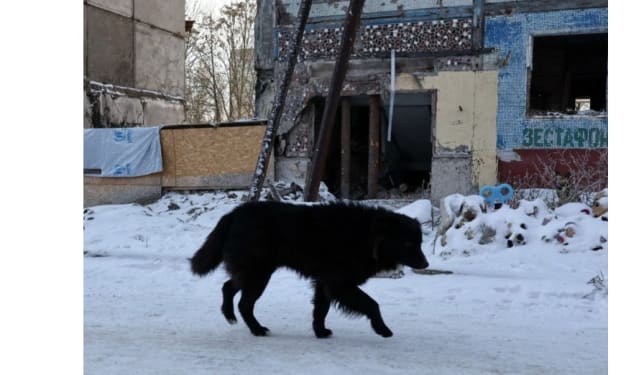
Dogs are reverse domesticated due to the conflict in Ukraine.
After months of continuous fighting, the surviving canines near Ukraine's front lines have clearly changed to resemble wolves in both appearance and behaviour. Their changed bodies demonstrate how characteristics formed by centuries of human friendship can be quickly erased by battle.
By Francis Dami7 days ago in Petlife



Comments
There are no comments for this story
Be the first to respond and start the conversation.