

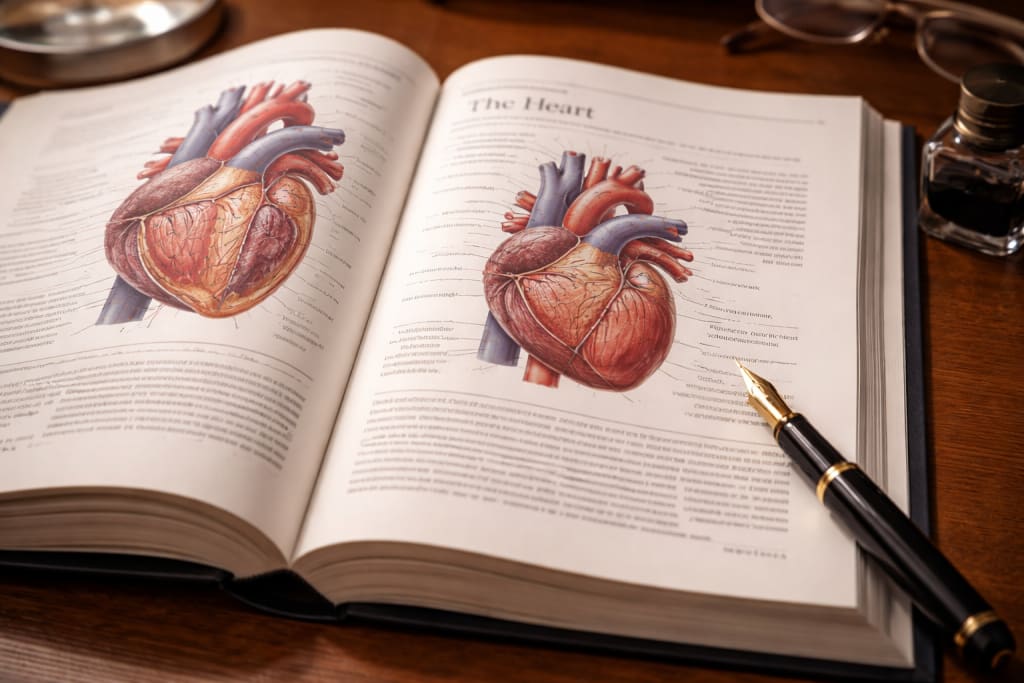
The love that makes a human long,
Cultivates hope, inspires song,
Is said to live within the heart,
Embedded from the very start.
It runs within the nervous system,
Textbook biomechanisms.
Neurons strengthen when reused,
Synapses reinforced and fused.
Dopamine increases drive.
Reward pathways connect and thrive.
Norepinephrine shifts the rate
At which the heart now fluctuates.
Oxytocin bonds mark their place,
Through touch, through trust, through warm embrace,
Vasopressin serves to maintain
Attachment tracts within the brain.
Each pathway fixed, each signal timed,
Just like a poem’s formal rhyme.
It follows rules of stress and sound.
Its structure can be broken down.
Yet what cannot be fully named
Is what gives language weight and aim.
Words may point to roles and parts,
But data cannot show the heart.
For hearts in cardiology
Are not the source of poetry.
The beating organ moves the blood.
But does not write and does not love.
About the Creator
Siege A.
A neuroscience student with fantastical ideas that have no place in science (at least not yet:)).


Trickle Them Down, But Not Out
The thing about smart people is that they should know better, but alas, intelligence is not the same as wisdom. Not only do the mistakes of experts too short on vision—when they are not corrected—have the potential to do great and far-reaching damage, but they also undermine public confidence in the very notion of expertise. This is particularly so when expertise is wielded in defence of the rich and powerful as a cudgel against those laid low. As an academic, this lack of faith in “so-called experts” is painful to see as it plays out in the spread of dis-/misinformation, conspiracy theories, and anti-intellectualism writ large. But it is also an understandable impulse given the catastrophic failure of an economic ideology pushed by certain economic experts. Supply-side economics has shaped a broken system for the last half-century and has arguably done more to undermine the fabric of the American Dream than any policy framework of the past century.
By Cory Wright-Maley6 days ago in Humans
Comments
There are no comments for this story
Be the first to respond and start the conversation.